作成日: 2026-02-21
日本語版(HP向け)
どんなテーマ?
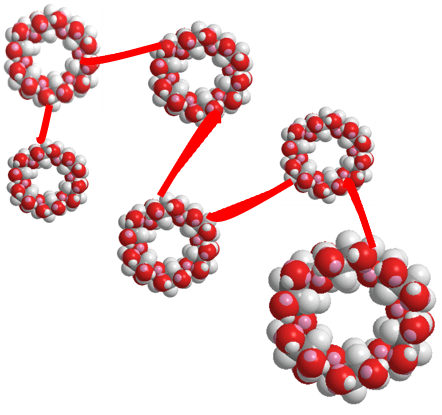
シクロデキストリン(CD)やCDポリマー(CDP)は、分子を包み込む“空洞”(ホスト–ゲスト相互作用)を持つ糖由来材料です。
その特性を活かして、
– 食品成分の安定化・徐放(機能性食品)
– タンパク質バイオマーカーの選択的濃縮・検出
– 吸入薬の肺内持続デリバリー
などへの応用が進んでいます。
論文紹介
Maize starch and (3-cyclodextrin nanocarriers for encapsulation of Centella asiatica polyphenols: synthesis, physicochemical properties, and pH-responsive delivery
- 掲載誌:Food Chemistry(参考JIF 2024: 9.8)
- 年:2026(APR 1)
- 著者:Tripathy, S, Srivastav, PP
- DOI:10.1016/j.foodchem.2026.148202
やさしい解説(Abstractの要点を整理:本文の転載なし)
– 機能性食品成分(ポリフェノールなど)は、光・熱・塩濃度で劣化しやすく、胃で分解されると腸まで届きにくいことが課題です。
– 本研究は、トウモロコシデンプン(MS)のゲルネットワークによる“物理的包み込み”と、β-シクロデキストリン(β‑CD)の“包接”を組み合わせた二重多糖ナノキャリアを提案しています。
– 最適配合(MS:β‑CD=2:1)で、粒径が約167 nmの均一ナノ粒子を作り、封入効率約85%・高い搭載量を達成したと報告。
– 分光・熱分析から、非晶質化と水素結合により、熱・光・イオン強度・保存による劣化への耐性が高まることを示しています。
– 胃条件では放出を抑え、腸条件で放出が進む pH応答型の徐放を示し、拡散+マトリクス緩和で制御される放出機構を提案。
– 食品グレードの“クリーンラベル”材料で、安定性とバイオアクセシビリティを高める設計例として参考になります。
Sensitive label-free SERS detection of cTnI enabled by epitope molecularly imprinted polymer based on host-guest interaction of cyclodextrin and ferrocene
- 掲載誌:Sensors And Actuators B-Chemical(参考JIF 2024: 7.7)
- 年:2026(MAY 1)
- 著者:Xu, YT, Zhao, YM, Jia, Q
- DOI:10.1016/j.snb.2026.139601
やさしい解説(Abstractの要点を整理:本文の転載なし)
– 心筋梗塞の重要バイオマーカー cTnI(心筋トロポニンI) は、血清中で微量であり、選択的に濃縮して迅速に測る方法が求められます。
– 本研究は、タンパク質全体ではなく“エピトープ(部分ペプチド)”を鋳型にした 分子インプリントポリマー(MIP) を設計し、選択性を高めています。
– テンプレート固定化に、β‑シクロデキストリン(β‑CD)×フェロセン(Fc)のホスト–ゲスト相互作用を利用し、鋳型配置を安定・高効率化。
– その後、複数官能モノマーでインプリント層を形成し、再利用性と高いインプリント因子(選択性指標)を示したと報告。
– SERSを用いたラベルフリー測定系として、外部ナノタグ無しで広い直線範囲(10^-3–10^3 ng/mL)と高感度検出を達成。
– ヒト血清試料でも測定可能で、疾患バイオマーカーの迅速検出プラットフォームとして有望です。
Development of hydrolytically stable γ-cyclodextrin-based microparticles derived from MOFs for sustained pulmonary drug delivery
- 掲載誌:Journal Of Drug Delivery Science And Technology(参考JIF 2024: 4.9)
- 年:2026(MAR)
- 著者:Wang, CF, Zhang, GQ, Nie, Q, Peng, NN, et al.
- DOI:10.1016/j.jddst.2026.108064
やさしい解説(Abstractの要点を整理:本文の転載なし)
– 慢性肺疾患では、吸入薬が気道で速くクリアされるため、肺深部へ届き、長時間放出できるキャリアが求められます。
– 本研究は、γ‑シクロデキストリンMOFを“鋳型”として、ジフェニルカーボネートでエステル架橋し、加水分解に強いγ‑CDP微粒子を作製しました。
– 粒子径はD50 ≈ 1.19 µm、架橋度は約4で、内部空洞を保ちつつ水中安定性が向上したとしています。
– デキサメタゾン(DEX)を包接してDEX@CDPを作り、インパクター試験で高いエアロゾル化(微粒子分率:CDP 85%、DEX 67%)を示しました。
– in vitro では24 hで放出が31%未満の持続放出を示し、in vivo 薬物動態で平均滞留時間と半減期が増加したと報告。
– 細胞毒性が低く、生体適合性も良好として、吸入型の持続放出キャリアとして有望です。
English version (for website)
What is this topic about?
Cyclodextrins (CDs) and cyclodextrin polymers (CDPs) are carbohydrate‑based hosts with a hydrophobic cavity enabling host–guest interactions.
They are increasingly used for:
– Stabilization and controlled release of food bioactives
– Selective enrichment/detection of protein biomarkers
– Inhalable carriers for sustained pulmonary drug delivery
Selected papers (top 3 by 2024 JIF in the attached file)
Maize starch and (3-cyclodextrin nanocarriers for encapsulation of Centella asiatica polyphenols: synthesis, physicochemical properties, and pH-responsive delivery
- Journal: Food Chemistry (2024 JIF: 9.8)
- Year: 2026 (APR 1)
- Authors: Tripathy, S, Srivastav, PP
- DOI: 10.1016/j.foodchem.2026.148202
Plain-language bullets (paraphrased; no verbatim abstract text)
– Bioactive compounds (e.g., polyphenols) are often unstable to heat/light/ionic strength and can degrade before reaching the intestine, limiting bioaccessibility.
– This study proposes dual‑polysaccharide nanoparticles combining maize starch (MS) gel‑network entrapment with β‑cyclodextrin (β‑CD) inclusion complexation.
– An optimized MS:β‑CD ratio (2:1) yields uniform nanoparticles (~167 nm) with high encapsulation efficiency (~85%) and high loading capacity.
– Spectroscopic/thermal analyses suggest an amorphous, hydrogen‑bond‑stabilized nanocomposite that improves resistance to heat, light, ionic strength, and storage degradation.
– The carrier shows gastrointestinal pH‑responsive release: suppressed under gastric conditions and enhanced intestinal release, consistent with diffusion + matrix relaxation control.
– It demonstrates a scalable, food‑grade, clean‑label platform for improving stability and sustained availability of nutraceutical bioactives.
Sensitive label-free SERS detection of cTnI enabled by epitope molecularly imprinted polymer based on host-guest interaction of cyclodextrin and ferrocene
- Journal: Sensors And Actuators B-Chemical (2024 JIF: 7.7)
- Year: 2026 (MAY 1)
- Authors: Xu, YT, Zhao, YM, Jia, Q
- DOI: 10.1016/j.snb.2026.139601
Plain-language bullets (paraphrased; no verbatim abstract text)
– Cardiac troponin I (cTnI) is a key biomarker for acute myocardial infarction, requiring selective enrichment and sensitive detection in complex serum.
– This work uses epitope‑oriented molecular imprinting (using a peptide epitope rather than the full protein) to improve selectivity.
– Template immobilization leverages a β‑cyclodextrin (β‑CD) / ferrocene (Fc) host–guest interaction, enhancing imprinting efficiency and simplifying the assay design.
– An imprinted layer is polymerized with multiple functional monomers, yielding high specificity, strong imprinting factors, and good reusability.
– A label‑free SERS assay is demonstrated without extrinsic nanotags, providing a wide linear range (10^-3–10^3 ng/mL) and rapid detection.
– Successful detection in human serum suggests strong potential for practical disease‑biomarker sensing.
Development of hydrolytically stable γ-cyclodextrin-based microparticles derived from MOFs for sustained pulmonary drug delivery
- Journal: Journal Of Drug Delivery Science And Technology (2024 JIF: 4.9)
- Year: 2026 (MAR)
- Authors: Wang, CF, Zhang, GQ, Nie, Q, Peng, NN, et al.
- DOI: 10.1016/j.jddst.2026.108064
Plain-language bullets (paraphrased; no verbatim abstract text)
– For chronic lung diseases, inhaled drugs can be rapidly cleared; carriers that deposit in the deep lung and enable sustained release are desirable.
– This study converts γ‑cyclodextrin MOFs into hydrolytically stable covalently crosslinked γ‑CD polymer (CDP) microparticles via esterification with diphenyl carbonate.
– The resulting particles show D50 ≈ 1.19 µm and a crosslinking degree ~4, retaining internal cavities while improving aqueous stability.
– Dexamethasone (DEX) is encapsulated (DEX@CDP); impactor tests show strong aerosolization and deep‑lung deposition potential (fine particle fractions ~85% for CDP, ~67% for DEX).
– In vitro release is sustained (<31% released over 24 h), and in vivo pharmacokinetics show increased mean residence time and half‑life compared with controls.
– Good cytocompatibility and biocompatibility support CDP microparticles as promising inhalable sustained‑delivery carriers.
参考文献 / References(添付ファイル内・掲載分)
- Tripathy, S, Srivastav, PP (2026). Maize starch and (3-cyclodextrin nanocarriers for encapsulation of Centella asiatica polyphenols: synthesis, physicochemical properties, and pH-responsive delivery. Food Chemistry. doi:10.1016/j.foodchem.2026.148202
- Xu, YT, Zhao, YM, Jia, Q (2026). Sensitive label-free SERS detection of cTnI enabled by epitope molecularly imprinted polymer based on host-guest interaction of cyclodextrin and ferrocene. Sensors And Actuators B-Chemical. doi:10.1016/j.snb.2026.139601
- Wang, CF, Zhang, GQ, Nie, Q, Peng, NN, et al. (2026). Development of hydrolytically stable γ-cyclodextrin-based microparticles derived from MOFs for sustained pulmonary drug delivery. Journal Of Drug Delivery Science And Technology. doi:10.1016/j.jddst.2026.108064