キーワード / Keywords
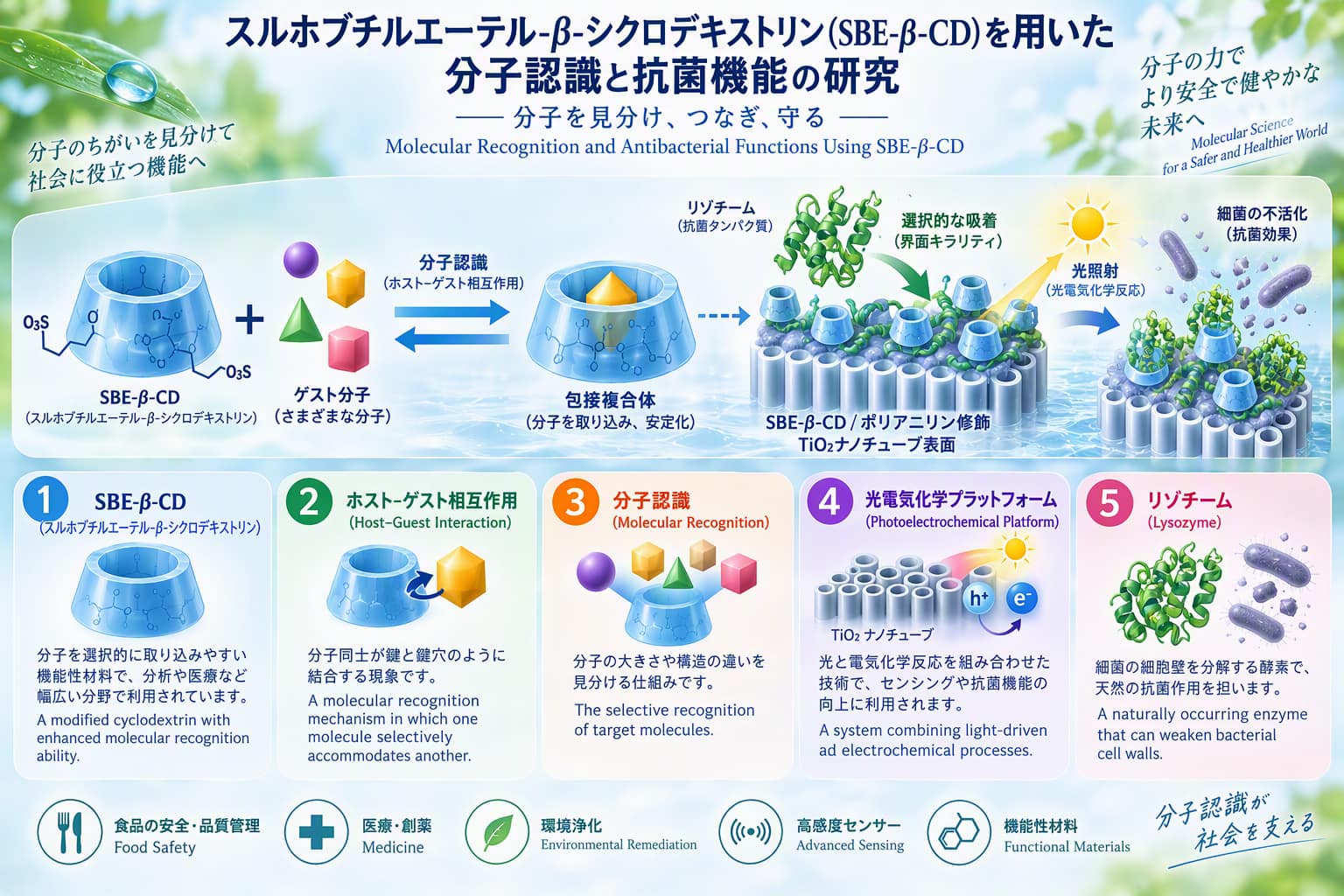
1. SBE-β-CD(スルホブチルエーテル-β-シクロデキストリン)
日本語:シクロデキストリンを改良した材料で、さまざまな分子を選択的に取り込みやすく、分子認識やセンサー開発に利用されています。
English: A modified cyclodextrin with enhanced molecular recognition ability, widely used in sensing and selective binding applications.
2. 分子認識(Molecular Recognition)
日本語:分子の形や性質の違いを見分ける仕組みです。高精度な分析や診断技術を支える重要な考え方です。
English: The ability to distinguish between molecules based on their structure and properties.
3. 界面キラリティ(Interfacial Chirality)
日本語:表面上に形成される左右非対称な構造で、分子との相互作用や選択性に影響を与えます。
English: Surface-based asymmetry that influences how molecules interact and bind to materials.
4. 光電気化学プラットフォーム(Photoelectrochemical Platform)
日本語:光と電気化学反応を組み合わせた技術で、センシングや抗菌機能の向上に利用されます。
English: A system combining light-driven and electrochemical processes for sensing and functional applications.
5. リゾチーム(Lysozyme)
日本語:細菌の細胞壁を分解する酵素で、天然の抗菌作用を担うタンパク質として知られています。
English: A naturally occurring enzyme that can weaken bacterial cell walls and contribute to antibacterial activity.
日本語版
はじめに
スルホブチルエーテル-β-シクロデキストリン(SBE-β-CD)は、分子を選択的に認識できる特性を持つ材料です。本研究では、SBE-β-CDを用いた機能性表面を設計し、分子認識から抗菌機能へとつながる新しい仕組みが検討されました。
論文紹介
Interfacial chirality bridges molecular recognition and lysozyme-mediated antibacterial function on a TiO2 nanotube photoelectrochemical platform
研究の目的
- 分子認識能力を持つ表面を設計する。
- 認識した情報をタンパク質吸着や抗菌作用につなげる。
研究の特徴
- TiO2ナノチューブ表面にSBE-β-CDとポリアニリンを組み合わせた機能層を形成。
- キラルな界面を構築し、分子の違いを識別できる仕組みを検証。
- リゾチーム吸着と光触媒作用を組み合わせた抗菌システムを開発。
主な結果
- 界面キラリティにより分子を選択的に認識できることを確認。
- 特定の構造を持つ界面ではリゾチームがより多く吸着した。
- 吸着したリゾチームと光触媒反応が協調して抗菌効果を示した。
- 模擬海水中で高い細菌不活化性能が報告された。
研究の意義
SBE-β-CDを活用した分子認識機能が、単なるセンシングだけではなく、抗菌表面設計にも役立つ可能性を示しました。バイオマテリアルや環境浄化技術への応用が期待されます。
研究全体の意義
この研究は、SBE-β-CDを利用した分子認識機能が、タンパク質吸着や抗菌機能へ発展できることを示しています。材料表面の設計によって複数の機能を統合できる可能性を示した点が特徴です。
Molecular Recognition and Antibacterial Functions Using Sulfobutylether-β-Cyclodextrin
English Version
Introduction
Sulfobutylether-β-cyclodextrin (SBE-β-CD) is a functional cyclodextrin derivative known for its molecular recognition capability. The study highlighted here demonstrates how molecular recognition can be linked to protein adsorption and antibacterial performance.
Paper Summary
Interfacial chirality bridges molecular recognition and lysozyme-mediated antibacterial function on a TiO2 nanotube photoelectrochemical platform
Objective
- To design a surface capable of molecular recognition.
- To connect molecular recognition with protein adsorption and antibacterial activity.
Key Features
- An SBE-β-CD/polyaniline functional layer was assembled on TiO2 nanotubes.
- Chiral interfaces were engineered to achieve selective molecular interactions.
- Lysozyme adsorption and photocatalysis were combined on a single platform.
Main Findings
- The interface demonstrated stereoselective molecular recognition.
- Enhanced lysozyme adsorption was observed on a specific chiral configuration.
- Enzymatic and photocatalytic effects worked together to suppress bacterial activity.
- Strong antibacterial performance was reported in simulated seawater conditions.
Significance
The work suggests that SBE-β-CD-based molecular recognition can support not only sensing but also the design of multifunctional antibacterial surfaces.
References / 文献情報
- Wang S., Zhang Z., Yang M. et al. Interfacial chirality bridges molecular recognition and lysozyme-mediated antibacterial function on a TiO2 nanotube photoelectrochemical platform. Chemical Engineering Journal, 2026, DOI: 10.1016/j.cej.2026.182164.