作成日: 2026-02-21
どんなテーマ?
フォトクロミック分子(光で色や性質が切り替わる分子)は、情報記録・センサー・有機デバイスなどへの応用が期待されています。
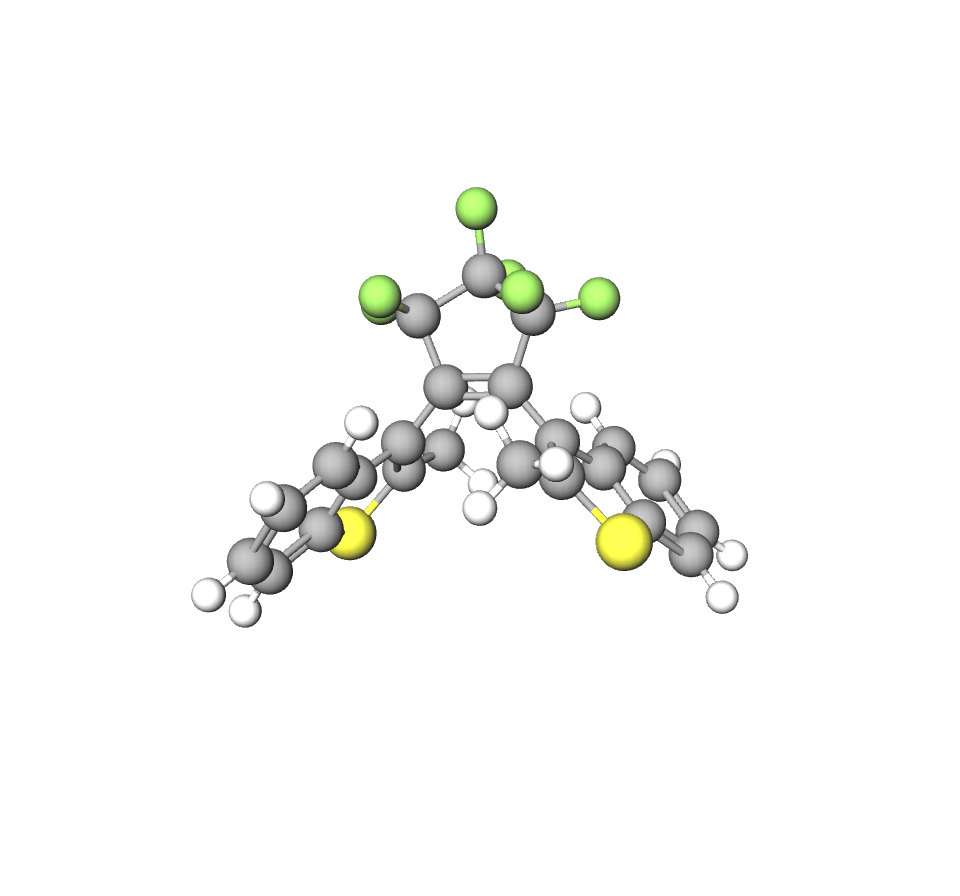
本ファイルには、ジアリールエテン(DAE/DE)を中心に、光応答性を「電気化学」「薄膜形態」「結晶挙動」へ広げた研究が収録されています。
Morphology Control in PDVT-10/DTCP Hybrid Films via Meniscus-Guided Cooperative Crystallization for High-Performance OFETs
- 掲載誌:Acs Applied Materials & Interfaces(参考JIF 2024: 8.2)
- 年:2026(2026 FEB 4)
- 著者:Lin, XY, Nipate, DS, Chen, SK, Harada, M, et al.
- DOI:10.1021/acsami.5c23619
やさしい解説
– 有機半導体薄膜では、分子の配向・結晶化(形態)が電荷移動度を大きく左右します。
– 本研究は、共役高分子PDVT‑10と、光応答性のジアリールエテン(DTCP)を混合し、メニスカス誘導コーティング(MGC)で高配向薄膜を作製しました。
– DTCPはUV/可視光で開環体⇄閉環体を切り替えられ、両異性体が“結晶化を助ける添加剤”として働くことを示しています(協同結晶化)。
– 閉環体DTCP‑cを10 wt%添加すると移動度が段階的に向上し、最大で 2.44 cm² V⁻¹ s⁻¹ を達成したと報告。
– さらに“絶縁性に見える”開環体DTCP‑oでも、3 wt%添加でPDVT‑10の移動度が 2.12→3.23 cm² V⁻¹ s⁻¹ に上がるという意外な結果を示しています。
– DFTでHOMO準位の整合が良いことから、分子配向の精密化とエネルギー準位整合により“協同的な電荷移動”が起こり得ると解釈し、光でエネルギー準位を調整できるOFET設計の可能性を示しました。
From photochromism to electrochromism: New property of diarylethene BTT and its fluorescent turn-on derivative BTTO4
- 掲載誌:Journal Of Molecular Structure(参考JIF 2024: 4.7)
- 年:2026(MAY 5)
- 著者:Wang, JH, Lan, KJ, Qi, AD, Xu, YJ, et al.
- DOI:10.1016/j.molstruc.2026.145559
やさしい解説(Abstractの要点を整理:本文の転載なし)
– ジアリールエテン(DAE)は高い耐熱性・耐疲労性をもつ代表的フォトクロミック分子で、多刺激応答化により情報記録やロジック材料へ応用が期待されています。
– 本研究は、代表的DAEであるBTTと、その蛍光“ターンオン”誘導体BTTO4について、電気化学(酸化剤)刺激によるエレクトロクロミズムを系統的に調べました。
– 両化合物の閉環体はCu(ClO₄)₂で開環へ戻る(シクロリバージョン)が、BTTO4は酸化電位が高いため、より多い酸化剤と長い反応時間を要することを示しています。
– 計算から、開環ラジカルカチオンがより安定で、閉環ラジカルカチオン→開環ラジカルカチオンの障壁がBTTで小さい(約25 kcal/mol)一方、BTTO4で大きい(約38 kcal/mol)点が差の原因と説明。
– CVでも閉環体の酸化電位がCu(ClO₄)₂より低いことを示し、反応の熱力学的可能性を支持しています。
– さらに、脂質膜に封入したBTT閉環体が水中でCuCl₂処理により電気化学的に開環することを示し、生体センシング応用の可能性にも触れています。
Photochromic, Thermosalient, Photophysical, and Electrochemical Properties of Pyridyl-Quinolinyl-Ethylene-Derived Multifunctional Organic Materials
- 掲載誌:Journal Of Physical Chemistry Letters(参考JIF 2024: 4.6)
- 年:2026(2026 FEB 6)
- 著者:Kannan, TS, Kurakula, U, Medishetty, R, Kole, GK
- DOI:10.1021/acs.jpclett.5c03952
やさしい解説(Abstractの要点を整理:本文の転載なし)
– 固体中の分子は、結晶の詰まり方(パッキング)や水和状態で光反応性や色変化が大きく変わります。
– 本研究は、新規オレフィンPQEと、そのN‑メチル化体MPQEについて、結晶構造と性質の関係を総合的に解析しました。
– PQEは固体で[2+2]光付加(フォトシクロ付加)が定量的に進み、生成したシクロブタン環が可逆的に切断する挙動も示します。
– PQE結晶はUVで色が変わるフォトクロミズムを示し、MPQEでは結晶化条件で無水型と水和型(MPQE·2.25H₂O)を得ています。
– 水和型は積層が適していても光反応しにくい一方、脱水に伴う格子歪みで“熱跳躍(サーモサリエント)”挙動を示します。
– N‑四級化により吸収が長波長化し、二量体では共役が失われ短波長化するなど、光物性・電気化学特性を含む多機能性を整理しています。
English version (for website)
What is this topic about?
Photoresponsive molecules (e.g., diarylethenes) can switch optical/electronic properties and are promising for data storage, sensing, and organic devices.
The papers below extend photochromism into electrochromism, morphology‑controlled electronics, and multifunctional crystal behavior.
Top 3 papers (sorted by 2024 JIF)
Morphology Control in PDVT-10/DTCP Hybrid Films via Meniscus-Guided Cooperative Crystallization for High-Performance OFETs
- Journal: Acs Applied Materials & Interfaces (2024 JIF: 8.2)
- Year: 2026 (2026 FEB 4)
- Authors: Lin, XY, Nipate, DS, Chen, SK, Harada, M, et al.
- DOI: 10.1021/acsami.5c23619
Plain-language bullets (paraphrased; no verbatim abstract text)
– Molecular alignment and crystallization strongly govern charge transport in organic semiconductor thin films.
– This work blends the conjugated polymer PDVT‑10 with a photoresponsive diarylethene dopant (DTCP) and uses meniscus‑guided coating (MGC) to form well‑aligned hybrid films.
– DTCP is photoswitchable (open‑ring ⇄ closed‑ring under UV/visible light), and both isomers act as morphology‑modulating additives that promote cooperative crystallization.
– Closed‑ring DTCP‑c progressively improves mobility, reaching 2.44 cm² V⁻¹ s⁻¹ at 10 wt% doping.
– Notably, even the open‑ring DTCP‑o (often considered insulating) at 3 wt% increases PDVT‑10 mobility from 2.12 to 3.23 cm² V⁻¹ s⁻¹.
– DFT suggests favorable HOMO–HOMO alignment, implying cooperative charge transfer enabled by precise alignment; the photoswitchable dopant offers a route to optically tunable OFET energy levels.
From photochromism to electrochromism: New property of diarylethene BTT and its fluorescent turn-on derivative BTTO4
- Journal: Journal Of Molecular Structure (2024 JIF: 4.7)
- Year: 2026 (MAY 5)
- Authors: Wang, JH, Lan, KJ, Qi, AD, Xu, YJ, et al.
- DOI: 10.1016/j.molstruc.2026.145559
Plain-language bullets (paraphrased; no verbatim abstract text)
– Diarylethenes (DAEs) are robust photochromic switches with high thermal stability and fatigue resistance, enabling multi‑stimuli functions for advanced information materials.
– This study systematically investigates electrochromism of a representative DAE (BTT) and a fluorescent turn‑on derivative (BTTO4) under oxidant stimulation.
– Closed‑ring isomers undergo Cu(ClO₄)₂‑triggered cycloreversion, but BTTO4 requires higher oxidant dosage and longer times due to its higher oxidation potential.
– Calculations indicate open‑ring radical cations are more stable; the barrier for BTT(c)•⁺→BTT(o)•⁺ is lower (~25 kcal/mol) than for BTTO4(c)•⁺→BTTO4(o)•⁺ (~38 kcal/mol), explaining reactivity differences.
– Cyclic voltammetry shows closed‑ring oxidation potentials are below that of Cu(ClO₄)₂, supporting thermodynamic feasibility.
– Encapsulation of BTT(c) in lipid membranes enables ring‑opening in water upon CuCl₂ treatment, pointing to potential bio‑sensing or bio‑imaging applications.
Photochromic, Thermosalient, Photophysical, and Electrochemical Properties of Pyridyl-Quinolinyl-Ethylene-Derived Multifunctional Organic Materials
- Journal: Journal Of Physical Chemistry Letters (2024 JIF: 4.6)
- Year: 2026 (2026 FEB 6)
- Authors: Kannan, TS, Kurakula, U, Medishetty, R, Kole, GK
- DOI: 10.1021/acs.jpclett.5c03952
Plain-language bullets (paraphrased; no verbatim abstract text)
– Solid‑state photoreactivity and color switching are strongly governed by crystal packing, hydration, and conjugation.
– This study correlates structure and properties of a new olefin PQE and its N‑methylated derivative MPQE, examining photochromic, thermosalient, photophysical, and electrochemical behaviors.
– PQE undergoes quantitative [2+2] photocycloaddition in crystals to form a head‑to‑tail dimer, and the resulting cyclobutane ring can cleave reversibly.
– PQE crystals show UV‑induced color change (photochromism). MPQE forms two crystal types depending on crystallization conditions: anhydrous MPQE and hydrated MPQE·2.25H₂O.
– Despite suitable stacking, the hydrated form is photoinert but exhibits thermosalient behavior due to dehydration‑induced lattice strain.
– N‑quaternization causes bathochromic shifts, while the dimer shows hypsochromic/hypochromic shifts due to reduced conjugation; redox properties are also reported, highlighting rare multifunctionality.
参考文献 / References
- Lin, XY, Nipate, DS, Chen, SK, Harada, M, et al. (2026). Morphology Control in PDVT-10/DTCP Hybrid Films via Meniscus-Guided Cooperative Crystallization for High-Performance OFETs. Acs Applied Materials & Interfaces. doi:10.1021/acsami.5c23619
- Wang, JH, Lan, KJ, Qi, AD, Xu, YJ, et al. (2026). From photochromism to electrochromism: New property of diarylethene BTT and its fluorescent turn-on derivative BTTO4. Journal Of Molecular Structure. doi:10.1016/j.molstruc.2026.145559
- Kannan, TS, Kurakula, U, Medishetty, R, Kole, GK (2026). Photochromic, Thermosalient, Photophysical, and Electrochemical Properties of Pyridyl-Quinolinyl-Ethylene-Derived Multifunctional Organic Materials. Journal Of Physical Chemistry Letters. doi:10.1021/acs.jpclett.5c03952