作成日: 2026-02-21
どんなテーマ?
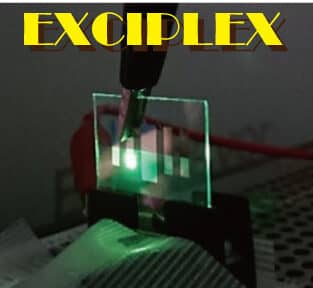
エキシプレックス(exciplex)は、異なる有機材料の界面で生じる励起状態で、発光やエネルギー移動をデバイス設計に活用できます。
本論文は、界面エキシプレックスを“中継”にして近赤外発光体へエネルギーを渡すことで、NIR OLEDの効率を高めるアプローチを示しています。
対象論文
Development of high-efficiency near-infrared organic light-emitting diodes using TPA-DCPP via interface exciplex formation
- 掲載誌:Journal Of Materials Chemistry C(2026 / 2026 FEB 6)
- 著者:Chuang, CY, Paul, B, Ke, JY, Ji, SH, et al.
- DOI:10.1039/d5tc04226g
やさしい解説
– 近赤外(NIR)OLEDは医療イメージングや光通信などで期待されますが、NIR発光体はバンドギャップが狭く、分子が集まると発光が弱くなる(ACQ:凝集消光)ため高効率化が難しい点が課題です。
– 本研究は、CBPとPO‑T2Tの界面で生じるインターフェース・エキシプレックスを“エネルギー供給源”として使い、NIR発光体TPA‑DCPPを増感する設計を提案しています。
– エキシプレックス発光とTPA‑DCPPの吸収がよく重なるため、FRET(フォルスター共鳴エネルギー移動)で効率よくエネルギーが移る点がポイントです。
– 重金属錯体や複雑なTADF分子設計に頼らず、重金属フリーかつ構造がシンプルなデバイス概念として提示されています。
– 輸送層厚みやドーピング濃度などを最適化し、最大EQE 15.2%、700 nmで最大輝度 2152 cd m⁻²を達成したと報告しています。
– 界面エキシプレックスを介したエネルギー移動が、ACQによる損失を緩和し、再現性の高いNIR OLED設計につながることを示しています。
English version (for website)
What is this topic about?
An exciplex is an excited-state complex formed at an interface between different organic materials, and it can be used as an energy-transfer mediator in OLEDs.
This paper uses an interfacial exciplex as a “relay” to sensitize a NIR emitter, improving NIR OLED efficiency.
Paper in the attached file
{title}
- Journal: {journal} ({year} / {pub})
- Authors: {authors}
- DOI: {doi}
Plain-language bullets (paraphrased; no verbatim abstract text)
– Near‑infrared (NIR) OLEDs are attractive for biomedical imaging and optical communication, but efficiencies are often limited by narrow‑gap emitters and strong aggregation‑caused quenching (ACQ).
– This paper demonstrates a high‑efficiency NIR OLED using an interfacial exciplex formed between CBP and PO‑T2T as an energy‑transfer medium to sensitize the NIR emitter TPA‑DCPP.
– Because the exciplex emission strongly overlaps with the TPA‑DCPP absorption band, efficient Förster resonance energy transfer (FRET) is achieved.
– The interfacial‑exciplex approach avoids heavy‑metal complexes and complex TADF‑molecule designs, enabling a heavy‑metal‑free and structurally simple device concept.
– With systematic optimization of transport‑layer thickness and guest‑doping concentration, the OLED reaches EQE_max 15.2% and 2152 cd m⁻² peak luminance at 700 nm.
– The work highlights exciplex‑mediated energy transfer as a straightforward, reproducible route to mitigate ACQ losses and improve NIR OLED performance.