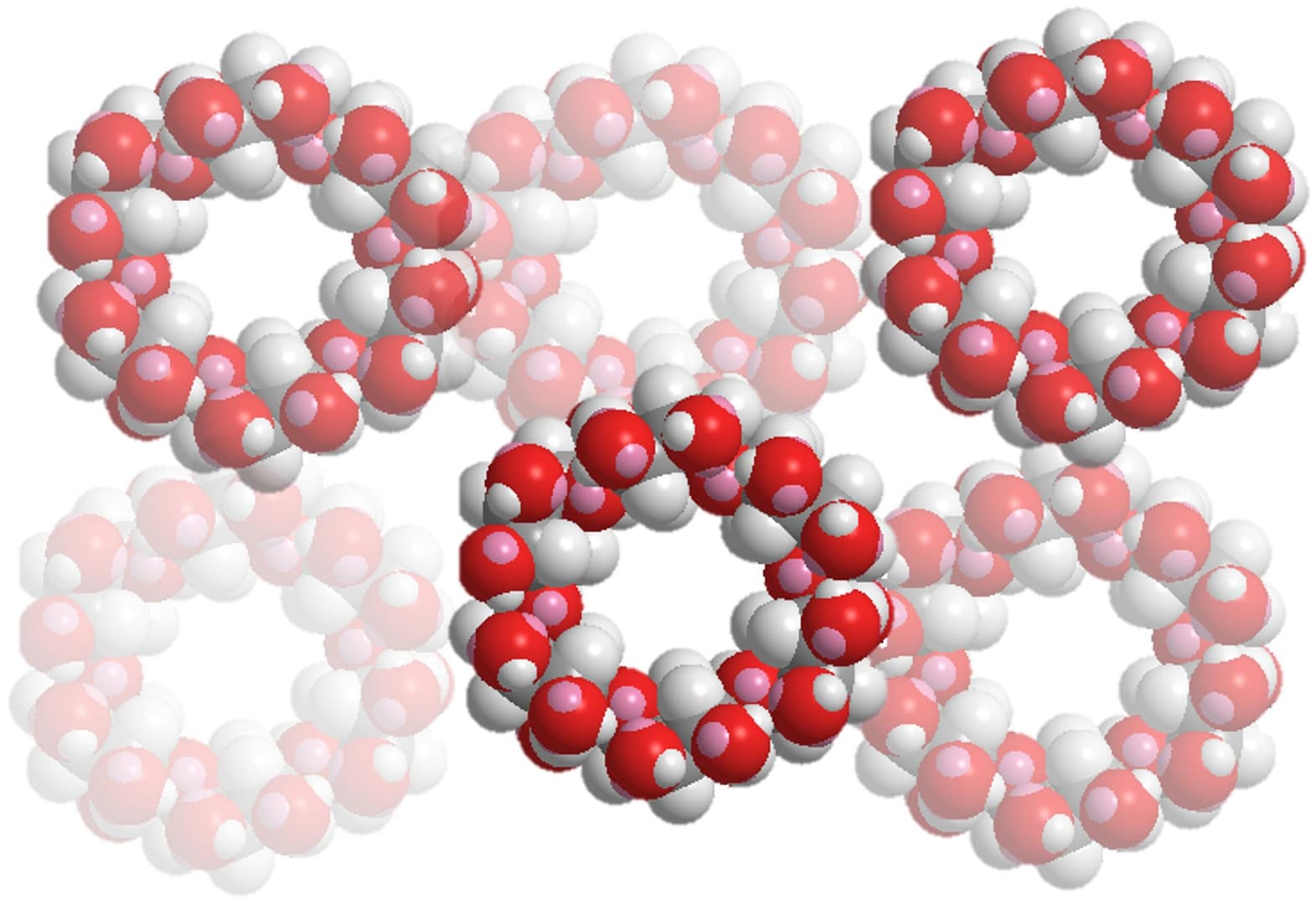
αCDPって何?
α-シクロデキストリン(αCD)は、ブドウ糖が輪になった「ドーナツ状の分子」です。
この“穴”に別の分子が入り込む(包接)性質を利用すると、分子同士を“はめ込み式”に組み合わせられます。
αCDP(α-シクロデキストリンポリマー) は、αCDを高分子に「つなぐ・増やす」ことで、
包接能を材料(膜・ゲル・微粒子など)に組み込んだものです。
研究の狙いは、たとえば次のような「機能の設計」です。
- 分子を取り込んで運ぶ(キャリア)
- 必要な刺激(光・pH・温度など)で放出する(刺激応答)
- やわらかいのに壊れにくいゲルを作る(自己修復・注入性)
このページで紹介する「古典レビュー3本」
添付ファイルに入っているレビュー論文3本を、HP向けに「1分でわかる」形でまとめました。
いずれも、αCDPを考えるうえで重要な ホスト–ゲスト自己集合 や 超分子材料設計 の基礎地図になります。
論文1
Recent Advances in Host-Guest Self-Assembled Cyclodextrin Carriers: Implications for Responsive Drug Delivery and Biomedical Engineering
Wankar, Jitendra, Kotla, Niranjan G., Gera, Sonia et al./ADVANCED FUNCTIONAL MATERIALS(2020)
DOI: 10.1002/adfm.201909049
被引用数(Web of Science, 取得時点): 388
- 何をまとめた?:シクロデキストリン(CD)の“穴”に分子が入る ホスト–ゲスト相互作用 を使って、薬剤キャリア(ミセル、疑似ポリロタキサン、プロドラッグなど)を自己組織化する研究動向を整理。
- ここがαCDPに効く:αCDを“ビーズ”のように高分子鎖に通す ポリロタキサン/疑似ポリロタキサン の考え方は、αCDP系の材料設計(網目化、刺激応答、ゲル化)に直結します。
- HP向け一言:「分子を入れる穴を“組み立て部品”にして、材料を賢くする」 という発想が見えるレビューです。
論文2
Supramolecular engineering of hydrogels for drug delivery
Bernhard, Stephane, Tibbitt, Mark W./ADVANCED DRUG DELIVERY REVIEWS(2021)
DOI: 10.1016/j.addr.2021.02.002
被引用数(Web of Science, 取得時点): 283
- 何をまとめた?:分子同士が“弱い結合”でつながる 超分子(supramolecular)ハイドロゲル を、ドラッグデリバリー用途でどう設計するか(せん断で流れる→止まる、自己修復など)を整理。
- ここがαCDPに効く:CD(とくにαCD/βCD)を高分子に導入すると、ゲスト分子との結合で 可逆的な架橋 を作れます。「注入できるゲル」「自己修復ゲル」など、αCDPの“使い道”の地図になります。
- HP向け一言:「やわらかいのに壊れにくい」ゲル材料の作り方 が、直感的に掴めます。
論文3
Cyclodextrins, from molecules to applications
Crini, Gregorio, Fourmentin, Sophie, Fenyvesi, Eva et al./ENVIRONMENTAL CHEMISTRY LETTERS(2018)
DOI: 10.1007/s10311-018-0763-2
被引用数(Web of Science, 取得時点): 263
- 何をまとめた?:シクロデキストリンの基礎(構造・性質)から、環境・医薬・材料など幅広い応用までを俯瞰した総説。
- ここがαCDPに効く:αCDPの議論でも必ず出る 包接(インクルージョン)、誘導体化、応用設計の考え方 を、土台から短時間で復習できます。
- HP向け一言:初学者向けの 「CDの全体像」 を押さえるのに便利です。
用語ミニ解説(やさしく)
- ホスト–ゲスト相互作用:ホスト(ここではCD)の“穴”に、ゲスト分子が入り、ゆるく結合すること。
- 包接(インクルージョン):ホスト–ゲスト相互作用で分子を取り込む現象。
- (疑似)ポリロタキサン:ビーズ状の分子(CD)が高分子鎖に通った構造(ゆるく組み立てられる場合は“疑似”)。
- 超分子(supramolecular):共有結合ではなく、複数の弱い相互作用で組み上がる分子集合体。
- ハイドロゲル:水をたくさん含む高分子の網目材料。やわらかいが形を保てる。
参考文献(添付ファイル内の文献のみ)
- Wankar, J, Kotla, NG, Gera, S et al. (2020). Recent Advances in Host-Guest Self-Assembled Cyclodextrin Carriers: Implications for Responsive Drug Delivery and Biomedical Engineering. ADVANCED FUNCTIONAL MATERIALS, 30(44). DOI: 10.1002/adfm.201909049
- Bernhard, S, Tibbitt, MW (2021). Supramolecular engineering of hydrogels for drug delivery. ADVANCED DRUG DELIVERY REVIEWS, 171, 240–256. DOI: 10.1016/j.addr.2021.02.002
- Crini, G, Fourmentin, S, Fenyvesi, É et al. (2018). Cyclodextrins, from molecules to applications. ENVIRONMENTAL CHEMISTRY LETTERS, 16(4), 1361–1375. DOI: 10.1007/s10311-018-0763-2
Three classic review papers that underpin α-cyclodextrin polymer (αCDP) research
(Source: only the references contained in the attached file αCDP_classics.txt)
What is αCDP?
α-Cyclodextrin (αCD) is a doughnut-shaped molecule made of glucose units.
Because it has a hydrophobic cavity, αCD can “host” other molecules (inclusion), enabling plug-and-play molecular assembly.
αCDP (α-cyclodextrin polymer) refers to materials where αCD units are incorporated into polymeric architectures,
so that inclusion chemistry becomes a built-in function of the material (films, gels, particles, etc.).
Typical design goals include:
- Capture and transport molecules (carriers)
- Release payloads upon triggers (light, pH, temperature, etc.)
- Build soft, robust gels (self-healing, injectability)
Why these three “classic” reviews?
The attached file contains three review papers, which we summarize below in a website-friendly way.
They provide a foundation for host–guest self-assembly and supramolecular materials design, both central to αCDP research.
Paper 1
Recent Advances in Host-Guest Self-Assembled Cyclodextrin Carriers: Implications for Responsive Drug Delivery and Biomedical Engineering
Wankar, Jitendra, Kotla, Niranjan G., Gera, Sonia et al. / ADVANCED FUNCTIONAL MATERIALS (2020)
DOI: 10.1002/adfm.201909049
Times cited (Web of Science, at the time of export): 388
- What does it cover? An overview of host–guest cyclodextrin (CD) systems that self-assemble into carriers (e.g., micelles, pseudopolyrotaxanes, prodrugs) with a focus on stimuli-responsive release.
- Why it matters for αCDP: The polyrotaxane/pseudopolyrotaxane concept—threading CDs onto polymer chains—is a core design motif for αCDP-based networks, gels, and responsive materials.
- One-line takeaway: “Use the CD cavity as a modular building block to create smart materials.”
Paper 2
Supramolecular engineering of hydrogels for drug delivery
Bernhard, Stephane, Tibbitt, Mark W. / ADVANCED DRUG DELIVERY REVIEWS (2021)
DOI: 10.1016/j.addr.2021.02.002
Times cited (Web of Science, at the time of export): 283
- What does it cover? Design rules for supramolecular hydrogels (reversible crosslinks, shear-thinning/injectability, self-healing) in the context of drug delivery.
- Why it matters for αCDP: Introducing CD units into polymers enables reversible crosslinking via guest binding—a practical map for αCDP applications such as injectable or self-healing gels.
- One-line takeaway: A clear guide to building soft yet tough gels using non-covalent interactions.
Paper 3
Cyclodextrins, from molecules to applications
Crini, Gregorio, Fourmentin, Sophie, Fenyvesi, Eva et al. / ENVIRONMENTAL CHEMISTRY LETTERS (2018)
DOI: 10.1007/s10311-018-0763-2
Times cited (Web of Science, at the time of export): 263
- What does it cover? A broad review from CD fundamentals (structure and inclusion) to applications across environment, pharma, and materials.
- Why it matters for αCDP: A quick refresh on the essentials—inclusion, derivatization, and application-driven design—that underpin most αCDP discussions.
- One-line takeaway: A handy “big picture” entry point for readers new to cyclodextrins.
Mini glossary (plain language)
- Host–guest interaction: A “host” cavity (CD) loosely binds a “guest” molecule.
- Inclusion: The phenomenon of hosting a guest molecule in the CD cavity.
- (Pseudo)polyrotaxane: A structure where bead-like molecules (CDs) are threaded onto polymer chains (“pseudo” when assembled non-covalently).
- Supramolecular: Assemblies built via multiple weak interactions rather than covalent bonds.
- Hydrogel: A water-rich polymer network that is soft yet shape-retaining.
References (only those in the attached file)
- Wankar, J, Kotla, NG, Gera, S et al. (2020). Recent Advances in Host-Guest Self-Assembled Cyclodextrin Carriers: Implications for Responsive Drug Delivery and Biomedical Engineering. ADVANCED FUNCTIONAL MATERIALS, 30(44). DOI: 10.1002/adfm.201909049
- Bernhard, S, Tibbitt, MW (2021). Supramolecular engineering of hydrogels for drug delivery. ADVANCED DRUG DELIVERY REVIEWS, 171, 240–256. DOI: 10.1016/j.addr.2021.02.002
- Crini, G, Fourmentin, S, Fenyvesi, É et al. (2018). Cyclodextrins, from molecules to applications. ENVIRONMENTAL CHEMISTRY LETTERS, 16(4), 1361–1375. DOI: 10.1007/s10311-018-0763-2