作成日: 2026-02-07
日本語版(HP向け)
どんなテーマ?
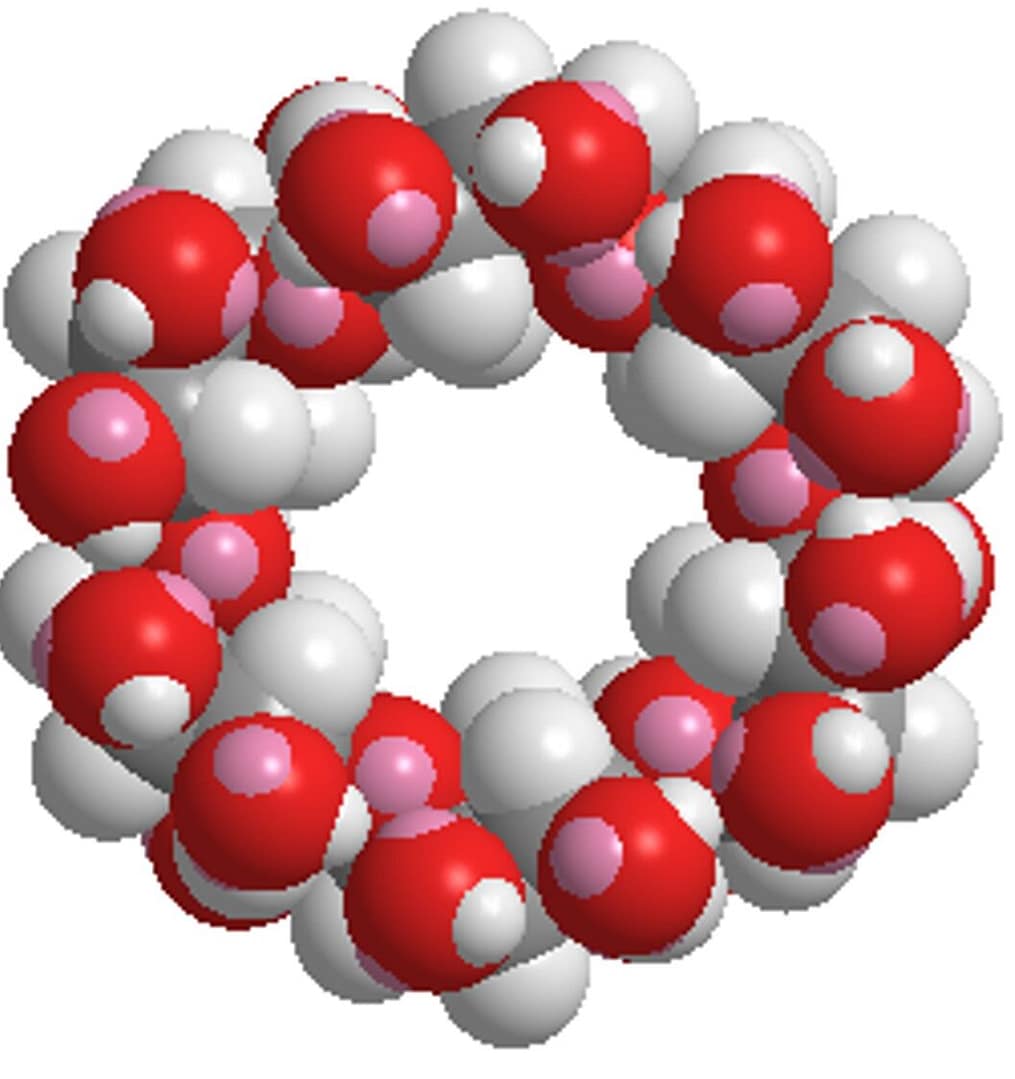
α-シクロデキストリン(αCD)は、分子を“包み込む”空洞をもつ糖由来分子です。
この論文では、αCDの包接(ホスト–ゲスト)を利用して、体温で発電できる柔らかいハイドロゲル(イオン熱電材料)を高性能化しています。
対象論文
Synergistic dual supramolecular interactions enhance ionic thermoelectric performance in dilute-electrolyte hydrogels
- 掲載誌: SCIENCE CHINA-MATERIALS
- 年: 2026(Early Access)
- 著者: Li, HB; Gu, ZJ; Sheng, SY; Chai, YP; Jiao, ZY; Zheng, F; Chi, XD
- DOI: 10.1007/s40843-025-3689-9
やさしい解説(Abstractの要点を整理:本文の転載なし)
– ウェアラブル機器を体温で動かすには、柔らかい材料で「温度差→電圧」を効率よく取り出す必要があります。
– 本研究は、α-シクロデキストリン(αCD)がI3−(トリヨージド)を包接する相互作用と、PVA鎖とI3−の水素結合を組み合わせた“二重の超分子相互作用”でイオン熱電ハイドロゲルを設計。
– ヨウ素濃度を非常に低く抑えた条件でも、熱起電力が2.21 mV/Kに達し、ピーク出力が約10倍に向上したと報告。
– 生体適合性と機械的強度を両立し、皮膚に直接触れる用途でも使える材料設計になっている。
– 体温から約100 mVを得る柔軟デバイスや、温度分布・動きを検知するセンサーアレイへの応用例を示した。
English version (for website)
What is this topic about?
α‑Cyclodextrin (αCD) is a sugar‑derived host molecule that can encapsulate guest species.
This paper leverages αCD host–guest chemistry to engineer a soft ionic thermoelectric hydrogel for wearable body‑heat energy harvesting.
Paper in the attached file
- 掲載誌: SCIENCE CHINA-MATERIALS
- 年: 2026(Early Access)
- 著者: Li, HB; Gu, ZJ; Sheng, SY; Chai, YP; Jiao, ZY; Zheng, F; Chi, XD
- DOI: 10.1007/s40843-025-3689-9
Plain-language bullets (paraphrased from the abstract; no verbatim text)
– Powering wearables from body heat requires soft materials that efficiently convert temperature gradients into voltage.
– This work designs an ionic thermoelectric hydrogel using dual supramolecular interactions: α‑cyclodextrin (αCD) host–guest complexation with I3− plus hydrogen bonding between PVA chains and I3−.
– Even at exceptionally low iodine concentration, the hydrogel reaches a high thermopower of 2.21 mV/K and shows ~10× higher peak power output.
– The material maintains biocompatibility and mechanical robustness suitable for direct skin contact.
– Demonstrations include flexible devices generating nearly 100 mV from body heat and sensor arrays for motion and spatial temperature sensing.