tags: [“cyclodextrin”, “αCDP”, “polyrotaxane”, “slide-ring gel”, “hydrogel”, “photoresponsive”, “supramolecular polymer”]
最終更新:2026-01-10
このページは、添付ファイル αCDP_Frontier.txt に含まれる文献(3報)だけを使い、シクロデキストリン(CD)を鍵にした「動く架橋」や刺激応答の材料研究を、一般向けにまとめたものです。
まず結論:この3報が示す流れ
- CDを“輪っか”として使い、材料内部の結び目(架橋)を“滑らせる”ことで、丈夫でしなやかなゲルが作れる
- 光(アゾベンゼンのE/Z異性化)や pH といった外部刺激で、“滑りやすさ”や“組み立ち/分解”を制御できる
- その結果、硬い⇄柔らかいを切り替えたり、一時的にだけできる超分子ポリマーを設計できる
背景:なぜCD(シクロデキストリン)?
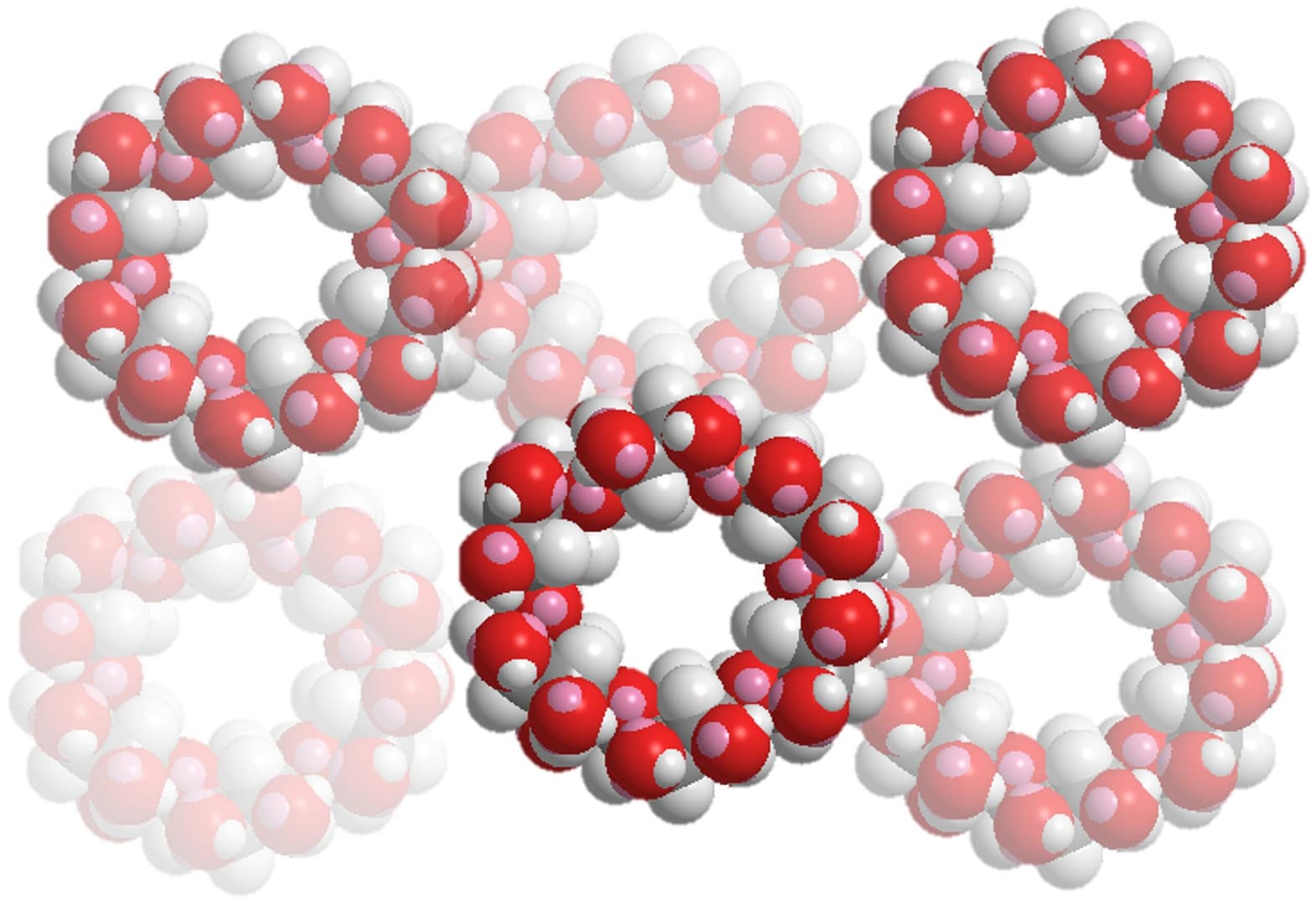
CDは、ドーナツ状(輪っか状)の分子で、穴(空洞)に別の分子を取り込む「包接」をします。さらに、ポリマー鎖にCDが通った構造(ポリロタキサン)を作ると、CDが鎖に沿って動けるため、材料の性質が大きく変わります。
論文解説(一般向け)
1) γ-CDで“トポロジカル架橋”:丈夫で伸びるハイドロゲルの全体像(Communications Chemistry, 2025, Review)
レビュー論文で、γ-シクロデキストリン(γ-CD)を使った スライドリング(滑る架橋)型のゲル研究を整理しています。
ここがポイント
– ロタキサン由来の“動く架橋”は、外力がかかったときに結び目が移動して応力を分散 → 高い靭性(ちぎれにくさ)や伸びにつながる
– γ-CDは空洞が大きく、金属テンプレートなしで珍しい二重スレッド(double-threaded)のトポロジーが作れる点が強み
2) 光で“滑り”を切り替える:アゾベンゼン×α-CDスライドリングゲル(Angew. Chem. Int. Ed., 2025)
α-CDが通ったポリマー骨格に アゾベンゼンを組み込み、光でE/Z異性化させることで、α-CDと骨格の相互作用を変え、CDの滑りやすさ(sliding dynamics)を制御した研究です。
ここがポイント
– E体ではα-CDがアゾベンゼン部位と相互作用しやすい → “滑りにくい”状態
– 光で Z体へ切り替えると相互作用が弱まり → “滑りやすい”状態
– その結果、ゲルの性質が 硬い(stiff)⇄柔らかい(soft) と可逆に切り替わる
3) pHで“一時的にだけ”できる超分子ポリマー:自己包接(in/out)を使った速度制御(Angew. Chem. Int. Ed., 2025)
CD(ホスト)と疎水性ゲストを1分子内でつないだ系で、ゲストがCD空洞に入る introverted(in) と、外に出て分子間会合できる extraverted(out) の2状態を設計し、pHで変換速度と重合を制御します。
ここがポイント
– 塩基性(pH > 8)では out → in が速く進み、集合が止まりやすい
– 強酸性(pH < 2)では out が速度論的にトラップされ、超分子ポリマーとして自己集合しやすい
– DFT計算で、変換を左右する“鍵の水素結合”が示され、DMSOでリセット(outへ戻す)も可能
研究室HPでの見せ方(例)
- 「動く架橋」=“結び目が滑る網目”という図解(1枚)
- 刺激応答を 光(E/Z) と pH の2軸で整理して、応用例(ソフトロボティクス、薬物担体、可変材料)を添える
- 「分子設計+トポロジー+計算(DFT)」で“材料機能を作り込む”流れを強調
用語ミニ解説
- ポリロタキサン:鎖(軸)に輪っか(CD)が通った“機械的に絡み合った”構造。
- スライドリングゲル(SRG):輪っかが動ける架橋点を持つゲル。力を受けたときに架橋が移動し、壊れにくくなる。
- E/Z異性化(アゾベンゼン):光で分子の形が変わるスイッチ機能。
- 速度論的トラップ:本来は安定でない状態を、反応速度の遅さで“しばらく固定”すること。
参考文献(添付ファイル内の3報のみ)
- Sapsford, E, Michieletto, D (2025). Topologically-crosslinked hydrogels based on γ-cyclodextrins. COMMUNICATIONS CHEMISTRY. 8 (1) Article 99. DOI: 10.1038/s42004-025-01469-3 (https://doi.org/10.1038/s42004-025-01469-3)
- Cafagno, D, Silvi, S, Tibbitt, MW, Mommer, S (2025). Photoresponsive Slide-Ring Gels Enable Modulation of Sliding Dynamics. ANGEWANDTE CHEMIE-INTERNATIONAL EDITION. 64 (36). DOI: 10.1002/anie.202507073 (https://doi.org/10.1002/anie.202507073)
- Hu, WT, Libérioux, V, Rossignol, J, Pembouong, G, Derat, E, Ménand, M, Bouteiller, L, Sollogoub, M (2025). Transient Supramolecular Polymers by pH-Gated Conformational Control of a Self-Assembling Cyclodextrin. ANGEWANDTE CHEMIE-INTERNATIONAL EDITION. 64 (29) Article e202507069. DOI: 10.1002/anie.202507069 (https://doi.org/10.1002/anie.202507069)
English Version
αCDP Frontier: Slide‑Ring Gels and Topology‑Engineered Stimuli‑Responsive Materials (3 papers)
Last updated: 2026-01-10
This page is a public‑friendly overview based only on the three papers included in the attached file αCDP_Frontier.txt.
The big picture from these 3 papers
- Cyclodextrins (CDs) can act as mobile rings in polymer networks, creating slidable crosslinks that dissipate stress.
- External stimuli such as light (azobenzene E/Z switching) and pH can tune sliding dynamics or assembly pathways.
- This enables materials that switch stiff ↔ soft and even transient supramolecular polymers with programmable lifetimes.
Why cyclodextrins?
CDs are donut‑shaped molecules with a cavity that can host guest groups. When CDs are threaded onto polymer chains (polyrotaxanes), the rings can move along the chain, dramatically changing mechanical behavior and enabling stimulus‑responsive functions.
Paper‑by‑paper highlights (plain language)
1) γ‑CD topological crosslinks in hydrogels (Communications Chemistry, 2025, Review)
This review summarizes γ‑cyclodextrin‑based slide‑ring/rotaxane gel materials and compares them to α‑CD systems.
– Mobile crosslinks redistribute stress → improved toughness and stretchability
– γ‑CD can support uncommon double‑threaded topologies without metal templating
2) Light‑responsive slide‑ring gels via azobenzene switching (Angew. Chem. Int. Ed., 2025)
Azobenzene units are incorporated into a polymer backbone threaded with α‑CD macrocycles. Light‑induced E/Z switching modulates CD‑azobenzene interactions and thus the sliding dynamics.
– E form: stronger interactions → less sliding
– Z form: weaker interactions → more sliding
– Mechanical properties reversibly toggle between stiff and soft states
3) pH‑gated transient supramolecular polymers (Angew. Chem. Int. Ed., 2025)
A CD host linked to a hydrophobic guest can adopt an in (self‑included) or out (assembly‑competent) conformation. pH controls interconversion kinetics and therefore polymerization lifetime.
– Basic pH (> 8) rapidly converts out → in
– Acidic pH (< 2) kinetically traps the out monomer, enabling supramolecular polymer formation
– DFT reveals a key hydrogen bond governing the mechanism; DMSO can reset the system
Mini glossary
- Polyrotaxane: a mechanically interlocked structure where rings (CDs) are threaded on a polymer axle.
- Slide‑ring gel (SRG): a gel with slidable crosslinks; crosslinks can move to dissipate stress.
- Azobenzene E/Z isomerization: a light‑driven molecular switch.
- Kinetic trapping: holding a metastable state due to slow interconversion.
References (only the 3 papers in the attached file)
- Sapsford, E, Michieletto, D (2025). Topologically-crosslinked hydrogels based on γ-cyclodextrins. COMMUNICATIONS CHEMISTRY. 8 (1) Article 99. DOI: 10.1038/s42004-025-01469-3 (https://doi.org/10.1038/s42004-025-01469-3)
- Cafagno, D, Silvi, S, Tibbitt, MW, Mommer, S (2025). Photoresponsive Slide-Ring Gels Enable Modulation of Sliding Dynamics. ANGEWANDTE CHEMIE-INTERNATIONAL EDITION. 64 (36). DOI: 10.1002/anie.202507073 (https://doi.org/10.1002/anie.202507073)
- Hu, WT, Libérioux, V, Rossignol, J, Pembouong, G, Derat, E, Ménand, M, Bouteiller, L, Sollogoub, M (2025). Transient Supramolecular Polymers by pH-Gated Conformational Control of a Self-Assembling Cyclodextrin. ANGEWANDTE CHEMIE-INTERNATIONAL EDITION. 64 (29) Article e202507069. DOI: 10.1002/anie.202507069 (https://doi.org/10.1002/anie.202507069)