3行でわかる
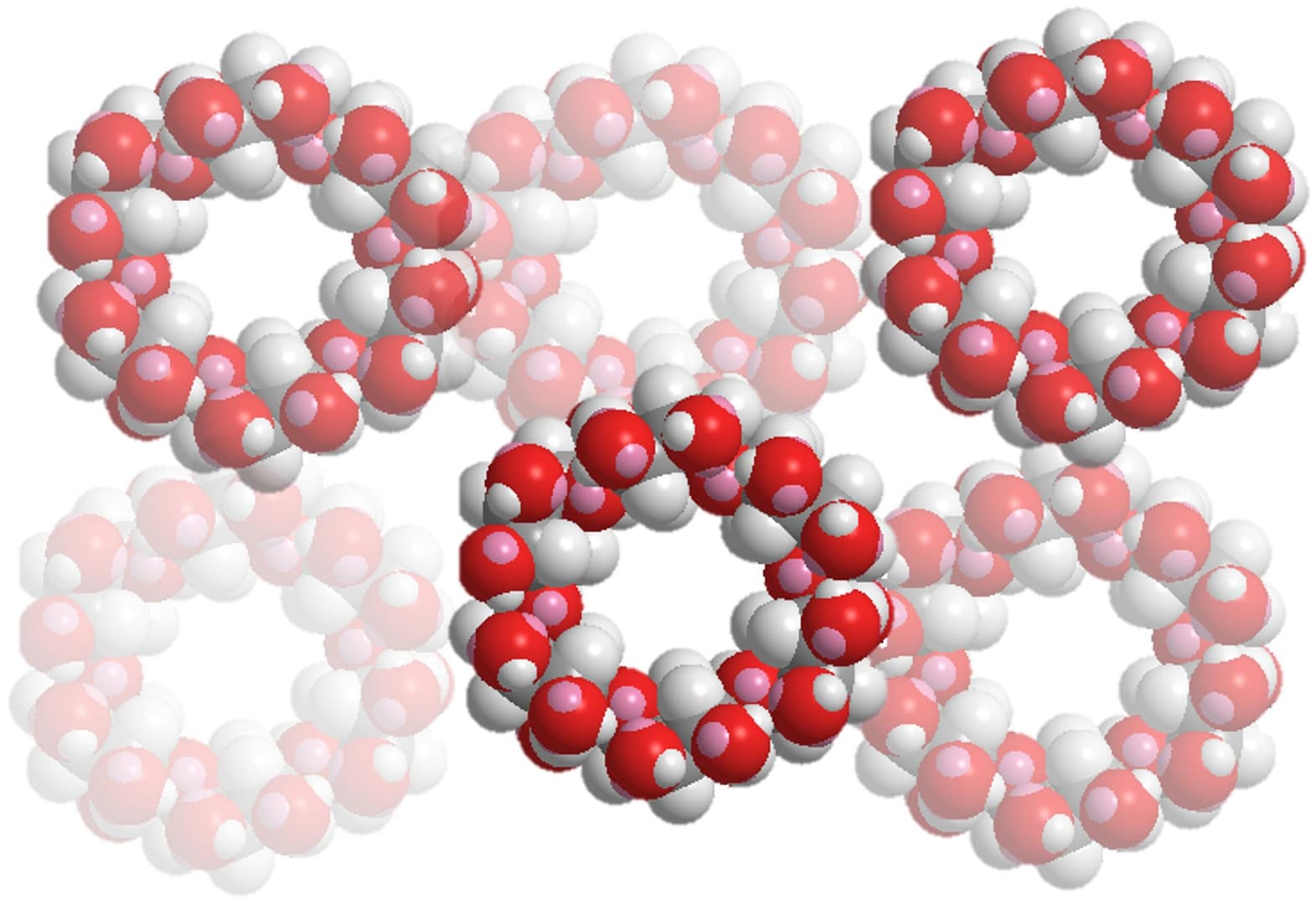
- シクロデキストリン(CD)は、“輪っか状”の分子で、内側に別の分子を取り込む「包接」が得意です。
- CDの包接を“結び目”として使うと、高分子が水中で自己組織化し、ナノ粒子・ゲル・繊維などに形を変えます。
- とくにα‑CDは鎖状高分子(例:PEG)に通りやすく、ポリ擬ロタキサン(polypseudorotaxane)型の材料設計で活躍します。
ここがポイント(一般向け)
- 化学結合で固めない:包接(ホスト–ゲスト)は可逆的なので、壊れても戻る“しなやかさ”が出やすい。
- 水系で組み立つ:生体・環境に優しいプロセス設計につながりやすい。
- 設計のつまみが多い:CDの種類(α/β/γ)、高分子鎖の太さ、濃度、添加剤などで物性を調整できる。
取り上げたレビュー3本と見どころ
1) CDホスト–ゲストで「自己組織化ポリマー」を組み立てる(概念の地図)
Wang ら(2016)は、CDの包接を使った水系での超分子高分子組み立てを体系的に整理しています。
– どんな部品(CD・客分子・高分子)をどう組み合わせると、どんな構造(ミセル、ナノ粒子、ネットワーク等)になるか
– 「可逆結合」だからこそ出る刺激応答性(溶媒、温度、競合分子 など)
を“設計者の目線”で俯瞰できます。
2) α‑CDならでは:ポリ擬ロタキサン・ハイドロゲルの設計
Dominski ら(2020)は、α‑CDが高分子鎖に通って形成するポリ擬ロタキサンを基盤にしたハイドロゲルをまとめています。
– α‑CDの“輪っか”が鎖に通って集まることで、物理架橋(非共有結合の架橋)ができる
– その結果、流動⇄固化のような扱いやすい性質や、自己修復などの機能が狙える
といったポイントが、材料設計の言葉で整理されています。
3) 実用の視点:食品・医薬分野でのCD系ポリマーの歩み
Petitjean ら(2021)は、CD系ポリマーが食品・医薬分野でどう使われ、どう広がってきたかをレビューしています。
– 安全性や製造スケール、用途の広がり
– 「包接」で何が良くなるのか(溶解性・安定性・機能性など)
を歴史的な流れの中で理解できます。
用語ミニ解説
- 包接(ホスト–ゲスト):輪っか(ホスト)が別分子(ゲスト)を取り込み、ゆるく結びつく相互作用。
- 超分子(supramolecular):共有結合ではなく、弱い相互作用の“集合”で機能を作る考え方。
- ポリ擬ロタキサン:高分子鎖にCDが多数通った状態(「ネックレス状」)の集合体。
- ハイドロゲル:水を大量に含むゼリー状材料。医療・食品・センサーなどで重要。
研究室での展開アイデア(一般向けの一例)
- 光で状態を切り替えるゲル:光で形が変わる分子(フォトクロミック分子)を“ゲスト”として組み込み、光で硬さや透過性を変える。
- 機能分子の“保護ケース”:酸化や光分解を受けやすい色素・発光分子を包接で守り、寿命を延ばす。
- やさしいプロセスで薄膜化:水系で自己組織化→乾燥で薄膜・コーティングへ、というルートの検討。
(※上はアイデア例です。実際の適用可否は材料系・目的に応じて検討が必要です。)
参考文献(本記事で取り上げた論文)
- Wang, J.; Qiu, Z.-Q.; Wang, Y.-M.; Li, L.; Guo, X.-H.; Pham, D. T.; Lincoln, S. F.; Prud’homme, R. K. (2016). Supramolecular polymer assembly in aqueous solution arising from cyclodextrin host–guest complexation. Beilstein Journal of Organic Chemistry, 12, 50–72. DOI: 10.3762/bjoc.12.7
- Dominski, A.; Konieczny, T.; Kurcok, P. (2020). α‑Cyclodextrin‑Based Polypseudorotaxane Hydrogels. Materials, 13(1), Article 133. DOI: 10.3390/ma13010133
- Petitjean, M.; García‑Zubiri, I. X.; Isasi, J. R. (2021). History of cyclodextrin‑based polymers in food and pharmacy: a review. Environmental Chemistry Letters, 19(4), 3465–3476. DOI: 10.1007/s10311-021-01244-5
Suggested tags
Cyclodextrin, α‑Cyclodextrin, Supramolecular, Host–guest, Polypseudorotaxane, Hydrogel, Cyclodextrin polymer
What is αCDP (α‑cyclodextrin‑based polymers)?
(A friendly HP article based on three review papers selected from “αCDP_Reviews”)
In three bullet points
- Cyclodextrins (CDs) are ring‑shaped molecules that can “host” other molecules inside their cavity (host–guest inclusion).
- Using inclusion as a reversible junction, polymers can self‑assemble in water into nanoparticles, networks, and gels.
- α‑CD is especially known for threading onto linear polymer chains (e.g., PEG), enabling polypseudorotaxane‑type designs.
Why people care (non‑specialist view)
- No hard covalent locking: inclusion is reversible, so materials can be soft, adaptive, and sometimes self‑recovering.
- Water‑based assembly: often compatible with greener, bio‑friendly processing.
- Many design knobs: CD type (α/β/γ), polymer chain size, concentration, and additives tune the final properties.
Three selected review papers and what you can learn
1) A design map for CD host–guest polymer self‑assembly
Wang et al. (2016) provides a structured overview of how CD inclusion drives supramolecular polymer assembly in aqueous media. It helps you see:
– which building blocks (CDs, guest motifs, polymers) lead to which structures (micelles, nanoparticles, networks), and
– how stimuli responsiveness emerges from reversible binding.
2) What makes α‑CD special: polypseudorotaxane hydrogels
Dominski et al. (2020) focuses on α‑CD‑based polypseudorotaxane hydrogels. Key takeaways include:
– α‑CD rings thread onto polymer chains and cluster to create physical crosslinks,
– enabling gelation and functional behaviors such as tunable flow/solid states and (in some systems) self‑recovery.
3) From concepts to real use: CD‑based polymers in food and pharmacy
Petitjean et al. (2021) reviews how CD‑based polymers have progressed toward practical applications—especially in food and pharmaceutical contexts—covering:
– how inclusion can improve solubility, stability, and functionality, and
– considerations related to application pathways and scalability.
Mini‑glossary
- Host–guest inclusion: a “host” cavity molecule (CD) forms a reversible complex with a “guest” molecule.
- Supramolecular: functions built from multiple weak interactions rather than permanent covalent bonds.
- Polypseudorotaxane: many CD rings threaded on a polymer chain (a “molecular necklace”) that can assemble into networks.
- Hydrogel: a water‑rich, jelly‑like material widely used in biomedical and soft‑material applications.
Example directions (idea level)
- Light‑switchable gels by embedding photochromic guest molecules.
- Protective hosting of fragile functional molecules (dyes/emitters) to improve stability.
- Water‑based thin‑film processing via self‑assembly → coating/drying routes.
(These are general ideas; feasibility depends on your specific materials and targets.)
References (the three papers featured in this article)
- Wang, J.; Qiu, Z.-Q.; Wang, Y.-M.; Li, L.; Guo, X.-H.; Pham, D. T.; Lincoln, S. F.; Prud’homme, R. K. (2016). Supramolecular polymer assembly in aqueous solution arising from cyclodextrin host–guest complexation. Beilstein Journal of Organic Chemistry, 12, 50–72. DOI: 10.3762/bjoc.12.7
- Dominski, A.; Konieczny, T.; Kurcok, P. (2020). α‑Cyclodextrin‑Based Polypseudorotaxane Hydrogels. Materials, 13(1), Article 133. DOI: 10.3390/ma13010133
- Petitjean, M.; García‑Zubiri, I. X.; Isasi, J. R. (2021). History of cyclodextrin‑based polymers in food and pharmacy: a review. Environmental Chemistry Letters, 19(4), 3465–3476. DOI: 10.1007/s10311-021-01244-5
Suggested tags
Cyclodextrin, α‑Cyclodextrin, Supramolecular, Host–guest, Polypseudorotaxane, Hydrogel, Cyclodextrin polymer