作成日: 2026-02-21
どんなテーマ?
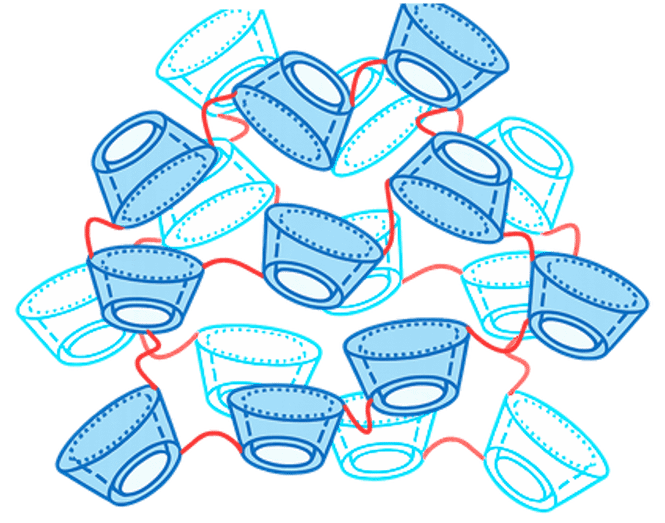
β-シクロデキストリン(βCD)やβCDポリマーは、分子を包み込む“空洞(ホスト–ゲスト)”と、親水性官能基を活かして、
– 食品成分の安定化・徐放
– 水中汚染物質の吸着除去
– 医療材料(ミセル・ハイドロゲル)の刺激応答設計
などへ応用が広がっています。
Maize starch and (3-cyclodextrin nanocarriers for encapsulation of Centella asiatica polyphenols: synthesis, physicochemical properties, and pH-responsive delivery
- 掲載誌:Food Chemistry(参考JIF 2024: 9.8)
- 年:2026(APR 1)
- 著者:Tripathy, S, Srivastav, PP
- DOI:10.1016/j.foodchem.2026.148202
やさしい解説(Abstractの要点を整理:本文の転載なし)
– 機能性食品成分(ポリフェノールなど)は光・熱・塩濃度で劣化しやすく、胃で分解されると腸まで届きにくいことが課題です。
– 本研究は、トウモロコシデンプン(MS)のゲルネットワークによる“物理的包み込み”と、β‑シクロデキストリン(β‑CD)の“包接”を組み合わせた二重多糖ナノキャリアを提案しています。
– MS:β‑CD=2:1の配合で、粒径約167 nmの均一ナノ粒子を形成し、高い封入効率(約85%)と搭載量を示したと報告。
– 分光・熱分析から、非晶質化と水素結合により、保存・熱・光・イオン強度に対する安定性が向上することを示します。
– 胃条件では放出を抑え、腸条件で放出が進む pH応答型の徐放を示し、拡散+マトリクス緩和で制御されると解釈しています。
– 食品グレード材料で“クリーンラベル”な機能性食品・サプリの送達基盤になり得る、と結論づけています。
Porous Polymer Adsorbents of Tris(4-formylphenyl)amine and β-Cyclodextrin for Endocrine-Disrupting Chemicals, Dyes, and Antibiotics
- 掲載誌:Acs Applied Polymer Materials(参考JIF 2024: 4.7)
- 年:2026(2026 FEB 10)
- 著者:Zhang, R, Xie, ZF, Hu, YJ, Li, J, et al.
- DOI:10.1021/acsapm.5c04364
やさしい解説(Abstractの要点を整理:本文の転載なし)
– 実排水には内分泌かく乱物質・色素・抗生物質などが混在し、単一機能の吸着材では同時除去が難しいことが課題です。
– 本研究は、β‑シクロデキストリン(β‑CD)に Tris(4‑formylphenyl)amine(TFPA) を架橋して、三次元多孔質のβ‑CDポリマー(TFPA‑N‑β‑CD)を作製しました。
– β‑CDの空洞(包接)と親水基による取り込みに加え、TFPAがネットワーク形成で比表面積(約63.7 m²/g)を増やし、追加の吸着サイトも提供します。
– 単一成分系で、BPA・メチレンブルー・テトラサイクリンの吸着を評価し、速度論(擬二次)と等温線(Sips)で整理。最大吸着量はBPA 164.7、MB 272.0、TC 33.9 mg/gと報告。
– 二成分混合でも吸着能が大きく落ちず(Rq>0.80)、物質ごとに支配的相互作用が異なる(包接/静電/親水)ことを示しています。
– 10回の吸脱着サイクル後も初期の55%以上を維持し、複合汚染水処理への再利用型吸着材として有望です。
Polymeric micelles and hydrogels: Tailored synthesis strategies and biomedical applications
- 掲載誌:Polymer(参考JIF 2024: 4.5)
- 年:2026(FEB 20)
- 著者:Manna, K, Roy, A, Pal, S
- DOI:10.1016/j.polymer.2026.129650
やさしい解説(Abstractの要点を整理:本文の転載なし)
– 刺激応答性ポリマー(ミセル・ハイドロゲル)は、薬物送達や止血、バイオエレクトロニクスなど医療応用で注目されています。
– 本論文(Feature Article)は、RAFT重合により分子量と分散を制御した両親媒性共重合体を設計し、サイズ(80–200 nm)や放出挙動を調整できるミセル系を紹介しています。
– pH・温度・酸化還元・光など、複数刺激に応答する設計例をまとめ、分子レベル制御が性能に直結する点を強調しています。
– ハイドロゲルでは、孔構造や強度など物性を調整し、共送達・止血・バイオエレクトロニクスへの応用を議論しています。
– 特に、β‑CDとポリ(N‑ビニルイミダゾール)からなるハイドロゲルで、溶血が少ない止血性能(<1.3%)を示した例を紹介しています。
– 「構造制御→機能最適化」という考え方が、次世代の適応型バイオ材料開発の指針になる内容です。
English version (for website)
What is this topic about?
β‑Cyclodextrin (βCD) and βCD‑based polymers combine a hydrophobic host cavity with hydrophilic functional groups.
They enable designs for:
– Food‑grade stabilization and pH‑responsive delivery of bioactives
– Porous adsorbents for complex wastewater pollutants
– Stimuli‑responsive micelles/hydrogels for biomedical applications
Top 3 papers (sorted by 2024 JIF)
Maize starch and (3-cyclodextrin nanocarriers for encapsulation of Centella asiatica polyphenols: synthesis, physicochemical properties, and pH-responsive delivery
- Journal: Food Chemistry (2024 JIF: 9.8)
- Year: 2026 (APR 1)
- Authors: Tripathy, S, Srivastav, PP
- DOI: 10.1016/j.foodchem.2026.148202
Plain-language bullets (paraphrased; no verbatim abstract text)
– Bioactive food compounds (e.g., polyphenols) are unstable to heat/light/ionic strength and may degrade before reaching the intestine, limiting oral bioaccessibility.
– This study proposes dual‑polysaccharide nanoparticles combining maize starch (MS) gel entrapment with β‑cyclodextrin (β‑CD) inclusion complexation.
– An optimized MS:β‑CD ratio (2:1) yields uniform nanoparticles (~167 nm) with high encapsulation efficiency (~85%) and high loading capacity.
– Spectroscopic/thermal data support an amorphous, hydrogen‑bond‑stabilized nanocomposite that improves resistance to storage, heat, light, and ionic‑strength stress.
– The carrier exhibits gastrointestinal pH‑responsive release: suppressed in gastric conditions and enhanced intestinal release, consistent with diffusion + matrix‑relaxation control.
– It suggests a scalable, food‑grade, clean‑label platform for functional foods/nutraceutical delivery.
Porous Polymer Adsorbents of Tris(4-formylphenyl)amine and β-Cyclodextrin for Endocrine-Disrupting Chemicals, Dyes, and Antibiotics
- Journal: Acs Applied Polymer Materials (2024 JIF: 4.7)
- Year: 2026 (2026 FEB 10)
- Authors: Zhang, R, Xie, ZF, Hu, YJ, Li, J, et al.
- DOI: 10.1021/acsapm.5c04364
Plain-language bullets (paraphrased; no verbatim abstract text)
– Real wastewater can contain endocrine disruptors, dyes, and antibiotics simultaneously, making one‑size‑fits‑all adsorbents insufficient.
– This work crosslinks tris(4‑formylphenyl)amine (TFPA) onto β‑cyclodextrin (β‑CD) to form a porous β‑CD polymer adsorbent (TFPA‑N‑β‑CD).
– β‑CD contributes host–guest cavities and hydrophilic groups, while TFPA builds a 3D network that increases surface area (~63.7 m²/g) and provides additional adsorption sites.
– Single‑component adsorption of BPA, methylene blue, and tetracycline follows pseudo‑second‑order kinetics and Sips isotherms; reported maximum capacities are 164.7 (BPA), 272.0 (MB), and 33.9 mg/g (TC).
– In binary mixtures, adsorption remains strong (Rq>0.80), and the dominant mechanism differs by pollutant (inclusion vs electrostatics vs hydrophilic interactions).
– After 10 adsorption–desorption cycles, >55% capacity is retained, supporting reuse for complex wastewater treatment.
Polymeric micelles and hydrogels: Tailored synthesis strategies and biomedical applications
- Journal: Polymer (2024 JIF: 4.5)
- Year: 2026 (FEB 20)
- Authors: Manna, K, Roy, A, Pal, S
- DOI: 10.1016/j.polymer.2026.129650
Plain-language bullets (paraphrased; no verbatim abstract text)
– Stimuli‑responsive polymer micelles and hydrogels are increasingly important for biomedical uses such as drug delivery, hemostasis, and bioelectronics.
– This feature article highlights RAFT‑polymerized amphiphilic copolymers with controlled molecular weight/dispersity and discusses micelles with tunable sizes (80–200 nm) and controllable release profiles.
– It summarizes designs responsive to pH, temperature, redox potential, and light, emphasizing how molecular‑level control translates to function.
– For hydrogels, it discusses tunable porosity/strength and applications including co‑delivery, hemostasis, and bioelectronics.
– An example hydrogel made from β‑CD and poly(N‑vinyl imidazole) is highlighted for strong hemostatic behavior with low hemolysis (<1.3%).
– Overall, it provides design principles linking structural control to adaptive biomedical material performance.
参考文献 / References(添付ファイル内・掲載分)
- Tripathy, S, Srivastav, PP (2026). Maize starch and (3-cyclodextrin nanocarriers for encapsulation of Centella asiatica polyphenols: synthesis, physicochemical properties, and pH-responsive delivery. Food Chemistry. doi:10.1016/j.foodchem.2026.148202
- Zhang, R, Xie, ZF, Hu, YJ, Li, J, et al. (2026). Porous Polymer Adsorbents of Tris(4-formylphenyl)amine and β-Cyclodextrin for Endocrine-Disrupting Chemicals, Dyes, and Antibiotics. Acs Applied Polymer Materials. doi:10.1021/acsapm.5c04364
- Manna, K, Roy, A, Pal, S (2026). Polymeric micelles and hydrogels: Tailored synthesis strategies and biomedical applications. Polymer. doi:10.1016/j.polymer.2026.129650