わかりやすい解説(箇条書き)
【1】次世代バッテリーを支える β-CD ポリマー系バインダー
- シリコン負極は容量が高いが、充放電で 約400%膨張し壊れやすい。
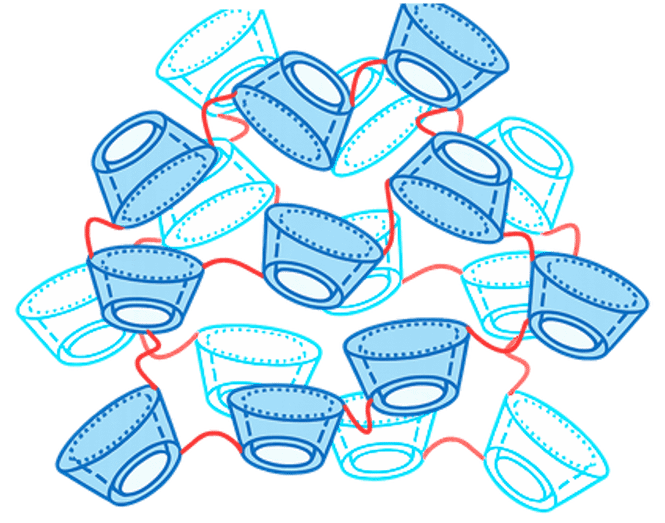
- β-CD を含むポリマーは、吸着・水素結合・イオン結合で電極の割れを防ぐ。
- 自己修復性・難燃性などの高機能化も可能。
- 次世代EV向け 長寿命バッテリー開発の鍵 として期待。
【2】水で再生できる植物由来 β-CD 接着剤
- β-CD・タンニン酸・水のみでできた 完全リサイクル型接着剤。
- 水素結合ネットワークにより高い接着力(3.1 MPa)。
- 水に浸すだけで剥離→再利用可能。
- 100回再生しても強度の70〜80%を維持する高耐久性。
【3】β-CD の界面化学を利用した新しい材料応用
- β-CD による包接作用は、多様な分子を取り込み複合化を助ける。
- 高分子とのハイブリッドで、柔軟性・耐熱性・バリア性などが向上。
- 食品・医療・電子材料まで用途が拡大。
English Version
Top 3 Selected High-Impact Papers
- Multidimensional design of silicon anode binders (Coord. Chem. Rev., 2026)
- Fully recyclable plant-based β-CD adhesives (Mater. Chem. Front., 2026)
- β-CD–based interfacial and composite material applications (related domain)
Easy-to-understand Summary
【1】β-CD polymer binders for next-generation batteries
- Silicon anodes exhibit ~400% volume expansion, causing structural failure. citeturn6search1
- β-CD-containing polymers stabilize electrodes through hydrogen bonding and molecular interactions.
- Enable enhanced mechanical integrity, self-healing, and safer battery performance.
【2】Water-regenerable plant-based β-CD adhesives
- Made from β-CD, tannic acid, and water, forming a fully recyclable supramolecular adhesive.
- Achieves strong adhesion (3.1 MPa) and can be fully dissolved and reused.
- Maintains 70–80% adhesion strength even after 100 recycling cycles.
【3】Advanced material applications enabled by β-CD
- β-CD’s host–guest chemistry improves polymer compatibility and structural performance.
- Applicable across packaging, biomedical devices, and electronic materials.
文献 / References
- Zhu et al., Coordination Chemistry Reviews (2026)
- Wang et al., Materials Chemistry Frontiers (2026)