※本ページは、添付ファイル γCD_Polymer_Reviews.txt(Web of Science 由来データ)に含まれる レビュー論文3本のみをもとに、一般向けに噛み砕いてまとめたものです。
まずは一言で(概要)
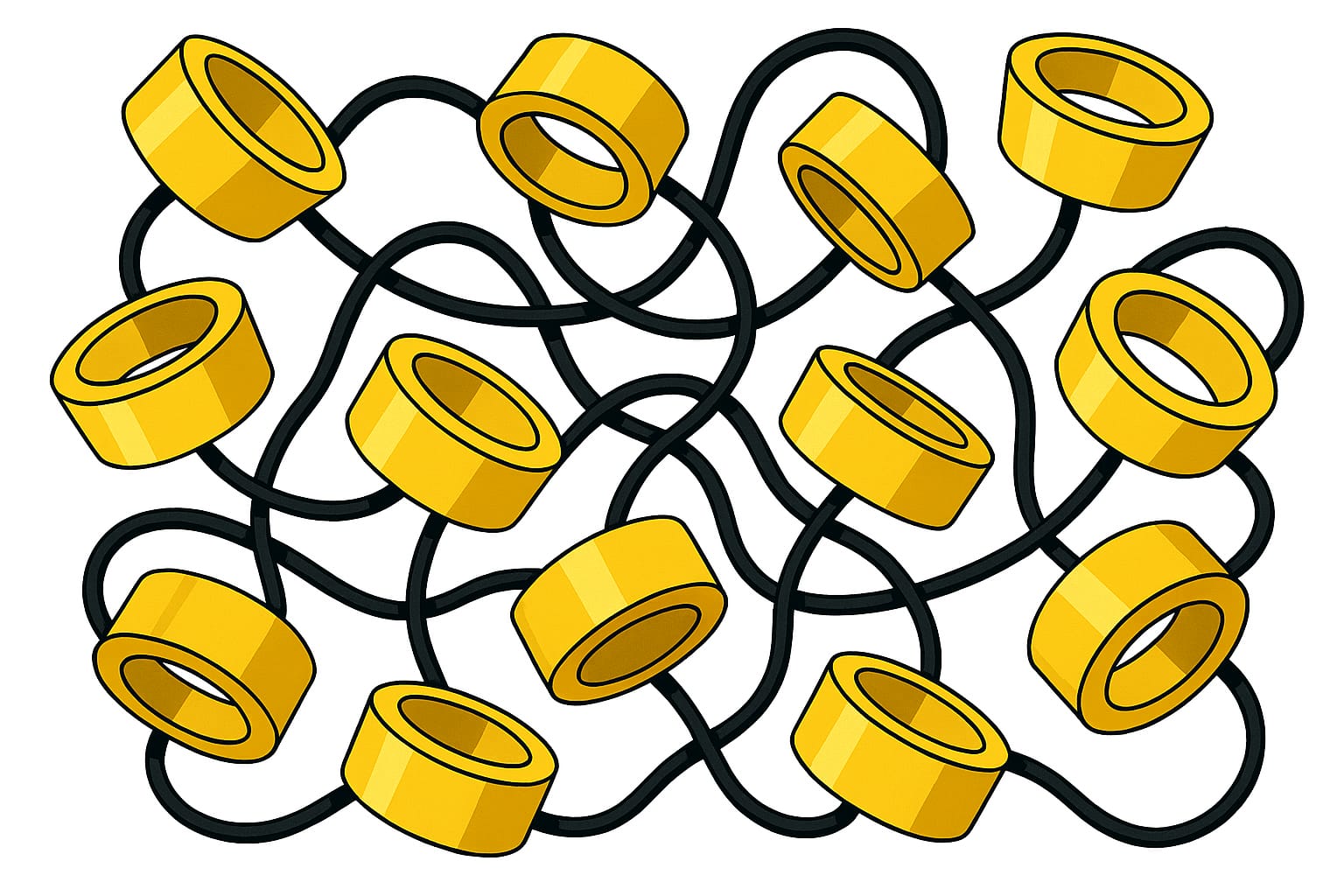
シクロデキストリン(CD)は、分子を“カップ”のように包み込む(包接する)ことができる環状分子です。
特に γ-シクロデキストリン(γCD)は空洞(内側の“入れ物”)が大きく、より大きな分子や集合体との相互作用が期待されます。
CDをポリマー化(高分子化)したり、ホスト–ゲスト相互作用で自己組織化させることで、ドラッグデリバリーや機能性材料へ応用が広がります。
何ができるの?(イメージ)
レビュー論文が繰り返し強調している「CD系材料の強み」は、ざっくり次の3つです。
- 包接(ホスト–ゲスト):疎水性分子を取り込み、溶けやすさ・安定性・機能を変えられる
- 自己組織化:包接を“のり”のように使って、ミセル・ゲル・超分子集合体を作れる
- 設計自由度:CDの修飾、グラフト化、架橋、他材料(無機クラスター等)との複合化で、用途に合わせて調整できる
レビュー論文3本の見どころ(一般向け要約)
1) ホスト–ゲストで作る「自己組織化キャリア」の最新動向
Wankar ら(Advanced Functional Materials, 2020)は、CDのホスト–ゲスト相互作用を利用して、自己組織化型のキャリア(運搬体)を設計する流れを体系的に整理しています。
キーワードとして、drug delivery/controlled release/stimulus responsive materials、さらに pseudopolyrotaxane(擬似ポリロタキサン)などの超分子構造が挙がっています。
- 「包接」を部品として、集合体(ミセル、ゲルなど)を作る考え方
- “分子マシン”的な発想(キーワード:cyclodextrin-molecular machine)
- 医療デバイスのコーティングなど、材料応用への広がり
2) CD研究全体を俯瞰する“地図”になる総説
Crini ら(Environmental Chemistry Letters, 2018)は、CDを「分子」から「応用」へつなぐ全体像をまとめています。
CDの基本(なぜ包接できるか)から、応用分野へ展開するための考え方が広く紹介されているタイプのレビューです。
- まずはCDを理解する:“分子の性質”が“機能”につながる
- 修飾・複合化によって、用途ごとに最適化する視点
- 幅広い分野への“入口”として読みやすいレビュー
3) γCD×無機クラスター(POM)などの「有機・無機ハイブリッド」へ
Cameron ら(Chemical Society Reviews, 2022)は、オルガノ機能化したハイブリッド・ポリオキソメタレート(POM)の超分子集合体を扱うレビューで、キーワードに gamma-cyclodextrin、metal coordination、inorganic hybrids が含まれています。
「有機のホスト–ゲスト」と「無機クラスター」をつなぐ発想は、新しい機能性材料設計のヒントになります。
- γCDを含むホスト分子を使い、無機ユニットを“組み上げる”視点
- 金属配位やハイブリッド化による、材料機能の拡張
- “分子設計 → 集合体設計”へ視点が上がるレビュー
研究室・教育での使いどころ(例)
- 導入(学部・高校向け):Crini らの総説でCDの基礎と応用の全体像を掴む
- 設計の発想を学ぶ:Wankar らのレビューで、ホスト–ゲストを“設計部品”として使う考え方を学ぶ
- 材料への展開:Cameron らのレビューから、γCDを含む超分子設計を「有機・無機ハイブリッド」へ広げる視点を得る
ミニ用語(5つだけ)
- ホスト–ゲスト:包み込む側(ホスト)と、包まれる側(ゲスト)の相互作用
- 自己組織化:分子同士が“勝手に並んで”集合体を作る現象
- 制御放出(controlled release):中身(薬など)を時間や刺激で少しずつ放出させる設計
- 擬似ポリロタキサン(pseudopolyrotaxane):輪(CD)が鎖状分子に通った超分子構造の一種
- 金属配位(metal coordination):金属イオンと配位子が結合して構造を作る相互作用
参考文献(本ページで紹介したレビュー3本)
- Wankar, J, Kotla, NG, Gera, S, Rasala, S, Pandit, A, Rochev, YA. Recent Advances in Host-Guest Self-Assembled Cyclodextrin Carriers: Implications for Responsive Drug Delivery and Biomedical Engineering. ADVANCED FUNCTIONAL MATERIALS, 2020, 30(44). DOI: 10.1002/adfm.201909049
- Crini, G, Fourmentin, S, Fenyvesi, É, Torri, G, Fourmentin, M, Morin-Crini, N. Cyclodextrins, from molecules to applications. ENVIRONMENTAL CHEMISTRY LETTERS, 2018, 16(4), 1361-1375. DOI: 10.1007/s10311-018-0763-2
- Cameron, JM, Guillemot, G, Galambos, T, Amin, SS, Hampson, E, Haidaraly, KM, Newton, GN, Izzet, G. Supramolecular assemblies of organo-functionalised hybrid polyoxometalates: from functional building blocks to hierarchical nanomaterials. CHEMICAL SOCIETY REVIEWS, 2022, 51(1), 293-328. DOI: 10.1039/d1cs00832c
English version (for website)
This page is a plain-language summary based only on the three review papers contained in the attached file γCD_Polymer_Reviews.txt (exported from Web of Science).
Overview in one paragraph
Cyclodextrins (CDs) are cyclic molecules that can host (include) other molecules like a “molecular cup.”
Among them, γ-cyclodextrin (γCD) has a relatively large cavity, enabling interactions with larger guests and assemblies.
By polymerizing CDs or using host–guest self-assembly, researchers can design functional systems ranging from delivery carriers and coatings to hybrid supramolecular materials.
What makes CD / γCD-based materials useful?
Across the three reviews, the key advantages can be summarized as:
- Host–guest inclusion to tune solubility, stability, and function
- Self-assembly (micelles, gels, supramolecular architectures) using inclusion as a “molecular glue”
- Design flexibility via functionalization, grafting, crosslinking, and hybridization with other components
Highlights from the three review papers
1) Host–guest self-assembled cyclodextrin carriers (Wankar et al., 2020)
This review organizes recent progress in designing self-assembled CD-based carriers, emphasizing concepts such as drug delivery, controlled release, stimulus-responsive materials, and supramolecular architectures including pseudopolyrotaxanes.
- Using inclusion interactions as building blocks for micelles / gels / assemblies
- “Molecular machine” inspired design (keyword: cyclodextrin-molecular machine)
- Expansion toward coatings and other functional materials
2) From cyclodextrin molecules to broad applications (Crini et al., 2018)
This review provides a wide-angle map of the CD field, linking fundamental properties to application-oriented design.
- A strong starting point for understanding how CD chemistry translates into function
- Emphasizes modification and hybrid strategies to optimize for different applications
3) Supramolecular assemblies of organo-functionalised hybrid POMs (Cameron et al., 2022)
This Chemical Society Reviews article focuses on supramolecular assemblies built from organo-functionalised hybrid polyoxometalates (POMs) and includes keywords such as gamma-cyclodextrin, metal coordination, and inorganic hybrids—offering design cues for hybrid functional materials.
- Connecting host–guest chemistry with inorganic building units
- Broadening the design space via coordination and hybridization
- A “molecule-to-assembly” perspective for next-step material design
Suggested use (lab / education)
- Introductory reading: Crini et al. for the big picture
- Design mindset: Wankar et al. to learn host–guest as a modular design element
- Toward functional materials: Cameron et al. to explore γCD-related supramolecular design in organic–inorganic hybrids
References (the 3 reviews used here)
- Wankar, J, Kotla, NG, Gera, S, Rasala, S, Pandit, A, Rochev, YA. Recent Advances in Host-Guest Self-Assembled Cyclodextrin Carriers: Implications for Responsive Drug Delivery and Biomedical Engineering. ADVANCED FUNCTIONAL MATERIALS, 2020, 30(44). DOI: 10.1002/adfm.201909049
- Crini, G, Fourmentin, S, Fenyvesi, É, Torri, G, Fourmentin, M, Morin-Crini, N. Cyclodextrins, from molecules to applications. ENVIRONMENTAL CHEMISTRY LETTERS, 2018, 16(4), 1361-1375. DOI: 10.1007/s10311-018-0763-2
- Cameron, JM, Guillemot, G, Galambos, T, Amin, SS, Hampson, E, Haidaraly, KM, Newton, GN, Izzet, G. Supramolecular assemblies of organo-functionalised hybrid polyoxometalates: from functional building blocks to hierarchical nanomaterials. CHEMICAL SOCIETY REVIEWS, 2022, 51(1), 293-328. DOI: 10.1039/d1cs00832c