(更新日: 2026-01-10)
まず、γCDとは?(超ざっくり)
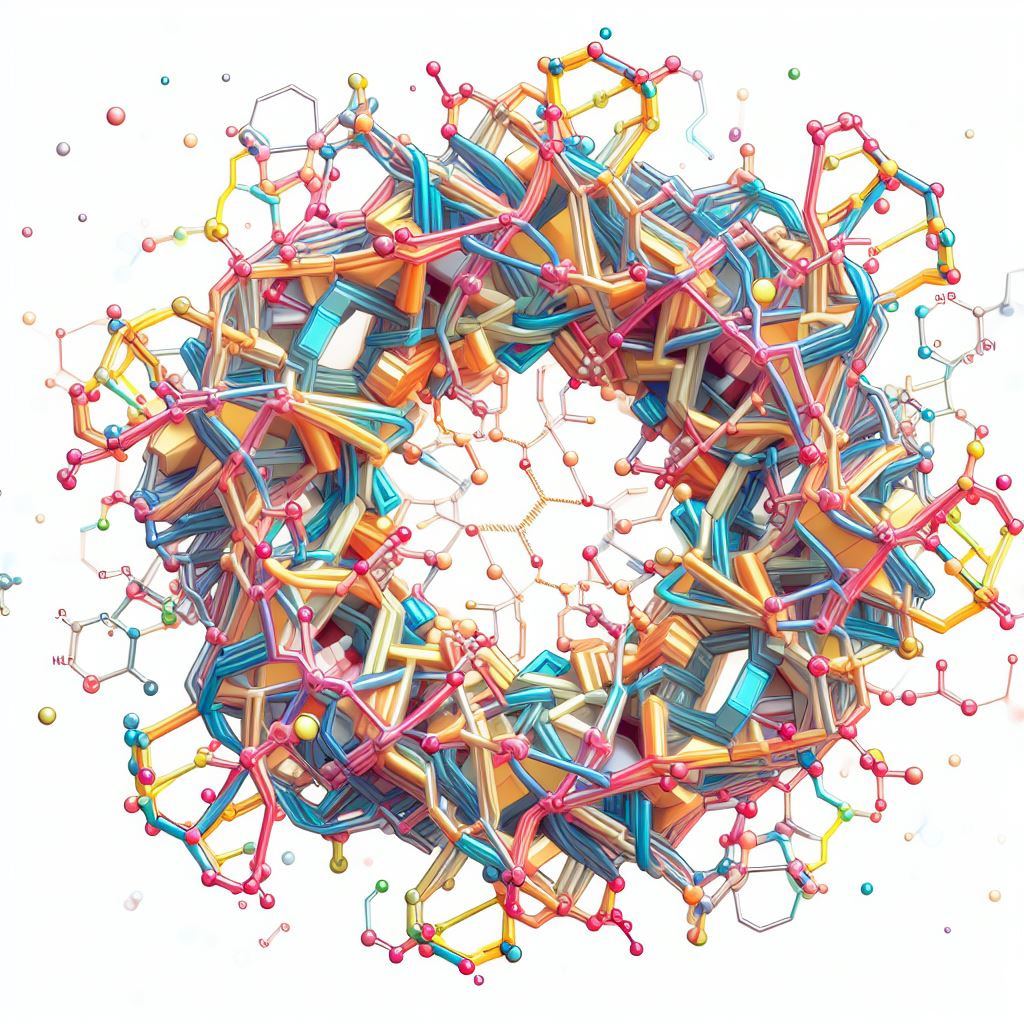
- γ-シクロデキストリン(γCD)は、ブドウ糖が輪になった“バケツ型”分子(空洞=疎水性キャビティ)です。
- 水に溶けやすい一方で、空洞に香り分子・色素・薬・有機分子などを“入れて保持”でき、包接(ホスト–ゲスト相互作用)として利用されます。
- その性質は、自己集合(集まって形を作る)、多孔体材料(スポンジのような孔)、環境・医薬・材料など広い分野に波及します。
このページの読みどころ(3つ)
- 水の中で“集まり方”を左右する見えない力(カオトロープ効果)
- γCDから作る多孔体(CD-MOF)で分離・精製
- シクロデキストリン応用の全体像(環境・材料・実用)
論文ハイライト(一般向け解説)
1) The Chaotropic Effect as an Assembly Motif in Chemistry
- 雑誌・年:ANGEWANDTE CHEMIE-INTERNATIONAL EDITION(2018) / 被引用数(WoS):308
- 著者:Assaf, KI, Nau, WM
- DOI:10.1002/anie.201804597
なにが新しい?(一言)
水中での分子集合を左右する「カオトロープ効果」を、“自己集合を設計するための考え方(モチーフ)”として整理したレビューです。
やさしい説明
水の中では、分子は単に“くっつく/くっつかない”だけでなく、周囲の水の並び方やイオンの性質に強く影響されます。
本論文は、大きな陰イオン(カオトロープ)が関与すると、疎水性相互作用や分子認識が“意外な方向”に進むことがある点をまとめています。
γCDのような水中ホスト分子でも、ゲスト分子・添加塩・溶媒条件で結合や集合が変わるため、材料設計の“地図”として役立ちます。
HPでの使いどころ
– 「水の中で分子が集まる理由」を説明する“背景理論”として引用しやすい
– ホスト–ゲスト材料(CD、CDP、フォトクロミック分子)設計の考え方に接続できる
2) CD-MOF: A Versatile Separation Medium
- 雑誌・年:JOURNAL OF THE AMERICAN CHEMICAL SOCIETY(2016) / 被引用数(WoS):301
- 著者:Hartlieb, KJ, Holcroft, JM, Moghadam, PZ, Vermeulen, NA, Algaradah, MM, Nassar, MS, et al.
- DOI:10.1021/jacs.5b12860
なにが新しい?(一言)
γCDを“部品”として組み上げた多孔性結晶(CD-MOF)を、分離・精製に使える材料として示した研究です。
やさしい説明
MOF(Metal–Organic Framework)は、金属イオンと有機分子を“骨組み”として作る、孔だらけの結晶です。
この論文で紹介されるCD-MOFは、食用にも使われることのあるγCDを用いて孔を作れる点が特徴です。
孔のサイズ・内部環境を利用して、混ざった成分を選択的に通す/捕まえることで、分離媒体(例:クロマト、吸着、精製)として働きます。
HPでの使いどころ
– 「γCDが“分離材料”にもなる」ことを示す代表例
– “天然由来分子 × 多孔体”という、環境調和型材料のストーリーに合う
3) Cyclodextrins, from molecules to applications
- 雑誌・年:ENVIRONMENTAL CHEMISTRY LETTERS(2018) / 被引用数(WoS):263
- 著者:Crini, G, Fourmentin, S, Fenyvesi, É, Torri, G, Fourmentin, M, Morin-Crini, N
- DOI:10.1007/s10311-018-0763-2
なにが新しい?(一言)
シクロデキストリン(α/β/γ)の応用全体像を、分野横断でまとめた“俯瞰レビュー”です。
やさしい説明
シクロデキストリンは「入れて運ぶ」「においを閉じ込める」「溶けにくい物質を水系で扱う」など、応用が非常に広い材料です。
本レビューは、材料・環境・産業利用まで含めて、どんな場面でCDが効くのかを整理しています。
HP記事としては、γCD研究を説明する際に、まず“CD全体の地図”を示してから、γCDやCDPなどの特色に話をつなげやすい利点があります。
HPでの使いどころ
– 初学者向けに「CDって何に使われているの?」を1本で説明できる
– 研究テーマ(環境調和型材料、機能層、包接・放出制御)への導入に便利
用語ミニ解説
- ホスト–ゲスト(包接):ホスト(例:γCD)が空洞にゲスト分子を取り込み、可逆的に結合する現象。
- カオトロープ効果(Chaotropic effect):特定のイオンが水の構造や溶媒和に影響し、分子集合・結合の起こり方を変える効果。
- MOF:金属イオンと有機分子からなる多孔性結晶。分離、触媒、貯蔵などに使われる。
- CD-MOF:シクロデキストリンを構成要素として作るMOF。
参考文献(添付ファイル内:3報)
- Assaf, KI, Nau, WM (2018). The Chaotropic Effect as an Assembly Motif in Chemistry. ANGEWANDTE CHEMIE-INTERNATIONAL EDITION. https://doi.org/10.1002/anie.201804597
- Hartlieb, KJ, Holcroft, JM, Moghadam, PZ, Vermeulen, NA, Algaradah, MM, Nassar, MS, et al. (2016). CD-MOF: A Versatile Separation Medium. JOURNAL OF THE AMERICAN CHEMICAL SOCIETY. https://doi.org/10.1021/jacs.5b12860
- Crini, G, Fourmentin, S, Fenyvesi, É, Torri, G, Fourmentin, M, Morin-Crini, N (2018). Cyclodextrins, from molecules to applications. ENVIRONMENTAL CHEMISTRY LETTERS. https://doi.org/10.1007/s10311-018-0763-2
English Version: Three Classic Papers Related to γ-Cyclodextrin (γCD)
Source: only the three papers included in the attached Web of Science export file (Last updated: 2026-01-10)
What is γCD (very briefly)?
- γ-Cyclodextrin (γCD) is a bucket-like, donut-shaped molecule made of glucose units, with a hydrophobic cavity.
- It is water-compatible, yet can “host” many organic molecules inside the cavity (host–guest inclusion).
- This enables molecular recognition, self-assembly, porous materials, and broad applications from separation to environmental technologies.
Why these three papers?
They provide a compact “foundation set”:
1. A guiding principle for assembly in water (chaotropic effect)
2. A γCD-based porous framework (CD-MOF) for separations
3. A panoramic review of cyclodextrin applications
Paper-by-paper highlights (plain language)
1) The Chaotropic Effect as an Assembly Motif in Chemistry
- Journal / Year: ANGEWANDTE CHEMIE-INTERNATIONAL EDITION (2018) | Times Cited (WoS): 308
- Authors: Assaf, KI, Nau, WM
- DOI: 10.1002/anie.201804597
Key idea
A review that frames the chaotropic effect as a practical motif to understand and design self-assembly in water.
In simple terms
In water, molecules interact not only with each other but also with the surrounding water structure and ions.
Certain large anions (chaotropes) can shift the balance of solvation and noncovalent interactions, sometimes leading to unexpected binding/assembly behavior.
This perspective is useful when thinking about cyclodextrin-based host–guest systems, where salts and solution conditions can strongly modulate inclusion and aggregation.
2) CD-MOF: A Versatile Separation Medium
- Journal / Year: JOURNAL OF THE AMERICAN CHEMICAL SOCIETY (2016) | Times Cited (WoS): 301
- Authors: Hartlieb, KJ, Holcroft, JM, Moghadam, PZ, Vermeulen, NA, Algaradah, MM, Nassar, MS, et al.
- DOI: 10.1021/jacs.5b12860
Key idea
A γCD-based metal–organic framework (CD-MOF) is presented as a versatile medium for separation and purification.
In simple terms
MOFs are crystalline materials full of pores, built from metal ions and organic linkers.
In CD-MOFs, γCD acts as a building block to create a pore network.
Because the pores have specific sizes and chemical environments, they can selectively capture or pass molecules—making them useful in separation workflows.
3) Cyclodextrins, from molecules to applications
- Journal / Year: ENVIRONMENTAL CHEMISTRY LETTERS (2018) | Times Cited (WoS): 263
- Authors: Crini, G, Fourmentin, S, Fenyvesi, É, Torri, G, Fourmentin, M, Morin-Crini, N
- DOI: 10.1007/s10311-018-0763-2
Key idea
A cross-disciplinary review mapping cyclodextrins (α/β/γ) from fundamental chemistry to real-world applications.
In simple terms
Cyclodextrins can encapsulate molecules, suppress odors, improve solubility, and tune interfacial behavior—so their use spans many fields.
For a lab website, this paper is handy as an “entry map”: you can introduce CD applications broadly, then zoom into γCD and functional derivatives (e.g., CD polymers) as your research focus.
Mini glossary
- Host–guest inclusion: reversible binding where a host (e.g., γCD) captures a guest molecule in its cavity.
- Chaotropic effect: ion-specific effects that alter solvation and can reshape binding/assembly in water.
- MOF / CD-MOF: porous crystalline frameworks; CD-MOF uses cyclodextrin building blocks.
References (3 papers from the attached file)
- Assaf, KI, Nau, WM (2018). The Chaotropic Effect as an Assembly Motif in Chemistry. ANGEWANDTE CHEMIE-INTERNATIONAL EDITION. https://doi.org/10.1002/anie.201804597
- Hartlieb, KJ, Holcroft, JM, Moghadam, PZ, Vermeulen, NA, Algaradah, MM, Nassar, MS, et al. (2016). CD-MOF: A Versatile Separation Medium. JOURNAL OF THE AMERICAN CHEMICAL SOCIETY. https://doi.org/10.1021/jacs.5b12860
- Crini, G, Fourmentin, S, Fenyvesi, É, Torri, G, Fourmentin, M, Morin-Crini, N (2018). Cyclodextrins, from molecules to applications. ENVIRONMENTAL CHEMISTRY LETTERS. https://doi.org/10.1007/s10311-018-0763-2