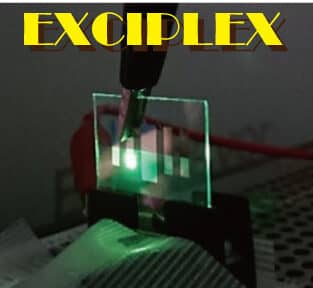
エキシプレックス型有機EL入門(クラシック論文編)
Exciplex-Based OLEDs – Classic Study
日本語版
1. 有機ELと「エキシプレックス」とは?
スマホや有機ELテレビの画面では、薄い有機分子の膜に電気を流して光を出しています。
その中でも「エキシプレックス(exciplex)」は、2種類の分子が“ペア”になって光る特別な状態です。
- A分子(電子を出しやすい)と B分子(電子を受け取りやすい)がペアになる
- 電気が流れて“励起状態”になったときだけ、一時的な「励起錯体=エキシプレックス」ができる
- このエキシプレックスが元の状態に戻るときに光を出す(発光)
エキシプレックスは、分子間電荷移動(チャージトランスファー)の性質を持ち、発光色の設計や、エネルギー移動の制御にとても便利です。
2. TADF材料とエキシプレックス:クラシックレビューが示したこと
クラシックな代表論文として、Wong & Zysman-Colman による TADF 材料の総説があります
(“Purely Organic Thermally Activated Delayed Fluorescence Materials for Organic Light-Emitting Diodes”, Advanced Materials)。
このレビューでは、
- TADF(Thermally Activated Delayed Fluorescence, 熱活性化遅延蛍光)材料を体系的に整理
- 小分子・デンドリマー・ポリマー・エキシプレックス型TADF発光体 まで幅広く解説
- 分子構造と発光特性・デバイス性能(効率・ロールオフなど)の関係を詳しく比較
といった点がまとめられています。
TADFの重要なポイントは、
- 一般の蛍光材料では捨ててしまう「三重項励起子」を
- 熱エネルギーを使って再び一重項励起子に戻し、ほぼ100%近くまで内部量子効率を高められること
です。金属錯体(Ir, Ptなど)を使わず、純有機材料だけで高効率を目指せる点が、照明・ディスプレイの低コスト化につながると期待されています。
この中でエキシプレックスは、
- ドナー/アクセプター分子の組み合わせを変えることで、
- 発光色
- エネルギーギャップ(ΔE_ST)
- キャリア輸送特性
を分子設計で細かく調整しやすい - 発光層そのもの、あるいはホスト材料として使える
といったTADF実装の“柔らかい設計ツール”として紹介されています。
3. 一般の方へのポイント整理(日本語)
- 有機ELの中には、2種類の分子がペアになって光る「エキシプレックス」という仕組みがあります。
- TADFというしくみを使うと、電気エネルギーをほとんどムダなく光に変えられます。
- エキシプレックス型TADF材料は、資源制約の少ない“純有機材料”だけで高効率な有機ELを実現するためのカギのひとつです。
English Version
1. What is an “Exciplex” in OLEDs?
In organic light-emitting diodes (OLEDs), thin organic layers emit light when an electric current flows.
An exciplex is a special excited-state complex formed between two different molecules:
- A donor molecule (electron-rich) and an acceptor molecule (electron-poor) form a loose pair
- Only in the excited state do they form an “excited complex” – the exciplex
- When the exciplex relaxes back to the ground state, it emits light
Because exciplex emission has a strong charge-transfer character, it is very useful for tuning the emission color and controlling energy transfer inside the OLED.
2. Classic Review: TADF Materials Including Exciplex Emitters
A classic review by Wong and Zysman-Colman (“Purely Organic Thermally Activated Delayed Fluorescence Materials for Organic Light-Emitting Diodes”, Advanced Materials) provides a comprehensive overview of TADF materials, including exciplex-type TADF emitters.
Key messages from this review include:
- Systematic comparison of TADF emitters:
- Small molecules, dendrimers, polymers, and exciplex emitters
- Clear links between molecular structure, photophysics, and device performance
- Demonstration that purely organic TADF materials can rival phosphorescent metal complexes
In TADF systems, triplet excitons—normally a “loss channel” in fluorescent OLEDs—are up-converted thermally to singlet states and used for emission, enabling near-unity internal quantum efficiency without heavy metals.
Exciplex-based TADF emitters and hosts are highlighted as versatile design tools to realize efficient and low-cost OLEDs.
3. Take-Home Messages (English)
- Exciplexes are excited-state complexes formed between two different molecules in OLEDs.
- TADF allows efficient utilization of both singlet and triplet excitons, pushing OLED efficiency close to 100% internally.
- Exciplex-type TADF materials are promising for high-efficiency, metal-free OLED lighting and display technologies.
References / 文献
- Wong, M. Y.; Zysman-Colman, E.
Purely Organic Thermally Activated Delayed Fluorescence Materials for Organic Light-Emitting Diodes.
Advanced Materials. (Review article on TADF emitters including exciplex systems.)