作成日: 2026-02-21
日本語版(HP向け)
どんなテーマ?
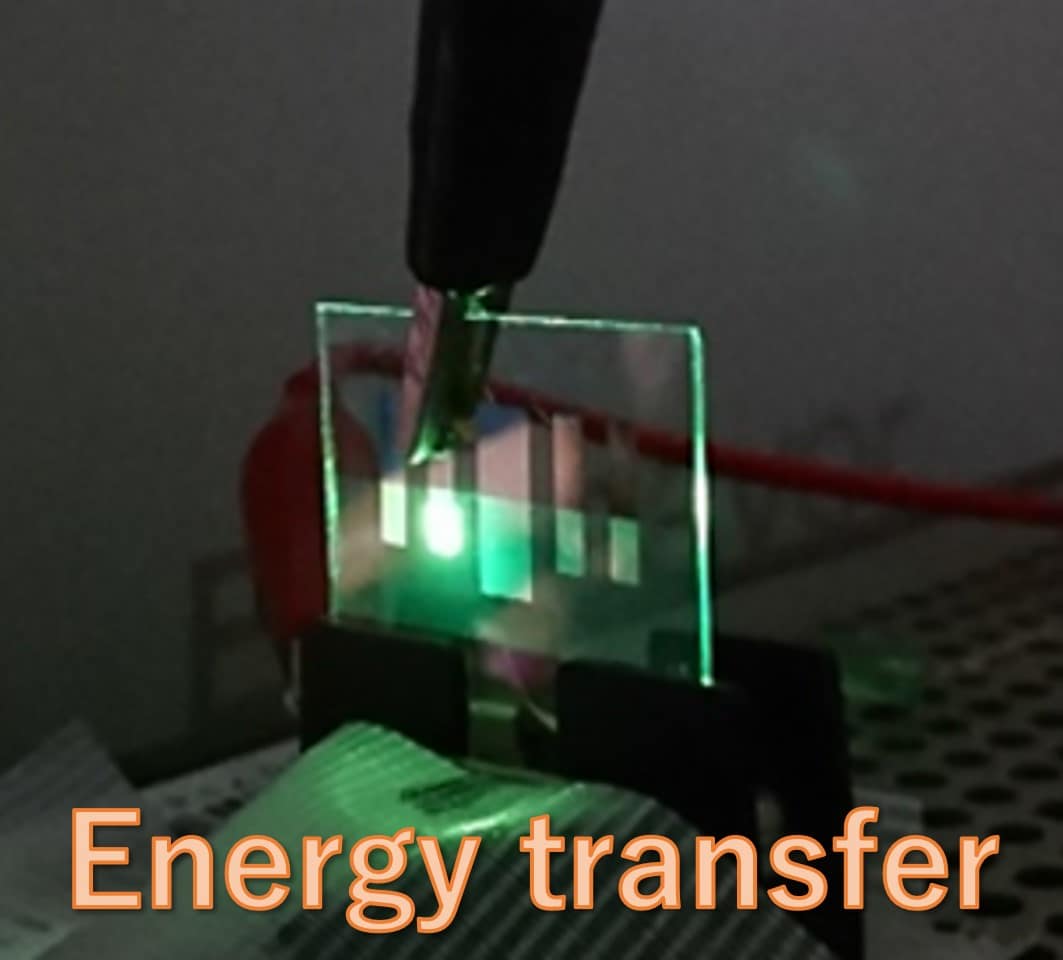
OLEDの高性能化では、発光体の分子設計だけでなく、エネルギー移動(FRET/Dexter)や、界面で生じるエキシプレックス、三重項励起子の管理(TTF/TTAなど)が鍵になります。
本ファイルでは、近赤外・青・緑の領域で、エネルギー移動を“デバイス設計に組み込む”研究が収録されています。
Synergistic indolocarbazole stitching and peripheral acceptor engineering enable narrowband green MR-TADF emitters for high-efficiency and long-lifetime OLEDs
- 掲載誌:Chemical Engineering Journal(JIF 2024: 13.2)
- 年:2026(FEB 15)
- 著者:Dang, HT, Truong, TT, Abitkar, N, Rajput, A, et al.
- DOI:10.1016/j.cej.2026.173453
やさしい解説(Abstractの要点を整理:本文の転載なし)
– 狭帯域グリーンOLEDでは、高効率と長寿命の両立が難しく、励起子起因の劣化を抑える分子設計が重要です。
– 本研究は、インドロカルバゾールを“縫い込む”ように埋め込んだB–N系MR‑TADF(ICz‑BN)発光体群を設計し、外周アクセプターも最適化して分子の頑健性を高めています。
– 発光は緑(約522–540 nm)で、バンド幅が狭い(FWHM 21–24 nm)うえ、PL量子収率が90%超と報告されています。
– エキシプレックス共ホストを用いたPSF OLEDで、キノリン誘導体(tBuICzBN‑Q)がFRETを効率化し、最大EQE 28.9%、540 nm(FWHM 30 nm)を達成。
– 高輝度5000 cd m⁻²でもEQE 26.2%とロールオフが小さく、さらにLT97=2591 h(@1000 cd m⁻²)と高い安定性を示します(別誘導体はさらに長寿命)。
– 結合解離エネルギー解析で“カチオン状態で壊れにくい骨格”が寿命と相関することを示し、分子設計×デバイス設計の指針を提示しています。
Triplet Tank Layer Activates Triplet-Triplet Fusion to Fluorescence in Blue-Emissive Organic Light-Emitting Diode
- 掲載誌:Advanced Optical Materials(JIF 2024: 7.2)
- 年:2026(2026 FEB 11)
- 著者:Lin, YL, Chen, CH, Chiu, TL, Lee, JH, et al.
- DOI:10.1002/adom.202501816
やさしい解説(Abstractの要点を整理:本文の転載なし)
– 青色OLEDでトリプレット–トリプレット融合(TTF)を使うと、三重項励起子を一重項へ変換して追加の光を取り出せますが、トリプレット損失(TPQなど)の抑制が課題です。
– 本研究は、TTF発光層の隣にトリプレットタンク層(TTL)を入れ、キャリア再結合をTTL側へ寄せてトリプレットを生成・供給する構造(Hyper TTF OLED)を検討しています。
– TTLはトリプレット–ポーラロン消光(TPQ)を抑え、Dexterエネルギー移動でトリプレットをTTF層へ注入→TTFで一重項生成を促進する、と説明されています。
– 磁気電界発光(MEL)と時間分解ELで、TTFが支配的になる指紋的応答(遅延蛍光など)を確認し、TTLの役割を検証。
– TTL厚みやトリプレットブロック層の有無でTTF強度と性能が変わり、最適化で最大EQE 13.24%を達成。
– “層設計でトリプレットを制御して蛍光へ変換する”という、青色高性能化の実装指針を示します。
Development of high-efficiency near-infrared organic light-emitting diodes using TPA-DCPP via interface exciplex formation
- 掲載誌:Journal Of Materials Chemistry C(JIF 2024: 5.2)
- 年:2026(2026 FEB 6)
- 著者:Chuang, CY, Paul, B, Ke, JY, Ji, SH, et al.
- DOI:10.1039/d5tc04226g
やさしい解説(Abstractの要点を整理:本文の転載なし)
– 近赤外OLED(NIR OLED)は医療イメージングや光通信などで有望ですが、NIR発光体はバンドギャップが狭く、凝集消光(ACQ)で効率が落ちやすいことが課題です。
– 本研究は、CBPとPO‑T2Tの界面にできるインターフェース・エキシプレックスを“エネルギー供給源”にし、NIR発光体TPA‑DCPPを増感するデバイス設計を提案します。
– エキシプレックス発光とTPA‑DCPP吸収の重なりが大きく、FRET(フォルスターエネルギー移動)で効率よくエネルギーが移る点がポイントです。
– 重金属錯体や複雑なTADF分子設計を避けつつ、ACQによる損失を緩和できる“シンプルな”構造として提示されています。
– 輸送層厚みやドーピング濃度を最適化し、最大EQE 15.2%、700 nmで最大輝度 2152 cd m⁻²を達成。
– 界面エキシプレックスを使ったエネルギー移動が、再現性の高いNIR OLED高性能化の道筋になることを示しています。
English version (for website)
What is this topic about?
High‑performance OLEDs often rely on device‑level control of energy transfer (FRET/Dexter), interfacial exciplexes, and triplet management (TTF/TTA).
The selected papers demonstrate how these mechanisms can be engineered for near‑infrared, blue, and narrowband green OLEDs.
Top 3 papers (sorted by 2024 JIF)
Synergistic indolocarbazole stitching and peripheral acceptor engineering enable narrowband green MR-TADF emitters for high-efficiency and long-lifetime OLEDs
- Journal: Chemical Engineering Journal (JIF 2024: 13.2)
- Year: 2026 (FEB 15)
- Authors: Dang, HT, Truong, TT, Abitkar, N, Rajput, A, et al.
- DOI: 10.1016/j.cej.2026.173453
Plain-language bullets (paraphrased; no verbatim abstract text)
– Narrowband green OLED emitters still face a major challenge: combining very high efficiency with long operational lifetime.
– This work designs indolocarbazole‑stitched B–N multi‑resonance TADF emitters (ICz‑BN series) and uses peripheral acceptor engineering to improve intrinsic robustness.
– The emitters show intense green emission (~522–540 nm) with narrow bandwidth (FWHM 21–24 nm) and >90% PL quantum yield.
– In phosphor‑sensitized fluorescence (PSF) OLEDs using an exciplex co‑host, the quinoline derivative (tBuICzBN‑Q) enables efficient FRET and delivers EQE_max 28.9% with 540‑nm narrowband emission (FWHM 30 nm).
– Efficiency roll‑off is strongly suppressed (26.2% at 5000 cd m⁻²) and stability is outstanding (LT97 = 2591 h at 1000 cd m⁻²; another analogue reaches even longer lifetime).
– Bond‑dissociation‑energy analysis links cationic framework stability to device lifetime, providing a combined molecular + device design principle for stable MR‑TADF OLEDs.
Triplet Tank Layer Activates Triplet-Triplet Fusion to Fluorescence in Blue-Emissive Organic Light-Emitting Diode
- Journal: Advanced Optical Materials (JIF 2024: 7.2)
- Year: 2026 (2026 FEB 11)
- Authors: Lin, YL, Chen, CH, Chiu, TL, Lee, JH, et al.
- DOI: 10.1002/adom.202501816
Plain-language bullets (paraphrased; no verbatim abstract text)
– Triplet–triplet fusion (TTF) can upconvert triplets into emissive singlets in blue OLEDs, but suppressing triplet loss processes (e.g., TPQ) is crucial.
– This study introduces a triplet tank layer (TTL) adjacent to the TTF emitting layer to confine recombination, generate triplets, and feed them into the TTF layer (Hyper‑TTF OLED concept).
– The TTL suppresses triplet‑polaron quenching and injects triplets into the TTF layer via Dexter transfer, enhancing singlet formation through TTF and producing delayed fluorescence signatures.
– Magneto‑electroluminescence (MEL) and time‑resolved electroluminescence are used to verify TTF‑dominated behavior and the role of TTL.
– Device performance depends on TTL thickness and additional triplet‑blocking layers; optimization achieves EQE_max 13.24%.
– The work provides a device‑architecture guideline for controlling triplets and activating TTF to boost blue OLED performance.
Development of high-efficiency near-infrared organic light-emitting diodes using TPA-DCPP via interface exciplex formation
- Journal: Journal Of Materials Chemistry C (JIF 2024: 5.2)
- Year: 2026 (2026 FEB 6)
- Authors: Chuang, CY, Paul, B, Ke, JY, Ji, SH, et al.
- DOI: 10.1039/d5tc04226g
Plain-language bullets (paraphrased; no verbatim abstract text)
– Near‑infrared OLEDs (NIR OLEDs) are promising for biomedical imaging and optical communications, yet efficiencies are limited by narrow‑gap emitters and aggregation‑caused quenching (ACQ).
– This work uses an interfacial exciplex formed between CBP and PO‑T2T as an energy‑transfer medium to sensitize the NIR emitter TPA‑DCPP.
– Strong spectral overlap enables efficient Förster resonance energy transfer (FRET) from the exciplex emission to the TPA‑DCPP absorption band.
– The strategy avoids heavy‑metal complexes and complex TADF‑molecule design, offering a simpler, heavy‑metal‑free device concept while mitigating ACQ losses.
– By optimizing transport‑layer thickness and guest doping concentration, the OLED reaches EQE_max 15.2% and 2152 cd m⁻² peak luminance at 700 nm.
– The study highlights interfacial‑exciplex‑mediated energy transfer as a straightforward, reproducible route to high‑performance NIR OLEDs.
参考文献 / References
- Dang, HT, Truong, TT, Abitkar, N, Rajput, A, et al. (2026). Synergistic indolocarbazole stitching and peripheral acceptor engineering enable narrowband green MR-TADF emitters for high-efficiency and long-lifetime OLEDs. Chemical Engineering Journal. doi:10.1016/j.cej.2026.173453
- Lin, YL, Chen, CH, Chiu, TL, Lee, JH, et al. (2026). Triplet Tank Layer Activates Triplet-Triplet Fusion to Fluorescence in Blue-Emissive Organic Light-Emitting Diode. Advanced Optical Materials. doi:10.1002/adom.202501816
- Chuang, CY, Paul, B, Ke, JY, Ji, SH, et al. (2026). Development of high-efficiency near-infrared organic light-emitting diodes using TPA-DCPP via interface exciplex formation. Journal Of Materials Chemistry C. doi:10.1039/d5tc04226g