はじめに
私たちの身の回りには、スマートフォンの画面やディスプレイ、LED照明など
「光るデバイス」がたくさん使われています。これらに使われる材料は、
- どれだけ明るく光るか(効率)
- どれだけ長く壊れずに使えるか(安定性・耐久性)
- どれだけ環境にやさしいか
が重要なポイントです。
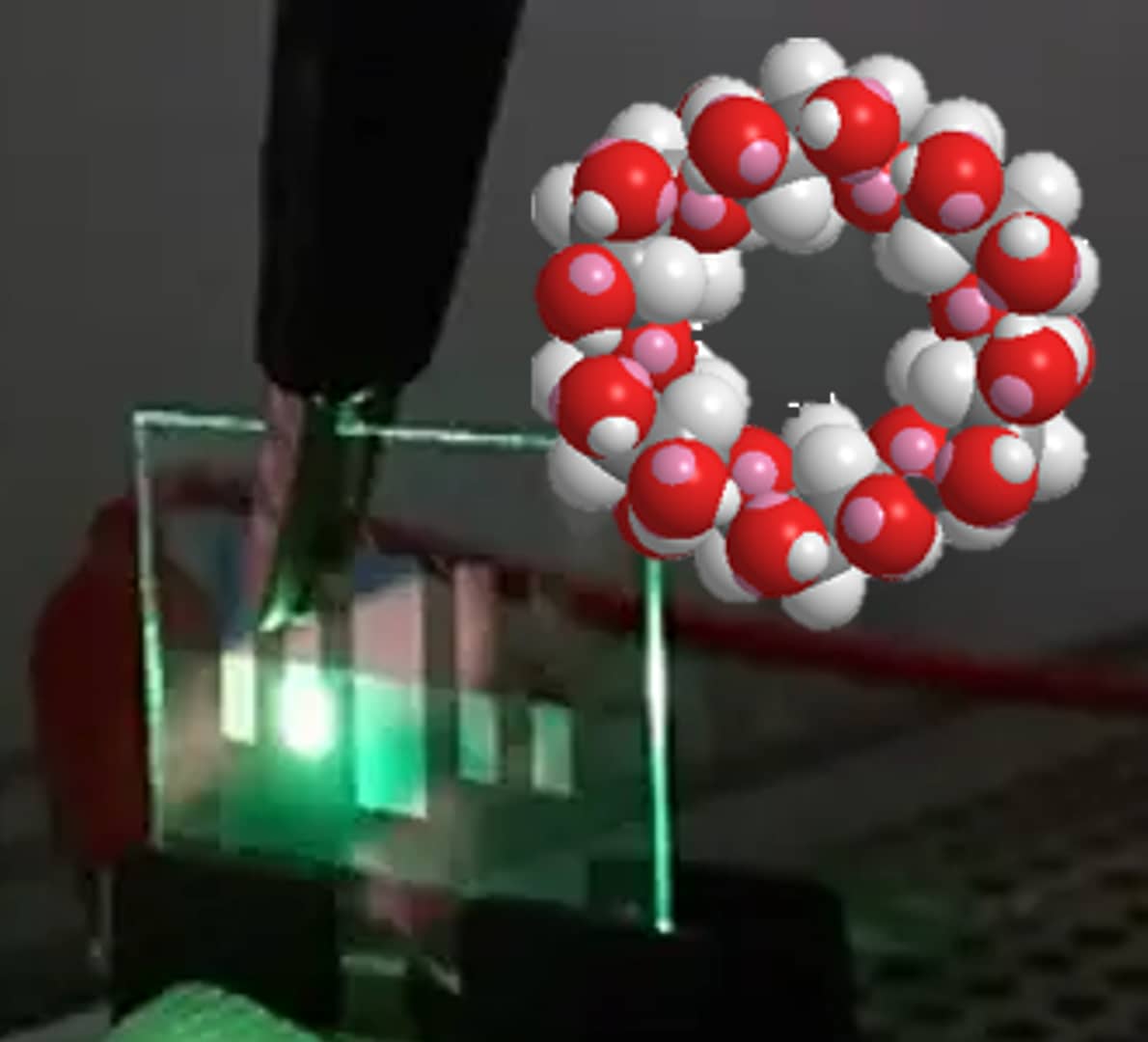
ここでは、食品にも使われる糖からできた分子 シクロデキストリン(Cyclodextrin, CD) を
有機光デバイスの材料設計に活かした 3 本の研究を紹介します。
- 有機非線形光学膜で、高耐熱・高効率の発光を実現した研究
- 室内光を電気に変える有機太陽電池で、CD高分子を使って電極を改良した研究
- ペロブスカイト発光・太陽電池材料を、CDを含む高分子と複合化して安定化するレビュー
いずれも「光」「電気」「環境調和」をつなぐ、次世代有機デバイスのヒントになる成果です。
1. DAST@シクロデキストリン膜で高耐熱・高効率に光らせる
(Tian et al., Nat. Commun. 2023)
どんな研究?
有機材料でつくる「光る膜」は、有機ELやバイオイメージングへの応用が期待されていますが、
- 発光効率があまり高くない
- 熱や溶媒に弱く、性能がすぐ落ちてしまう
といった課題があります。
Tian らは、DAST という有機色素を
シクロデキストリンの「かご」構造の中に入れたホスト–ゲスト複合体として扱い、
それを大面積の有機膜として作製しました。
主な成果
- シクロデキストリンで DAST 分子を包むことで、分子同士がくっつきすぎて光らなくなる
「アグリゲーション消光」を抑制。 - 得られた膜は、発光量子収率 73.5% と非常に高い発光効率を示しました。
- なんと 300 ℃ に加熱してもオレンジ色の発光を保つ 高い耐熱性を持っています。
- 極性溶媒中でも非線形光学特性が保たれ、熱や環境に強い有機光学材料と言えます。
- さらに、1000 nm の近赤外光で励起して大腸菌(E. coli)の in vivo イメージングにも成功し、
バイオプローブとしての応用も示されました。
有機ELとの関わり
有機EL素子では、「発光層にどんな分子を、どのような形で配置するか」が性能を左右します。
この研究は、
- シクロデキストリンで有機色素を「やさしく固定」することで
明るく・壊れにくい発光膜が実現できる
ことを示しており、高温やハードな条件で使える有機ELパネル設計へのヒントになります。
2. CD高分子でITO電極の仕事関数を調整し、室内光太陽電池を高効率化
(Kim et al., J. Mater. Res. Technol. 2022)
どんな研究?
IoT センサーなどの小型機器を、室内のLED照明だけで動かす
「室内光用有機太陽電池(Indoor OPV)」 が注目されています。
ところが、室内光は太陽光に比べてとても弱いため、
- 電極と有機層のエネルギー準位が少し合わないだけでも
- 電荷の取り出し効率が大きく下がってしまう
という問題があります。
Kim らは、透明電極として使われる ITO の表面を
β-シクロデキストリンと polyacryloyl hydrazide からなる高分子(CD-PAH) でコーティングし、
ITO の仕事関数を 4.5 eV → 4.1 eV に下げる ことで、電荷取り出しを最適化しました。
主な成果
- CD-PAH は水溶性の高分子で、ITO の上に薄い層として形成可能。
- 高分子中のアミン基により真空準位がシフトし、ITO の仕事関数が 4.1 eV に低下。
→ 有機活性層とのエネルギー整合が改善され、電子が流れやすくなります。 - この処理により、逆構造 OPV の平均 PCE は
- 1 sun 下:1.2 ± 0.1% → 3.5 ± 0.1%
- LED 室内光下:2.4 ± 0.2% → 8.1 ± 0.4%
と大幅に向上しました。 - 表面は平滑で透過率も高く、光取り込みを妨げません。
有機ELとの関わり
有機ELでも、ITO はしばしば電極として使われます。
CD-PAH のような高分子で ITO の仕事関数を調整できれば、
- 電子注入(またはホール注入)を最適化して駆動電圧を下げる
- 発光層との界面を改善して効率を上げる
といった効果が期待されます。
つまり、この研究は 「CDを含む高分子で電極をチューニングする」 という発想が、
室内光太陽電池だけでなく、有機ELや他の有機デバイスにも有効であることを示しています。
3. ペロブスカイト×高分子・バイオポリマー複合材料のレビュー
(Farfan et al., Opto-Electron. Rev. 2023)
どんな研究?
金属ハロゲン化物ペロブスカイトは、
- 高い発光効率
- 鮮やかな色
- 低コストな溶液プロセス
などの利点から、太陽電池だけでなく LEDやレーザー への応用でも注目されています。
一方で、ペロブスカイトは 水・酸素・光・熱に弱く、壊れやすい という欠点があります。
Farfan らのレビュー論文は、これまでの研究を整理しながら、
- 鉛系・鉛フリー(Sn, Ge)ペロブスカイト
- CsBr, CsCl, CsI などの無機ペロブスカイト
- FA, MA など有機カチオンを含むハイブリッド型
- さらに ポリマー(PMMA, PVDF)やバイオポリマー(デンプン、シクロデキストリン、ポリ乳酸、ポリリシンなど)との複合材料
といった幅広い材料設計を紹介し、
より安定でスケーラブルなペロブスカイトデバイスを目指す流れを解説しています。
主なポイント
- ペロブスカイトは、効率は高いが環境安定性に課題があり、
長寿命化と工業スケールでの製造が大きなテーマとなっています。 - 高分子・バイオポリマーとの複合化によって、
- 結晶の成長や粒径を制御
- 表面を被覆・パッシベーションして水分や酸素から保護
- フレキシブルなフィルム化
などの効果が得られます。 - 特に、デンプンやシクロデキストリンなどのバイオポリマーは、
環境負荷の少ない素材として注目されています。
有機ELとの関わり
ペロブスカイトLED(PeLED)は、有機ELとは別系統の材料ですが、
- 高効率・高色純度の発光
- フレキシブルデバイス化
- 長寿命化・環境調和
という「目指す姿」は共通しています。
CD を含むバイオポリマーでペロブスカイトを包み込んで安定化するという考え方は、
有機EL材料の安定化や光取り出しの改善にも応用でき、
「グリーンな発光デバイス」を設計するうえで共通のキーワードになっています。
まとめ(日本語)
この 3 本の研究・レビューから見えてくるのは、
- シクロデキストリンなどの 糖由来分子は、
- 発光分子を「包んで守る」
- 電極の表面を「やさしくチューニングする」
- ペロブスカイトなどの無機材料を「安定化する」
- その結果、明るく・長持ちで・環境にも配慮した光デバイスに近づける
という姿です。
有機ELを含む有機光デバイスの研究において、
「CD × 有機材料・ペロブスカイト・電極」の組み合わせは、
今後ますます重要になると考えられます。
Cyclodextrins for Organic Light-Emitting and Photonic Devices (English)
Introduction
Modern society heavily relies on light-emitting devices such as smartphone displays, TVs,
indoor LED lighting, and various optical sensors. For these technologies, it is crucial to develop materials that are:
- highly efficient light emitters,
- stable and durable, and
- environmentally friendly.
Cyclodextrins (CDs), which are cyclic oligosaccharides also used in food and pharmaceuticals,
offer a unique “host–guest” cavity structure that can interact with organic dyes, polymers, and even inorganic materials.
In this page, we highlight three representative works that illustrate how CDs contribute to:
- Durable, highly efficient organic luminescent membranes
- Work-function-tuned electrodes for indoor organic photovoltaics
- Polymer/biopolymer composites for stable perovskite-based devices
All of these concepts are closely related to the development of advanced OLED-type and organic photonic devices.
1. Thermotolerant organic luminescent membranes using DAST@CD
(Tian et al., Nat. Commun. 2023)
Overview
Organic luminescent membranes are attractive for OLEDs and bioimaging,
but they often suffer from:
- relatively low photoluminescence quantum yields, and
- poor stability against heat and polar environments.
Tian et al. demonstrate large-area, flexible organic nonlinear optical membranes
composed of the dye DAST hosted by cyclodextrins.
Key results
- DAST molecules are encapsulated inside CD cavities, suppressing aggregation-caused quenching.
- The resulting membranes exhibit a record-high PLQY of 73.5%.
- They can continuously emit orange light even when heated at 300 °C,
showing excellent thermal stability. - The nonlinear optical properties are preserved in polar media.
- Supramolecular assemblies with multiphoton absorption are used for in vivo real-time imaging of E. coli
under 1000 nm excitation, demonstrating their potential as human-friendly multiphoton probes.
Relevance to OLEDs
The work shows that CD-based host–guest design can simultaneously improve:
- brightness (PLQY), and
- robustness (thermal and environmental stability)
of organic luminescent materials.
Such strategies are directly relevant to stable, thermotolerant OLED emitting layers.
2. CD-PAH modified ITO for efficient indoor organic photovoltaics
(Kim et al., J. Mater. Res. Technol. 2022)
Overview
Indoor organic photovoltaics (OPVs) are promising power sources for emerging IoT devices.
Under weak indoor lighting, however, even small mismatches in energy levels at the electrodes
can significantly limit performance.
Kim et al. modify indium tin oxide (ITO) with a water-soluble β-cyclodextrin-polyacryloyl hydrazide (CD-PAH) layer
to optimize the electron-collecting properties of ITO.
Key results
- CD-PAH forms a thin interfacial layer on ITO.
Amine functional groups induce a vacuum-level shift, reducing the ITO work function from 4.5 eV to 4.1 eV. - This provides better energy-level alignment between ITO and the active layer.
- For inverted P3HT:ICBA-based OPVs, the average PCE improves from:
- 1.2 ± 0.1% to 3.5 ± 0.1% under 1-sun illumination, and
- 2.4 ± 0.2% to 8.1 ± 0.4% under LED illumination.
- The modified ITO maintains high transmittance and smooth surface morphology.
Relevance to OLEDs
Although the devices studied are OPVs, the underlying concept is highly relevant to OLEDs:
- Tuning the work function of ITO with a CD-containing polymer
can improve charge injection/collection and reduce driving voltages. - CD-PAH-type interlayers may thus be used as versatile interfacial layers for various organic optoelectronic devices,
including OLEDs.
3. Perovskite composites with polymers and biopolymers including CDs
(Farfan et al., Opto-Electron. Rev. 2023)
Overview
Metal halide perovskites have unique optical and electronic properties that make them attractive for:
- solar cells,
- lasers, and
- light-emitting diodes (LEDs).
However, they are sensitive to moisture, oxygen, heat, and light.
Long-term stability and scalable processing are major challenges.
Farfan et al. review the progress in:
- lead-based and lead-free (Sn, Ge) perovskites,
- purely inorganic perovskites (e.g., CsBr, CsCl, CsI),
- hybrid perovskites with organic cations (formamidinium, methylammonium), and
- composites with polymers and biopolymers, including starch, cyclodextrin, polylactic acid, and polylysines.
Key aspects
- The review emphasizes that efficiency must be balanced with stability and scalability for industrial applications.
- Polymer and biopolymer composites help to:
- passivate surfaces and defects,
- protect perovskites from harsh environments,
- form flexible, processable films.
- Cyclodextrin-containing biopolymers can act as protective shells or structure-directing agents
for perovskite nanocrystals, supporting green and stable perovskite-based devices.
Relevance to OLED research
While perovskites differ from conventional OLED emitters,
the device-level issues—stability, interfaces, scalability—are similar.
CD-based biopolymer composites provide inspiration for:
- stabilizing emitting and charge-transport layers,
- designing environmentally friendly, durable light-emitting devices.
Overall Take-home Message (English)
Across these three works, cyclodextrins and related biopolymers emerge as powerful tools to:
- stabilize organic and hybrid luminescent materials,
- tune interfaces and work functions of electrodes, and
- enable flexible, green composite architectures.
For OLEDs and related organic photonic devices,
CD-based strategies open new pathways toward bright, long-lived, and sustainable light sources.
References
- Tian, T.; Fang, Y. X.; Wang, W. H.; Yang, M. F.; Tan, Y.; Xu, C.; Zhang, S.; Chen, Y. X.; Xu, M. Y.; Cai, B.; Wu, W.-Q.,
“Durable organic nonlinear optical membranes for thermotolerant lightings and in vivo bioimaging”,
Nature Communications 14, 4429 (2023). DOI: 10.1038/s41467-023-40168-2. - Farfan, H. I.; Roa, K. L.; Castro, H. F.,
“Advances in hybridised and inorganic composite metal halide perovskites: A review”,
Opto-Electronics Review 31, e148221 (2023). DOI: 10.24425/opelre.2023.148221. - Kim, S. H.; Park, C. H.; Saeed, M. A.; Ko, D.-H.; Lee, J.-H.; Shim, J. W.,
“β-cyclodextrin-polyacryloyl hydrazide-based surface modification for efficient electron-collecting electrodes of indoor organic photovoltaics”,
Journal of Materials Research and Technology 16, 1659–1666 (2022). DOI: 10.1016/j.jmrt.2021.12.086.