このページのねらい
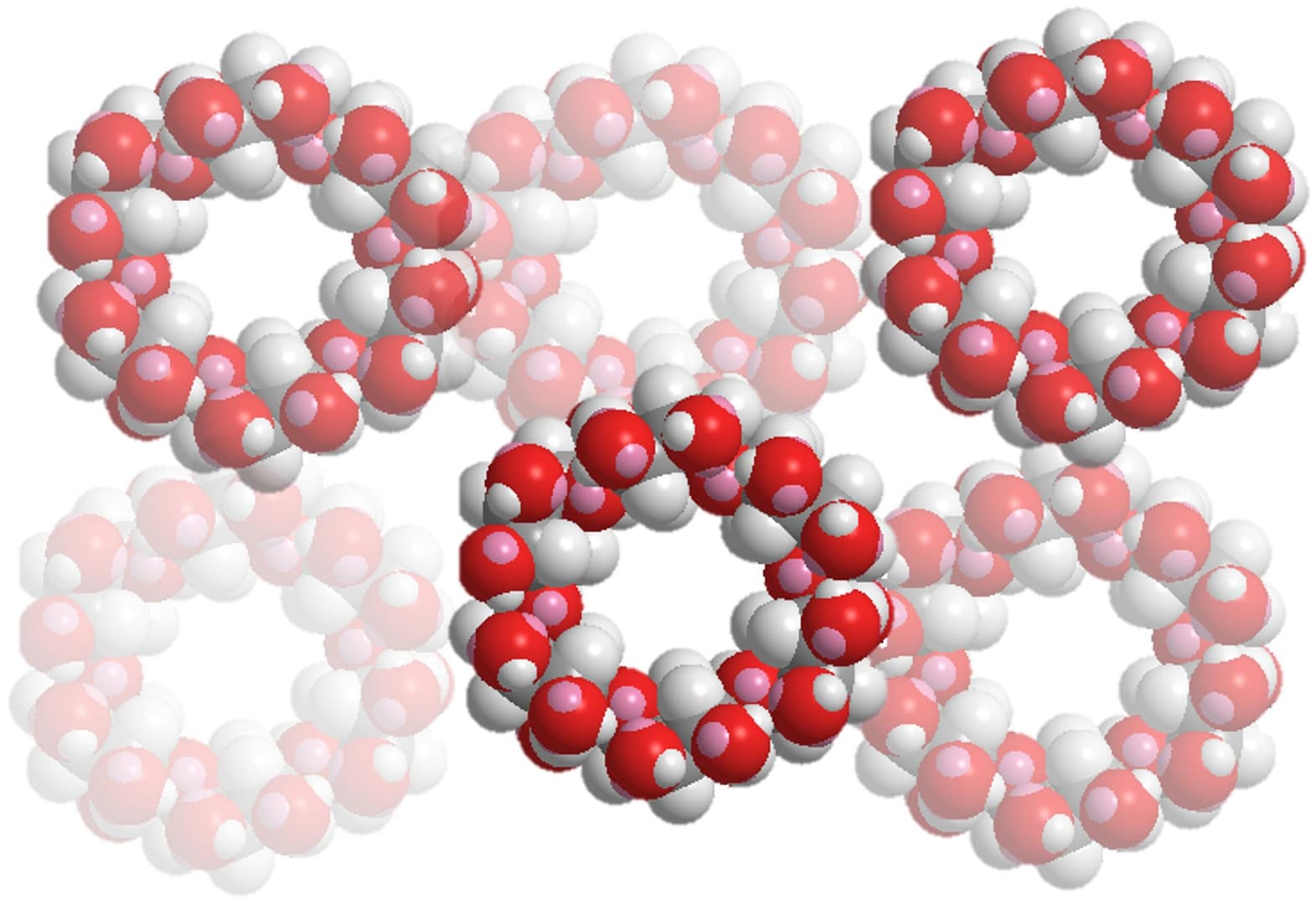
シクロデキストリン(Cyclodextrin; CD)は、分子を中に取り込める“分子の入れ物”として知られる環状オリゴ糖です。
ここでは、代表的な3本を手がかりに、CDの考え方と応用を一般向けに整理します。
1. CDって何?(ざっくり)
- CDは、グルコースが輪になった分子です。
- 外側は親水性、内側の空洞は疎水性に近く、そこへ他の分子(ゲスト)を入れられます。
- この「ホスト–ゲスト(包接)」が、CDの最大の特徴です。
イメージ:
“水に溶けるカップ(CD)に、溶けにくい分子(ゲスト)を入れて運ぶ”
2. CDが役立つ理由(応用の出発点)
CDが使われる理由は、主に次の3つです。
1) 溶けやすさ(溶解性)を変えられる
2) 分子同士の“くっつき(凝集)”を抑えられる/変えられる
3) 弱い結合(可逆結合)でネットワークを作れる(材料が“動く・戻る”)
3. ファイル内クラシック論文 3 本のポイント
論文A:CDの溶解性と包接体の基本(レビュー)
Saokham et al., Molecules (2018)
「Solubility of Cyclodextrins and Drug/Cyclodextrin Complexes」
何が書かれている?
- CDが薬物分子と包接体(複合体)を作り、見かけの溶解性を改善できる
- 多くは 1:1 の比で複合体を作る
- ただし天然CDは水中で自己会合(集まってしまう)しやすく、溶解性に上限が出る
- ヒドロキシプロピル化などの誘導体化で性質が大きく変わる
- 添加剤(高分子・界面活性剤など)との競合包接にも注意が必要
一般向けに言うと
「CDは“溶けにくいものを溶かす”道具になれる。でも、CD自身も集まったり、周りの成分と奪い合ったりするので、設計が大事」という話です。
論文B:CDを使った“可逆ネットワーク”材料(自己修復ハイドロゲル)
Loebel et al., Nature Protocols (2017)
「Shear-thinning and self-healing hydrogels as injectable therapeutics and for 3D-printing」
何がすごい?
- β-CD(ホスト)とアダマンタン(ゲスト)の相互作用で、物理架橋ゲルを作る
- 強い力をかけると一旦崩れて流れる(shear-thinning)
- 力を止めるとすぐ元に戻る(self-healing)
- 3Dプリント用の“バイオインク”にも使える
一般向けに言うと
CDの包接は「弱いけどたくさん集まると強い」結合です。
その性質で、“押すと流れて、止めると固まる”ような材料が作れます。
論文C:ポリマー複合材料の“界面設計”の考え方(レビュー)
Dechnik et al., Angew. Chem. Int. Ed. (2017)
「Mixed-Matrix Membranes」
CDはどう関係する?
このレビューは主に「多孔質材料(MOFなど)+高分子」の複合膜を扱いますが、キーワードに β-シクロデキストリン も含まれ、
分子添加剤(CDのような有機分子)を使って材料の性能や安定性を上げる発想が示されています。
一般向けに言うと
「異なる材料を混ぜると、境目(界面)で失敗しやすい。だから相性(相互作用)を設計する」という“複合材料の基本”を学べます。
CDは“相互作用を設計するための分子ツール”として登場しうる、という位置づけです。
まとめ:CDは「分子を運ぶ・整える・つなぐ」ツール
3本をまとめると、CDは次のように働きます。
- 運ぶ:溶けにくい分子を包接して扱いやすくする(論文A)
- つなぐ:可逆結合でネットワークを作り、自己修復などの機能を生む(論文B)
- 整える:複合材料で“界面”を設計する発想につながる(論文C)
参考文献(提供ファイル内の3報)
- Saokham, P.; Muankaew, C.; Jansook, P.; Loftsson, T.
Solubility of Cyclodextrins and Drug/Cyclodextrin Complexes. Molecules 2018, 23(5), 1161. DOI: 10.3390/molecules23051161 - Loebel, C.; Rodell, C. B.; Chen, M. H.; Burdick, J. A.
Shear-thinning and self-healing hydrogels as injectable therapeutics and for 3D-printing. Nat. Protoc. 2017, 12(8), 1521–1541. DOI: 10.1038/nprot.2017.053 - Dechnik, J.; Gascon, J.; Doonan, C. J.; Janiak, C.; Sumby, C. J.
Mixed-Matrix Membranes. Angew. Chem. Int. Ed. 2017, 56(32), 9292–9310. DOI: 10.1002/anie.201701109
Cyclodextrins (CDs) explained for a general audience (English)
Purpose of this page
Cyclodextrins (CDs) are cyclic sugar molecules that can host other molecules inside a cavity—a “molecular cup.”
Using three classic papers listed in CD_Polymer_Classics.txt, this page explains the core ideas and why CDs are useful.
1. What is a cyclodextrin?
- CDs are rings of glucose units.
- The outside is hydrophilic, while the inner cavity is relatively hydrophobic.
- Therefore, CDs can form host–guest inclusion complexes.
Simple image:
A water-friendly “cup” (CD) carrying a poorly soluble molecule (guest).
2. Why CDs are useful
CDs are widely used because they can:
1) change solubility and dispersion,
2) reduce or control aggregation,
3) build reversible networks via host–guest interactions.
3. Key messages from three classic papers
Paper A (Review): Solubility and inclusion complexes
Saokham et al., Molecules (2018)
– CDs often form 1:1 complexes with guest molecules and can improve apparent solubility.
– Natural CDs may self-associate in water, limiting solubility.
– Chemical substitution (e.g., hydroxypropylation) strongly changes CD properties.
– Excipients (polymers, surfactants) may cause competitive complexation.
Takeaway: CDs can help solubilize guests, but formulation and competition effects matter.
Paper B (Protocol): Shear-thinning, self-healing CD-based hydrogels
Loebel et al., Nature Protocols (2017)
– β-CD (host) + adamantane (guest) interactions create physically crosslinked hydrogels.
– The gel flows under shear (shear-thinning) and quickly reforms (self-healing).
– Applicable to injectable systems and 3D-printing bioinks.
Takeaway: CD host–guest bonds enable dynamic, functional soft materials.
Paper C (Review): Interface design in polymer composites
Dechnik et al., Angew. Chem. Int. Ed. (2017)
– Reviews polymer composites with porous fillers (MMMs) and emphasizes compatibility and interface engineering.
– β-cyclodextrin appears as a molecular additive concept within the broader framework.
Takeaway: When combining materials, performance often depends on interfacial design—CDs can be tools to tune interactions.
Summary
Across these papers, CDs function as tools to:
– carry and solubilize molecules (Paper A),
– connect components into reversible networks (Paper B),
– tune interactions in composites (Paper C).
References (the 3 papers in the provided file)
- Saokham, P.; Muankaew, C.; Jansook, P.; Loftsson, T. Molecules 2018, 23(5), 1161. DOI: 10.3390/molecules23051161
- Loebel, C.; Rodell, C. B.; Chen, M. H.; Burdick, J. A. Nat. Protoc. 2017, 12(8), 1521–1541. DOI: 10.1038/nprot.2017.053
- Dechnik, J.; Gascon, J.; Doonan, C. J.; Janiak, C.; Sumby, C. J. Angew. Chem. Int. Ed. 2017, 56(32), 9292–9310. DOI: 10.1002/anie.201701109