最終更新:2026-01-03
本ページは、レビュー論文 3本のみを対象に、一般の方にもわかりやすい形で要点をまとめたものです。研究紹介・教育用の概説としてご利用ください。
まず結論:CD(シクロデキストリン)×ポリマーは何が面白い?
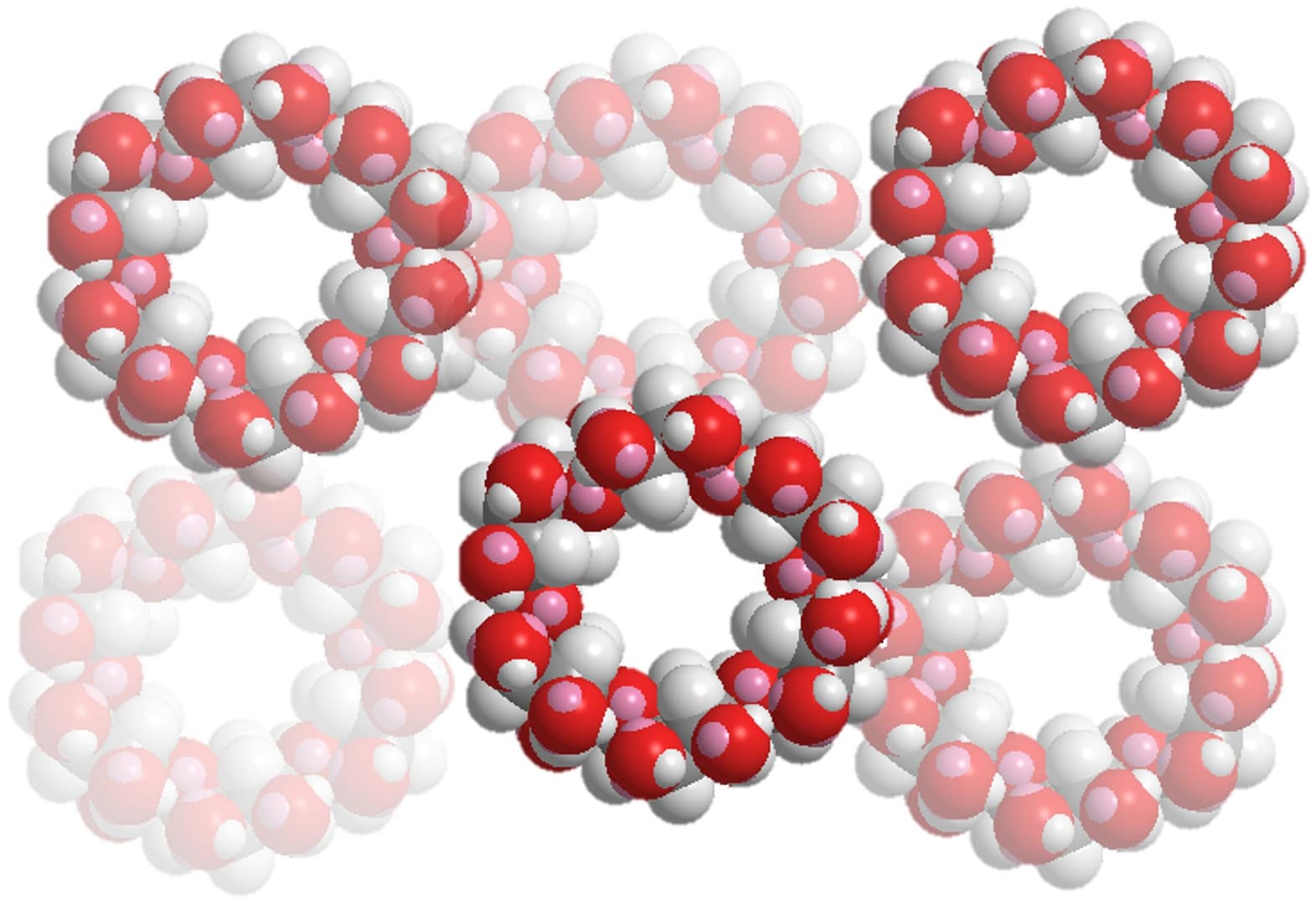
- CDは“分子を包むカゴ”:ドーナツ状の空洞に分子を取り込み、溶けやすさ・安定性・移動のしやすさなどを変えられます。
- ポリマーは“材料の骨格”:膜・電池電極・薬剤製剤など、実用材料の形にできます。
- 組み合わせると、「分子レベルの相互作用」×「材料としての機能」を同時に設計できます。
3本のレビュー論文:やさしい解説
論文1:Mixed-Matrix Membranes
- 掲載誌:ANGEWANDTE CHEMIE-INTERNATIONAL EDITION(2017)
- DOI:10.1002/anie.201701109
どんなレビュー?(やさしく)
ガス分離に使う「膜材料」に、MOFなどの“穴あき粒子(多孔性材料)”を混ぜ込む 混合マトリックス膜(MMM) の最新動向を整理したレビューです。粒子表面の改質、粒子サイズや分散性の工夫など、性能を左右する設計ポイントが議論されています。
CDとの関係
キーワードに β-シクロデキストリン が含まれており、界面設計や相互作用制御の文脈でCD系材料が関連していることが示唆されます。
要旨(ポイント抜粋:要約)
– 多孔性フィラー(例:MOF)を高分子膜に混ぜることで分離性能の向上が期待される。
– 性能はフィラーと高分子の相性(界面)、粒子サイズ・形状・分散に強く依存する。
– MOF以外の多孔性有機材料や分子添加剤も、耐老化・相溶化の観点で注目されている。
主要キーワード(データ記載)
gas separation / metal-organic frameworks / mixed-matrix membranes / porous materials
論文2:Solubility of Cyclodextrins and Drug/Cyclodextrin Complexes
- 掲載誌:MOLECULES(2018)
- DOI:10.3390/molecules23051161
どんなレビュー?(やさしく)
CDが薬(疎水性分子)を取り込み、溶けにくい薬を溶けやすくする 仕組みと、その限界を整理したレビューです。CD誘導体化、添加剤(高分子・界面活性剤など)の影響、最適添加量の考え方がまとめられています。
ポリマーとの接点
製剤中の 水溶性ポリマー が、CDの溶解・包接平衡に影響しうる点が、CD×ポリマー複合設計の基礎になります。
要旨(ポイント抜粋:要約)
– CDは分子改変なしに溶解性などを改善できる。
– 天然CDは会合して溶けにくくなる場合があり、誘導体化で改善できるが置換基・置換度に依存する。
– 添加剤(高分子・保存料・界面活性剤など)が溶解・包接に影響し、最適量設計が重要。
主要キーワード(データ記載)
cyclodextrin / complex / solubility / poorly soluble drug
論文3:A Review of the Design of Advanced Binders for High-Performance Batteries
- 掲載誌:ADVANCED ENERGY MATERIALS(2020)
- DOI:10.1002/aenm.202002508
どんなレビュー?(やさしく)
電池電極で活物質粒子をまとめる“のり”に相当する バインダー(高分子) に注目し、高容量電極や厚膜電極で求められる機能(接着性、機械強度、輸送、耐久性など)と設計戦略をまとめたレビューです。
CDとの関係
キーワードに β-シクロデキストリンポリマー が含まれており、CD由来の分子設計がバインダー機能の付与に使われる可能性が示されています。
要旨(ポイント抜粋:要約)
– 従来バインダー(例:PVDF)には、接着性や機能性などの課題がある。
– 高エネルギー密度化に向け、電極ごとの課題に対応した“機能性高分子バインダー”設計が重要。
– 新規バインダーの設計原理と、今後の開発方向が整理されている。
主要キーワード(データ記載)
binder design / high energy density / lithium batteries / multifunction / polymers
研究・教育向けに使える「見取り図」
- 分子(CD)側の設計:包接の強さ/水への溶けやすさ/誘導体化(置換基・置換度)
- 材料(ポリマー)側の設計:相溶性/機械強度/輸送特性(ガス・イオン等)/耐久性
- 界面の設計:CDや官能基で界面を“なじませる”と性能が上がることが多い
- 応用先:薬剤(溶解性・膜透過)/分離膜(選択性・耐老化)/電池(接着・耐久)
References(添付ファイル内の3報)
- Mixed-Matrix Membranes
ANGEWANDTE CHEMIE-INTERNATIONAL EDITION (2017) 56 (32) 9292.0–9310.0
DOI: 10.1002/anie.201701109 - Solubility of Cyclodextrins and Drug/Cyclodextrin Complexes
MOLECULES (2018) 23 (5)
DOI: 10.3390/molecules23051161 - A Review of the Design of Advanced Binders for High-Performance Batteries
ADVANCED ENERGY MATERIALS (2020) 10 (45)
DOI: 10.1002/aenm.202002508
English Version
Cyclodextrin (CD) × Polymers: What Review Papers Tell Us (from Web of Science export)
Last updated: 2026-01-03
This page summarizes only the three review papers listed in the attached Web of Science export file. It is written for a broad audience and can be used as an introductory handout.
Take-home message: why “CD × polymers” matters
- Cyclodextrins (CDs) act like molecular ‘hosts’: they can include guest molecules inside a hydrophobic cavity and change solubility, stability, and transport behavior.
- Polymers provide the macroscopic ‘framework’: practical materials (membranes, electrodes, formulations) are typically polymer-based.
- Combining them enables design at both the molecular-interaction level and the device/material level.
The 3 review papers (plain-language summaries)
Paper 1: Mixed-Matrix Membranes
- Journal: ANGEWANDTE CHEMIE-INTERNATIONAL EDITION (2017)
- DOI: 10.1002/anie.201701109
What is this review about?
It reviews state-of-the-art mixed-matrix membranes (MMMs) for gas separation, where porous fillers (e.g., MOFs) are embedded in polymer matrices. Key design factors include filler–polymer compatibility, surface chemistry, particle size/morphology, and dispersion.
Connection to cyclodextrins
The keywords include β-cyclodextrin, suggesting CD-related chemistry can be relevant to interfacial design and compatibility control.
Keywords (as listed in the dataset)
gas separation / metal-organic frameworks / mixed-matrix membranes / porous materials
Paper 2: Solubility of Cyclodextrins and Drug/Cyclodextrin Complexes
- Journal: MOLECULES (2018)
- DOI: 10.3390/molecules23051161
What is this review about?
It explains how CDs form inclusion complexes with drug molecules to improve solubility and formulation performance, and also discusses limitations such as CD aggregation. It covers CD derivatives, excipient effects, and how to optimize CD amount.
Where polymers come in
Water-soluble polymers and other excipients can shift solubilization/complexation equilibria—foundational for CD–polymer co-design.
Keywords (as listed in the dataset)
cyclodextrin / complex / solubility / poorly soluble drug
Paper 3: A Review of the Design of Advanced Binders for High-Performance Batteries
- Journal: ADVANCED ENERGY MATERIALS (2020)
- DOI: 10.1002/aenm.202002508
What is this review about?
It focuses on polymeric binders in rechargeable batteries and summarizes design strategies for high-performance electrodes (adhesion, mechanical integrity, transport, durability).
Connection to cyclodextrins
The keywords include β-cyclodextrin polymer, indicating CD-derived polymer design can be leveraged for binder functionality.
Keywords (as listed in the dataset)
binder design / high energy density / lithium batteries / multifunction / polymers
A simple concept map (useful for teaching)
- CD-side design: binding strength, aqueous solubility, derivatization (substituents/degree of substitution)
- Polymer-side design: compatibility, mechanics, transport, durability
- Interface design often dominates performance in composites
- Applications: drug formulation, gas-separation membranes, battery electrodes
References (the 3 papers in the attached file)
- Mixed-Matrix Membranes
ANGEWANDTE CHEMIE-INTERNATIONAL EDITION (2017) 56 (32) 9292.0–9310.0
DOI: 10.1002/anie.201701109 - Solubility of Cyclodextrins and Drug/Cyclodextrin Complexes
MOLECULES (2018) 23 (5)
DOI: 10.3390/molecules23051161 - A Review of the Design of Advanced Binders for High-Performance Batteries
ADVANCED ENERGY MATERIALS (2020) 10 (45)
DOI: 10.1002/aenm.202002508