作成日: 2026-02-07
日本語版(HP向け)
どんなテーマ?
シクロデキストリン(CD)は、分子を“包み込む”空洞をもつ糖由来分子です。
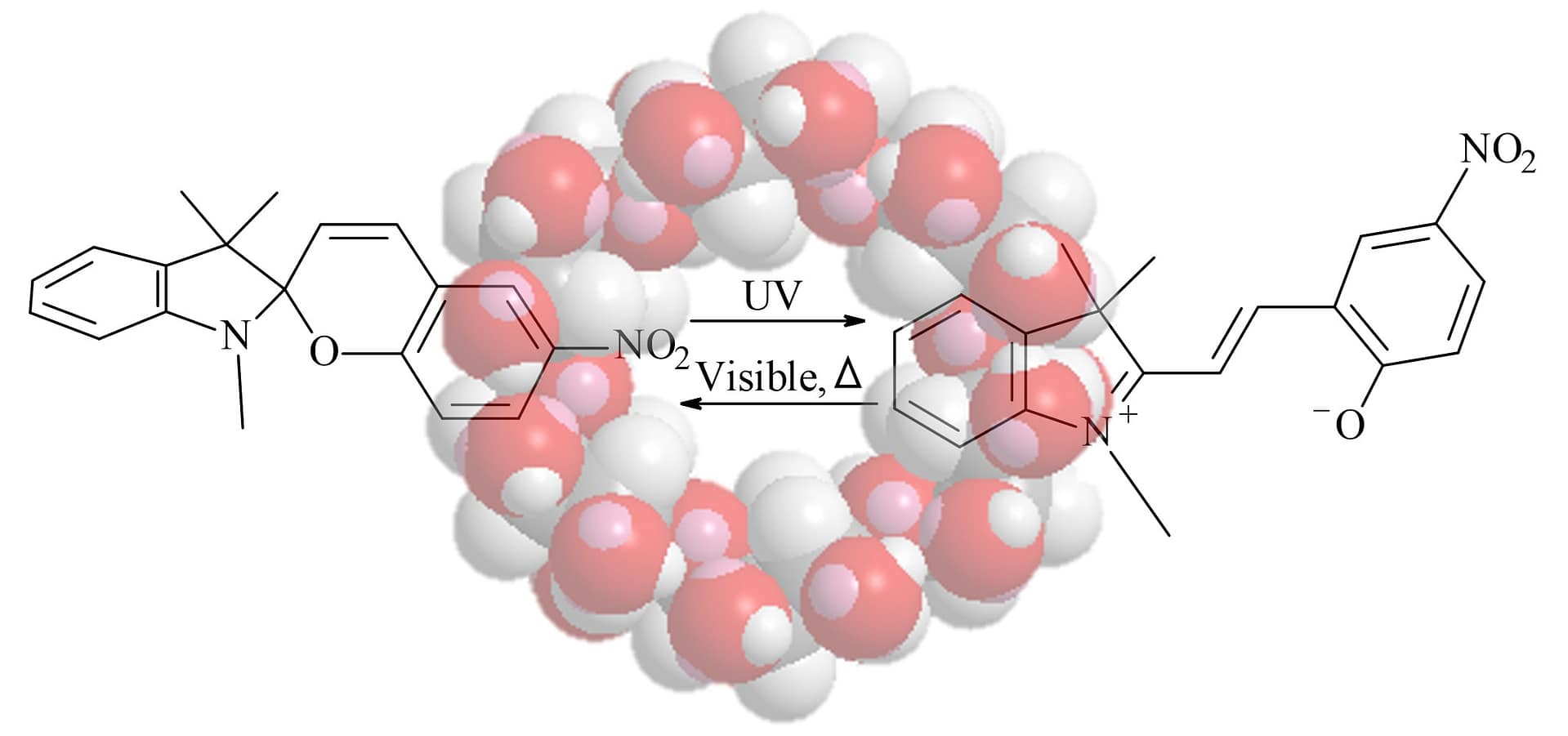
一方、スピロピラン(SP)は、光で形が変わって色や発光が変化するフォトクロミック分子です。
この論文は、CDの包接作用と「競争置換」を利用して、魚の鮮度指標(ヒスタミン)を高感度に検出する仕組みを提案しています。
対象論文
Fluorescence Turn-on Detection of Food Freshness Triggered by Competitive Displacement: Determination of Histamine Content in Fish
- 掲載誌: FOOD ANALYTICAL METHODS
- 年: 2026
- 著者: Cao, XL; Li, GH; He, DF; Li, F
- DOI: 10.1007/s12161-026-02997-x
やさしい解説(Abstractの要点を整理:本文の転載なし)
– 魚の鮮度低下で増えやすいヒスタミンを、蛍光の“ON”で超高感度に検出する分子プローブを提案した研究。
– 材料の核は、スルホブチルエーテル化β-シクロデキストリン(SBE-β-CD)がニトロスピロピラン(SP)を包み込み、通常は光らない複合体を作る点。
– ヒスタミンが入ると、包接部位の“場所取り”が起きてSPが追い出され(競争置換)、SPが光で開環して発光するメロシアニン(MC)に変わることで信号が出る。
– 10–70 nMの範囲で定量でき、検出限界は0.069 nMと報告。妨害となる他アミンの影響も小さく、選択性を示した。
– 魚試料への添加回収試験で良好な回収率(約94–98%)を示し、実サンプルでの鮮度評価への応用可能性を示した。
English version (for website)
What is this topic about?
Cyclodextrins (CDs) are sugar‑derived host molecules that can encapsulate guests in their cavity.
Spiropyrans (SPs) are photochromic molecules whose structure (and fluorescence) can change upon light irradiation.
This paper combines host–guest chemistry and competitive displacement to create a practical fluorescence probe for fish freshness assessment via histamine detection.
Paper in the attached file
{row.get(‘TI’,”).strip()}
- Journal: {row.get(‘SO’,”).strip()}
- Year: {row.get(‘PY’,”).strip()}
- Authors: {row.get(‘AU’,”).strip()}
- DOI: {row.get(‘DI’,”).strip()})})
Plain-language bullets (paraphrased from the abstract; no verbatim text)
– This study proposes a fluorescence “turn‑on” probe for ultra‑sensitive detection of histamine, a key indicator linked to fish freshness.
– The core concept is a host–guest complex where sulfobutyl ether‑β‑cyclodextrin (SBE‑β‑CD) encapsulates a nitro‑spiropyran (SP) to form a non‑fluorescent state.
– When histamine is introduced, it competitively displaces SP from the cyclodextrin cavity; the released SP can photo‑open to a fluorescent merocyanine (MC) form, producing the signal.
– The paper reports a quantitative range of 10–70 nM and a low detection limit (0.069 nM), along with good selectivity against other amines.
– Spiked fish samples show high recoveries (~94–98%), supporting practical use for fish freshness assessment.