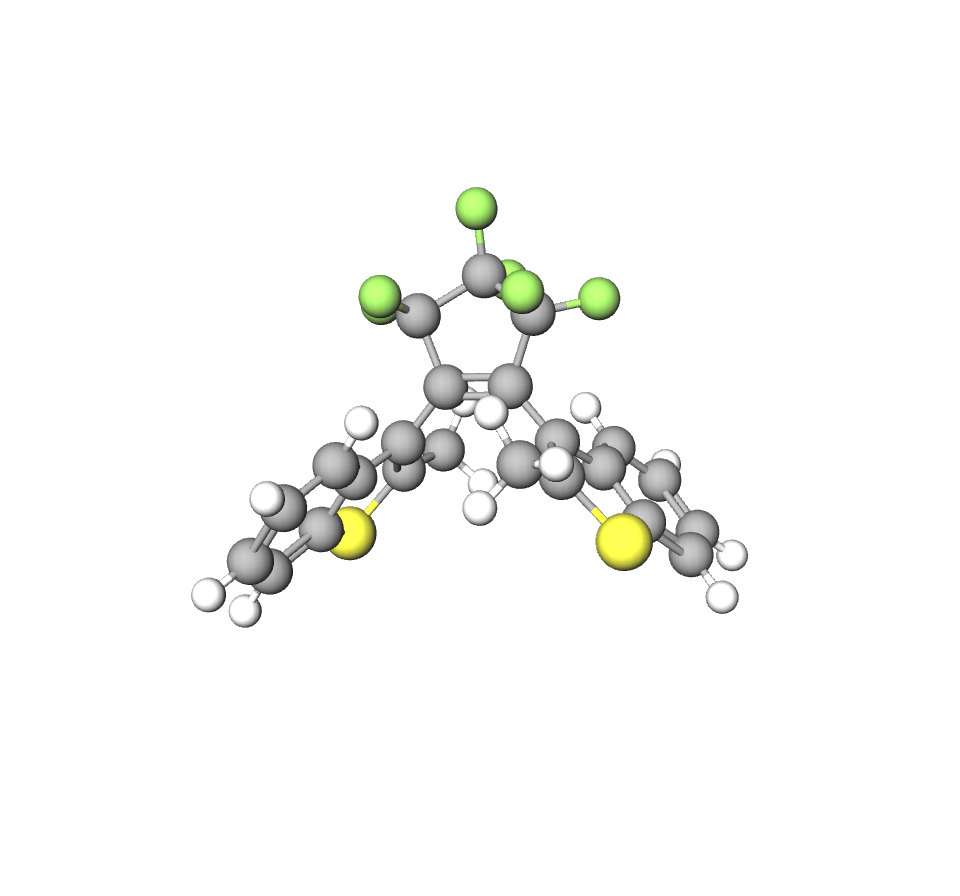
— diarylethene_Frontier.txt(収録3報)から、一般向けにやさしく解説 —
更新日: 2026-01-05
日本語版(HP掲載用)
1分でわかる:ジアリールエテン(Diarylethene, DTE/DAE)とは?
ジアリールエテンは、光(紫外〜可視)を当てると分子の形が可逆的に切り替わる「フォトスイッチ」の代表選手です。
「開環型 ↔ 閉環型」の変化により、色・吸収・蛍光・分子の大きさ(占める体積)などが変わります。これを材料の中に組み込むと、光で“機能のON/OFF”ができるようになります。fileciteturn7file0
このファイルに入っている最新3報は、ジアリールエテンを使って、
– 多孔性材料(MOF)の孔サイズを光で調節して分離を行う
– MOF内部のフォトスイッチング速度を設計で“チューニング”する
– 紫外線ではなく可視光だけで高収率に切り替わる蛍光スイッチを作る
という「材料化・実用化に近い」方向の研究です。fileciteturn7file0
研究①:光で“孔サイズ”を変えるMOFで、海水からウランを選択回収
Zhang, P. ほか, Nature Communications (2025)
題目:Photoisomerization-mediated tunable pore size in metal organic frameworks for U(VI)/V(V) selective separation
DOI:10.1038/s41467-025-57638-4fileciteturn7file0
何が新しい?
海水からウランを回収したいのですが、似た化学種(特にバナジウム)が邪魔で、「選択性」と「吸着量」を同時に上げるのが難しいとされています。
この研究では、ジアリールエテンの光異性化を使って、MOF内部を“開いた状態/閉じた状態”に切り替え、孔サイズと配位環境を動的に合わせる戦略を提案しています。fileciteturn7file0
ざっくり仕組み
- UV/可視光照射でジアリールエテンが開閉
- それに伴い、MOFの内部空間が「通りやすい/通りにくい」へ変化
- ウラン種に“ちょうど合う”状態を作り、選択回収を高める
というイメージです。fileciteturn7file0
応用の見え方
「光で孔を“ゲート”のように制御して、狙ったイオンだけ通す/捕まえる」という発想は、資源回収・環境浄化・分離膜に波及し得ます。fileciteturn7file0
研究②:光で切り替わる3D MOFを、設計で“動きやすく”する
Jin, E. ほか, Journal of the American Chemical Society (2025)
題目:Engineering Photoswitching Dynamics in 3D Photochromic Metal-Organic Frameworks through a Metal-Organic Polyhedron Design
DOI:10.1021/jacs.4c17203fileciteturn7file0
何が新しい?
ジアリールエテンをMOFに入れると便利ですが、材料の中では分子が動きにくくなり、
– うまく切り替わらない
– 切り替わりが遅い
– 方向がバラバラで“協調的に動かない”
などが起きやすいです。fileciteturn7file0
この研究では、金属有機多面体(MOP)を部品として使い、3Dフレームワーク内でジアリールエテン(DTE)部位が多軸配向しつつ協調的にスイッチするような設計を示しています。さらに、金属–配位子結合の強さを変えることで、スイッチングの“動力学(速さ・進み方)”を調整できる、という点が重要です。fileciteturn7file0
どこが実用に効く?
「光で動く材料」を実用に近づけるには、“動く/動かない”を設計で再現できることが鍵です。
この研究は、フォトスイッチを“混ぜる”のではなく、スイッチが働く舞台(骨格)ごと設計する方向性を示しています。fileciteturn7file0
研究③:可視光だけで、ほぼ“定量的”に切り替わる蛍光フォトスイッチ
Zhai, J. ほか, Advanced Science (2025)
題目:Visible-Light-Driven Fluorescence Turn-on Photoswitches With Near Quantitative Photocyclization Yield
DOI:10.1002/advs.202414881fileciteturn7file0
何が新しい?
情報記録・偽造防止などで「光で蛍光がONになるスイッチ」は注目されています。
ただし従来はUVを使うことが多く、フォトブリーチ(劣化)や耐久性が課題でした。fileciteturn7file0
この研究は、405 nm(可視光)で駆動でき、しかも環化(ring-closing)の収率が最大約94%に達する「蛍光turn-on」ジアリールエテン系を報告しています(置換位置で応答が変わる点も示されています)。fileciteturn7file0
何がうれしい?
- UVを避けて可視光で動かせる(扱いやすい・材料劣化を抑えやすい)
- 高い変換率=くっきりしたON/OFFにつながる
- 情報暗号化、パターン書き換えなどへの展開が描かれている
という点が、実装に近い魅力です。fileciteturn7file0
まとめ:この3報から見える「ジアリールエテンの現在地」
このファイルの3報は、ジアリールエテン研究が
1) 分子単体のスイッチから
2) 多孔性材料・センサー・情報材料など“機能材料の部品”へ
進んでいることを示しています。fileciteturn7file0
参考文献(本ファイル内に限定)
- Zhang, P.; Zhang, Y.; Wu, F.; et al. Photoisomerization-mediated tunable pore size in metal organic frameworks for U(VI)/V(V) selective separation. Nature Communications (2025). DOI: 10.1038/s41467-025-57638-4.fileciteturn7file0
- Jin, E.; Bon, V.; Das, S.; et al. Engineering Photoswitching Dynamics in 3D Photochromic Metal-Organic Frameworks through a Metal-Organic Polyhedron Design. Journal of the American Chemical Society (2025). DOI: 10.1021/jacs.4c17203.fileciteturn7file0
- Zhai, J.; Ai, Q.; Li, H.; et al. Visible-Light-Driven Fluorescence Turn-on Photoswitches With Near Quantitative Photocyclization Yield. Advanced Science (2025). DOI: 10.1002/advs.202414881.fileciteturn7file0
English version (for your website)
Diarylethene (DTE/DAE) in 1 minute
Diarylethenes are iconic molecular photoswitches. Upon light irradiation (UV–visible), they reversibly interconvert between open-ring and closed-ring forms, changing their color/absorption, fluorescence, and effective molecular size. When embedded in materials, this enables light-controlled ON/OFF functions.fileciteturn7file0
The three papers in diarylethene_Frontier.txt highlight “materials-oriented” directions:
– Light-tunable pore gating in MOFs for selective separation
– Designing photoswitching dynamics in 3D photochromic MOFs
– Visible-light-driven fluorescent photoswitches with near-quantitative conversionfileciteturn7file0
Study 1: Light-tunable MOF pores for selective uranium capture (U over V)
Zhang, P. et al., Nature Communications (2025)
Title: Photoisomerization-mediated tunable pore size in metal organic frameworks for U(VI)/V(V) selective separation
DOI: 10.1038/s41467-025-57638-4fileciteturn7file0
Key idea: Uranium extraction from seawater is hampered by competing vanadium species. This work introduces a diarylethene photoswitch into MOFs and uses UV–Vis irradiation to dynamically tune pore size and coordination environment, improving U(VI)/V(V) selectivity while maintaining high uptake.fileciteturn7file0
Study 2: Engineering switching speed in 3D photochromic MOFs via MOP design
Jin, E. et al., Journal of the American Chemical Society (2025)
Title: Engineering Photoswitching Dynamics in 3D Photochromic Metal-Organic Frameworks through a Metal-Organic Polyhedron Design
DOI: 10.1021/jacs.4c17203fileciteturn7file0
Key idea: In solids, photoswitches often suffer from restricted motion. Using metal–organic polyhedra (MOPs) as building blocks, the authors assemble 3D frameworks with multiaxially aligned DTE units showing cooperative switchability. By varying metal–ligand bond strengths, they deliberately tune the kinetics of photoswitching.fileciteturn7file0
Study 3: Visible-light-driven “turn-on” fluorescent photoswitches with ~94% cyclization yield
Zhai, J. et al., Advanced Science (2025)
Title: Visible-Light-Driven Fluorescence Turn-on Photoswitches With Near Quantitative Photocyclization Yield
DOI: 10.1002/advs.202414881fileciteturn7file0
Key idea: Many fluorescent photoswitches rely on UV light, which can cause photobleaching and limit durability. This work reports diarylethene derivatives that can be switched by 405 nm visible light, achieving up to 94% ring-closing yield, with good stability and fatigue resistance, enabling applications such as anti-counterfeiting and rewritable patterns.fileciteturn7file0
Take-home message
Across these three studies, diarylethenes are moving from “molecular switches” to practical components of functional materials—including separations, porous frameworks, and information/anti-counterfeiting systems.fileciteturn7file0
References (limited to the attached file)
- Zhang, P. et al. Nat. Commun. (2025). DOI: 10.1038/s41467-025-57638-4.fileciteturn7file0
- Jin, E. et al. J. Am. Chem. Soc. (2025). DOI: 10.1021/jacs.4c17203.fileciteturn7file0
- Zhai, J. et al. Adv. Sci. (2025). DOI: 10.1002/advs.202414881.fileciteturn7file0