date: 2026-01-24
keywords: [All-Optical Switching, Diarylethene, Hydrogen bonding interaction, Photochromic cotton fabrics, Photochromism, Photofatigue resistance, Spiropyran, Thermally Irreversible, Thermally Reversible, Thiol-ene click chemistry]
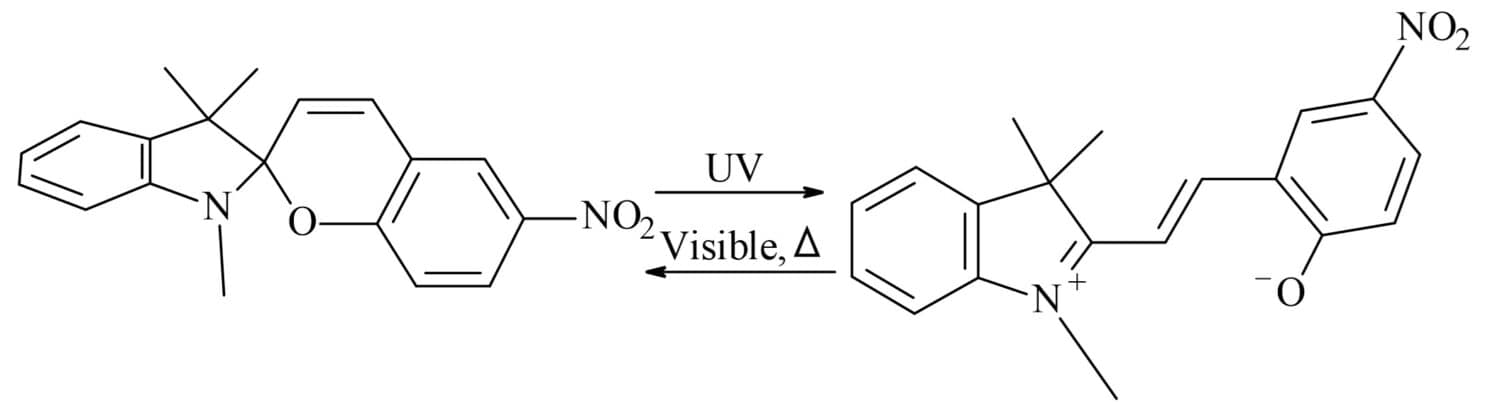
スピロピラン(Spiropyran, SP)って何?
スピロピランは、紫外光で色が出て、可視光や暗所で戻るタイプの代表的フォトクロミック分子です。
分子の形が 閉環(SP)⇄開環(MC) と切り替わることで、吸収スペクトル=“色”が変わります。
- 光でON/OFFできる(可逆スイッチ)
- 分子設計や周囲環境(極性・pH・水素結合)で反応速度や安定性が変わる
- 材料(樹脂・繊維・ゲル)に固定化すると、スマート材料として応用可能
論文のやさしい解説
論文1:All-optical switching of thermally irreversible/reversible photochromism of diarylethenes by negative-photochromic acidity-controllable spiropyran
- 著者:Kobayashi, H; Ohtsuki, K; Ubukata, T; Nakagawa, T; Yokoyama, Y
- 掲載誌:RESEARCH ON CHEMICAL INTERMEDIATES(2026)
- DOI:10.1007/s11164-025-05883-z
日本語:何の研究?(ひとことで)
ジアリールエテンの“熱で戻る/戻らない”モードを、スピロピランが作る酸性度で“光だけ”で切り替える
ポイント(やさしく)
– フォトクロミック分子は「熱で戻りにくい(P-type)」と「熱で戻りやすい(T-type)」に大別される。
– スピロピラン(SP)は光で形が変わり、強酸性(SP形)⇄弱酸性(MC形)を行き来できる“酸性度スイッチ”として働く。
– 酸性度の変化でジアリールエテンがプロトン化/脱プロトン化し、P-type↔T-typeの反応モードを試薬なしに往復可能。
応用イメージ
– 試薬交換なしの分子スイッチ・分子メモリ
– 光学材料(フォトニクス)での多状態制御
– 環境応答(酸性度)を使う情報記録・暗号化
English: What is this about?
All‑optical switching of diarylethene photochromic modes via spiropyran‑controlled acidity
Key points
– Photochromic systems are often categorized as thermally irreversible (P‑type) or thermally reversible (T‑type).
– Spiropyran toggles between strongly acidic and weakly acidic forms depending on light/thermal conditions, acting as an acidity switch.
– Acidity‑driven protonation/deprotonation changes the diarylethene reaction mode, enabling reagent‑free P‑type↔T‑type cycling.
Possible applications
– Reagent‑free molecular switching and memory
– Multistate photonic materials
– Information encryption via stimulus‑controlled states
論文2:Constructing photochromic cotton fabrics by thiol-Ene click chemistry: The enhancing effect of hydrogen bonding on comprehensive properties
- 著者:Jin, CW; Zhang, RZ; Xie, PJ; Chen, T
- 掲載誌:JOURNAL OF PHOTOCHEMISTRY AND PHOTOBIOLOGY A-CHEMISTRY(2026)
- DOI:10.1016/j.jphotochem.2026.117025
日本語:何の研究?(ひとことで)
スピロピランを綿布に“クリック反応”で固定化し、水素結合で発色速度・耐光疲労を底上げしたスマート繊維
ポイント(やさしく)
– 綿布表面をチオール基で修飾し、チオール–エン(thiol‑ene)クリック反応でスピロピランを共有結合固定化。
– スピロピラン分子にカルバメート基を導入し、水素結合で開環体MCを安定化 → SP→MC変換が速くなる。
– 365 nm UVで約2秒の高速発色、繰り返し20サイクル後も85%以上の性能保持など、実用性を高めた。
応用イメージ
– UV防護・色変化テキスタイル
– 模様切替・インク不要の書き込み
– 情報隠蔽/暗号化・センサー布
English: What is this about?
Photochromic cotton via thiol–ene click chemistry; hydrogen bonding boosts speed and photofatigue resistance
Key points
– Cotton is thiolated and covalently functionalized with spiropyran via thiol–ene click chemistry for robust attachment.
– Introducing carbamate groups enables intermolecular hydrogen bonding that stabilizes the merocyanine (MC) form and accelerates SP→MC isomerization.
– The fabric shows rapid coloration (~2 s under 365 nm UV) and retains >85% performance after 20 UV/visible cycles.
Possible applications
– UV‑responsive smart textiles
– Pattern switching and ink‑free writing
– Information encryption and sensing fabrics
用語ミニ解説 / Mini‑Glossary
- Spiropyran (SP) / Merocyanine (MC):閉環体SPと開環体MCの相互変換で色が変わる
- Photochromism(フォトクロミズム):光で構造が変化し、色(吸収)が変わる現象
- Thiol–ene click chemistry(チオール–エン クリック反応):温和条件で高効率に結合を作れる反応(材料固定化に便利)
- Photofatigue resistance(耐光疲労性):繰り返し照射しても性能が落ちにくい性質
- P‑type / T‑type:熱で戻りにくい/戻りやすいフォトクロミズム挙動の分類(文脈依存)
References
- Kobayashi, H; Ohtsuki, K; Ubukata, T; Nakagawa, T; Yokoyama, Y All-optical switching of thermally irreversible/reversible photochromism of diarylethenes by negative-photochromic acidity-controllable spiropyran. RESEARCH ON CHEMICAL INTERMEDIATES (2026). DOI: 10.1007/s11164-025-05883-z
- Jin, CW; Zhang, RZ; Xie, PJ; Chen, T Constructing photochromic cotton fabrics by thiol-Ene click chemistry: The enhancing effect of hydrogen bonding on comprehensive properties. JOURNAL OF PHOTOCHEMISTRY AND PHOTOBIOLOGY A-CHEMISTRY (2026). DOI: 10.1016/j.jphotochem.2026.117025
Tags
spiropyran, photochromism, smart materials, diarylethene, acidity switching, smart textiles, click chemistry