作成日: 2026-02-15
日本語版
どんなテーマ?
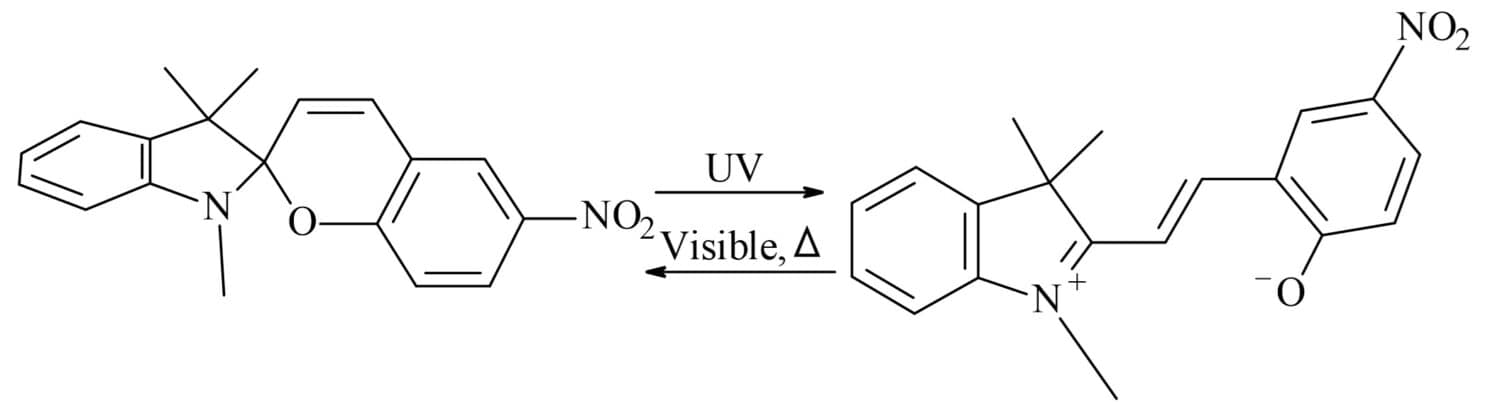
スピロピラン(Spiropyran, SP) は、光で構造が変わり(SP⇄メロシアニンなど)、色・蛍光・親水性が変化する代表的なフォトクロミック分子です。
そのため、スマート材料(情報暗号化、センサー、スマートテキスタイル、機能性バイオマテリアルなど)に応用されています。
論文紹介
Smart textiles based on liquid crystal elastomers with photochromic and thermally actuated properties
- 掲載誌:Chemical Engineering Journal
- 年:2026(FEB 15)
- 著者:Zhang, Y, Li, MH, Zhang, X, Wang, WD, et al.
- DOI:10.1016/j.cej.2026.173459
やさしい解説(Abstractの要点を整理:本文の転載なし)
– 環境の変化に自律応答する「スマート繊維」では、複数刺激(光+熱など)に応答して複雑な動きを出す材料が求められます。
– 本研究はスピロピラン(SP)を利用した液晶エラストマー繊維(LCEF)を液相紡糸で作り、光変色と熱収縮を統合した繊維を開発しています。
– 緑色染料の併用により、光変色の色域(色の表現範囲)を広げた繊維(SP/G/LCEF)を報告しています。
– 紫外光強度の調整や構造設計により、模様の書き込み→消去→再書き込みが可能な“プログラム可能”繊維として機能します。
– UV検知Tシャツ、サイズ自動適応テキスタイル、ニットによるスマート衣服など、実装例を示し、ウェアラブルやソフトロボティクス等への展開を提案しています。
Photochromic alginate biomaterials doped with sodium spiropyran carboxylate: fabrication and fluorescence characterization of films and fibers
- 掲載誌:International Journal Of Biological Macromolecules
- 年:2026(FEB)
- 著者:Li, F, Liu, JQ, Gong, XL, Qiao, F, et al.
- DOI:10.1016/j.ijbiomac.2026.150501
やさしい解説(Abstractの要点を整理:本文の転載なし)
– スピロピラン系フォトクロミック材料は有望ですが、化学グラフトは工程が複雑で環境負荷が大きい、という課題があります。
– 本研究は、水系(アクアス)での“物理ドーピング”により、スピロピラン(ナトリウム塩カルボキシレート)をアルギン酸ナトリウムに非共有結合で取り込む“グリーン”手法を提案します。
– ドーピング量(0.5–5.0 mol%)により、フィルムの蛍光特性を調整できることを示しています。
– グリセロール添加で発光ピークがやや長波長化し、蛍光寿命も伸びるなど、性能改善の工夫を報告しています。
– さらにCa²⁺架橋で蛍光マイクロスフェアや刺激応答ファイバーへ展開し、情報暗号化・スマートテキスタイルなどへ応用可能としています。
Time-evolving photoreconfigurable self-assembly for integrated fluorochromic cellulosic emitter
- 掲載誌:Communications Chemistry(参考JIF 2024: 6.2)
- 年:2025(DEC 29)
- 著者:Zhu, FF, Hou, XF, Zhang, HY, Wang, JP, et al.
- DOI:10.1038/s42004-025-01868-6
やさしい解説(Abstractの要点を整理:本文の転載なし)
– 光で駆動する自己組織化(散逸系自己組織化)は、時間・空間を狙って構造を作り替えられる点が魅力ですが、自由に扱える自立膜での高機能化は難題でした。
– 本研究は、セルロース材料中で、ホスト–ゲスト相互作用(ククルビツリル)を分子設計で組み込み、時間とともに変化する蛍光色(フルオロクロミズム)を実現しています。
– プロトン化ビニルピリジニウム由来メロシアニンを用い、光(475 nm)と熱緩和でスピロピラン⇄メロシアニンを可逆に行き来させます。
– 結合様式(1:2 と 1:1)を切り替えることで、球状↔直方体のナノ形態変化と、時間分解の発光色変化を示します。
– セルロース紙としては、自己消去型の一時的フォトライティングや多段階の偽造防止機能を示し、リサイクル性も強調しています。
English version (for website)
What is this topic about?
Spiropyrans (SPs) are classic photochromic molecules that switch between molecular states (e.g., SP ⇄ merocyanine), changing color, fluorescence, and polarity.
They are widely explored for smart materials such as encryption, sensing, smart textiles, and sustainable functional biomaterials.
Selected papers
Smart textiles based on liquid crystal elastomers with photochromic and thermally actuated properties
- Journal: Chemical Engineering Journal (2024 JIF: 13.2)
- Year: 2026 (FEB 15)
- Authors: Zhang, Y, Li, MH, Zhang, X, Wang, WD, et al.
- DOI: 10.1016/j.cej.2026.173459
Plain-language bullets (paraphrased; no verbatim abstract text)
– Smart textiles benefit from multi‑stimuli responsiveness to achieve complex, autonomous actuation.
– This study develops spiropyran‑based liquid crystal elastomer fibers (LCEFs) via liquid‑spinning, integrating photochromism and thermally induced shrinkage.
– Co‑incorporating green dyes expands the attainable photochromic color gamut in SP/G/LCEFs.
– By structural design and UV‑intensity control, the fibers enable programmable, erasable, and reprogrammable color patterns.
– Demonstrations include UV‑sensing T‑shirts, self‑adaptive textiles, and knitted smart garments, pointing to applications in wearables, soft robotics, and information storage.
Photochromic alginate biomaterials doped with sodium spiropyran carboxylate: fabrication and fluorescence characterization of films and fibers
- Journal: International Journal Of Biological Macromolecules (2024 JIF: 8.5)
- Year: 2026 (FEB)
- Authors: Li, F, Liu, JQ, Gong, XL, Qiao, F, et al.
- DOI: 10.1016/j.ijbiomac.2026.150501
Plain-language bullets (paraphrased; no verbatim abstract text)
– Spiropyran photochromic materials are promising, but conventional covalent grafting can be complex and less eco‑friendly.
– This work proposes a green, aqueous physical‑doping strategy to incorporate sodium spiropyran carboxylates into sodium alginate via non‑covalent interactions.
– Fluorescence can be tuned by the doping level (0.5–5.0 mol%) in the resulting films and fibers.
– Adding glycerol improves emission/lifetime, indicating a practical route to performance optimization.
– The doped alginate can be Ca²⁺‑crosslinked into fluorescent microspheres and stimuli‑responsive fibers for encryption and smart textile applications.
Time-evolving photoreconfigurable self-assembly for integrated fluorochromic cellulosic emitter
- Journal: Communications Chemistry (2024 JIF: 6.2)
- Year: 2025 (DEC 29)
- Authors: Zhu, FF, Hou, XF, Zhang, HY, Wang, JP, et al.
- DOI: 10.1038/s42004-025-01868-6
Plain-language bullets (paraphrased; no verbatim abstract text)
– Light‑driven dissipative self‑assembly enables spatiotemporal control, but integrating high‑fidelity patterning, programmability, and reconfigurability in a free‑standing platform is challenging.
– This work embeds engineered host–guest interactions (with cucurbiturils) into sustainable cellulose matrices to achieve time‑programmable fluorochromism.
– A protonated vinylpyridinium‑derived merocyanine is designed to show reversible spiropyran ⇄ merocyanine interconversion via 475‑nm photoactivation and thermal relaxation.
– Switching host–guest stoichiometry (1:2 vs 1:1) induces nanoscale morphology changes (spheres vs cuboids) along with time‑resolved fluorescence color shifts.
– Freestanding cellulosic papers demonstrate self‑erasing transient photowriting and multi‑level anti‑counterfeiting, with recyclability enabled by non‑covalent architecture.
参考文献 / References(ファイル内・掲載分)
- Zhang, Y, Li, MH, Zhang, X, Wang, WD, et al. (2026). Smart textiles based on liquid crystal elastomers with photochromic and thermally actuated properties. Chemical Engineering Journal. doi:10.1016/j.cej.2026.173459
- Li, F, Liu, JQ, Gong, XL, Qiao, F, et al. (2026). Photochromic alginate biomaterials doped with sodium spiropyran carboxylate: fabrication and fluorescence characterization of films and fibers. International Journal Of Biological Macromolecules. doi:10.1016/j.ijbiomac.2026.150501
- Zhu, FF, Hou, XF, Zhang, HY, Wang, JP, et al. (2025). Time-evolving photoreconfigurable self-assembly for integrated fluorochromic cellulosic emitter. Communications Chemistry. doi:10.1038/s42004-025-01868-6