作成日: 2026-02-21
日本語版(HP向け)
どんなテーマ?
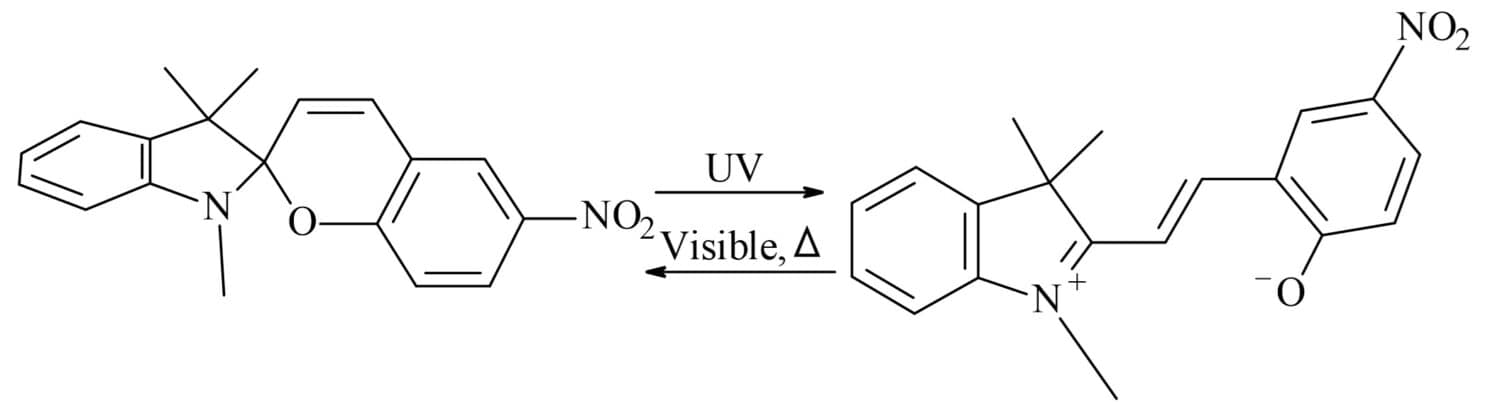
スピロピラン(Spiropyran, SP) は、光や環境条件で構造が切り替わり(SP ⇄ メロシアニン MC)、色や蛍光が変化する代表的フォトクロミック分子です。
そのため、光スイッチ材料、センサー、イオントロニクス/神経模倣デバイス、分子設計(計算化学)など幅広い分野で活用されています。
論文紹介
Giant and Programmable Ionic Rectification Induced by Voltage-Driven Dynamic Modulation of Interfacial Electric Double Layer for Bioinspired Neuromorphic Signal Conduction
- 掲載誌:Nano Letters(参考JIF 2024: 9.1)
- 年:2026(2026 FEB 11)
- 著者:Wang, X, Guo, YF, Jing, TY, Zhang, J, et al.
- DOI:10.1021/acs.nanolett.5c05477
やさしい解説(Abstractの要点を整理:本文の転載なし)
– 生体のイオンチャネルのように、一方向にだけイオンを通す“人工イオンダイオード”は、イオントロニクスや神経模倣デバイスで重要です。
– 本研究は、絶縁体‐ハイドロゲル界面の電気二重層(EDL)を電圧で動的に変調し、プロトン輸送の整流(rectification)を実現するデバイスを提案しています。
– ハイドロゲル内に光応答性スピロピラン誘導体を組み込んだ階層ナノチャネルを作ることで、プロトン輸送速度を大幅に高めています。
– 結果として、漏れ電流を抑えつつ、非常に大きい整流比(4×10⁵)を達成したと報告しています。
– このイオンダイオードを基盤に、光で信号を変調できる“フォトニック・シナプストランジスタ”を構築し、シナプス可塑性に相当する応答も示しています。
– 電圧依存のイオン→電子信号変換が高性能で、将来のニューロモーフィック素子や無線通信機能をもつイオントロニクスへの展開を示唆します。
A theoretical study on the mechanism of photoinduced ring-opening reaction of spiropyran derivatives
- 掲載誌:Journal Of Molecular Graphics & Modelling(参考JIF 2024: 3.0)
- 年:2026(MAY)
- 著者:Ding, S, Xia, Y
- DOI:10.1016/j.jmgm.2026.109314
やさしい解説(Abstractの要点を整理:本文の転載なし)
– スピロピラン(SP)は光で開環体(MC)へ変わり、色や発光が変化しますが、置換基や溶媒が反応の起こりやすさをどう左右するかは整理が必要です。
– 本研究は、カルボキシ基をもつSP誘導体(R=NO₂ / H / OCH₃)について、TD‑DFT(TD‑CAM‑B3LYP/6‑31G(d))で光誘起開環機構を解析しました。
– 基底状態(S0)ではC–O結合切断の障壁が高く自発開環しにくい一方、励起状態(S1)では障壁が大きく下がり、光でSP→MCへ進みやすくなることを示します。
– 電子求引性NO₂は障壁を下げ、電子供与性OCH₃は障壁を上げるなど、置換基の電子効果を定量的に比較しています。
– “明るい状態(光を吸いやすい状態)”がNO₂ではS2、H/OCH₃ではS1になるなど、励起状態の性質の違いも整理しています。
– 溶媒極性がMCの安定性や発光波長に影響し、特にtrans‑MC‑OCH₃が長波長側(約602–639 nm)へ発光が伸びる可能性を示し、材料設計指針を与えます。
English version (for website)
What is this topic about?
Spiropyrans (SPs) are classic photochromic molecules that switch between SP and merocyanine (MC), changing color and fluorescence.
They are used in optical switching, sensing, iontronics/neuromorphic devices, and computational design of photoresponsive systems.
Papers in the attached file
Giant and Programmable Ionic Rectification Induced by Voltage-Driven Dynamic Modulation of Interfacial Electric Double Layer for Bioinspired Neuromorphic Signal Conduction
- Journal: Nano Letters (Ref. 2024 JIF: 9.1)
- Year: 2026 (2026 FEB 11)
- Authors: Wang, X, Guo, YF, Jing, TY, Zhang, J, et al.
- DOI: 10.1021/acs.nanolett.5c05477
Plain-language bullets (paraphrased; no verbatim abstract text)
– Artificial ionic diodes that mimic biological ion channels—allowing unidirectional transport—are key components for iontronics and neuromorphic devices.
– This work builds a unipolar ionic diode by voltage‑driven dynamic modulation of an asymmetric electric double layer (EDL) at an insulator–hydrogel interface, enabling proton current rectification.
– Hierarchical hydrogel nanochannels incorporating light‑responsive spiropyran derivatives boost proton transport kinetics significantly.
– A record‑high rectification ratio of 4×10⁵ is reported while suppressing leakage in the closed state.
– Using the diode, the authors demonstrate a photonic synaptic transistor with strong current modulation, optical synaptic plasticity, and potential for wireless communication.
– The study highlights voltage‑dependent ion‑to‑electron signal transduction as a pathway toward advanced bioinspired nanofluidic iontronics and future neuromorphic devices.
A theoretical study on the mechanism of photoinduced ring-opening reaction of spiropyran derivatives
- Journal: Journal Of Molecular Graphics & Modelling (Ref. 2024 JIF: 3.0)
- Year: 2026 (MAY)
- Authors: Ding, S, Xia, Y
- DOI: 10.1016/j.jmgm.2026.109314
Plain-language bullets (paraphrased; no verbatim abstract text)
– Spiropyrans (SPs) switch to merocyanine (MC) under light, changing color and fluorescence, but how substituents and solvents control the ring‑opening pathway needs clarification.
– This paper uses TD‑DFT (TD‑CAM‑B3LYP/6‑31G(d)) to analyze photoinduced ring opening of carboxyl‑functionalized SP derivatives (R = NO₂, H, OCH₃).
– In the ground state (S0), the C–O cleavage barrier is high, suppressing spontaneous ring opening; in the excited state (S1), barriers drop dramatically, facilitating SP→MC conversion.
– Electron‑withdrawing NO₂ lowers the barrier, while electron‑donating OCH₃ raises it, quantifying substituent electronic effects.
– The work identifies different bright states (S2 for NO₂; S1 for H/OCH₃), reflecting differences in excited‑state character.
– Solvent polarity modulates MC stability and emission; trans‑MC‑OCH₃ is predicted to emit at longer wavelengths (~602–639 nm), offering guidance for photoresponsive material design.
参考文献 / References
- Wang, X, Guo, YF, Jing, TY, Zhang, J, et al. (2026). Giant and Programmable Ionic Rectification Induced by Voltage-Driven Dynamic Modulation of Interfacial Electric Double Layer for Bioinspired Neuromorphic Signal Conduction. Nano Letters. doi:10.1021/acs.nanolett.5c05477
- Ding, S, Xia, Y (2026). A theoretical study on the mechanism of photoinduced ring-opening reaction of spiropyran derivatives. Journal Of Molecular Graphics & Modelling. doi:10.1016/j.jmgm.2026.109314