日本語(HP用)
このページの目的
スピロピラン(SP)系フォトクロミック分子を 過渡吸収(Transient Absorption; TA)などの時間分解手法で追跡した“最前線”を、一般の方向けにやさしく紹介します。
まず一言:過渡吸収(TA)とは?
光を当てた直後、分子は 励起状態や 一時的な中間体になり、吸収スペクトルが少し変わります。
TAはこの「吸収の変化(ΔA)」を、ポンプ光(励起)→プローブ光(観測)で時間追跡する方法です。
時間スケールのイメージ
– fs(フェムト秒, 10⁻¹⁵ s):反応開始の“最初の動き”(電子・結合の変化の入口)
– ps(ピコ秒, 10⁻¹² s):分子構造の緩和、溶媒の追従
– ns(ナノ秒, 10⁻⁹ s)〜µs(10⁻⁶ s):比較的長寿命の状態や後続反応
なぜSP(スピロピラン)は測る価値がある?
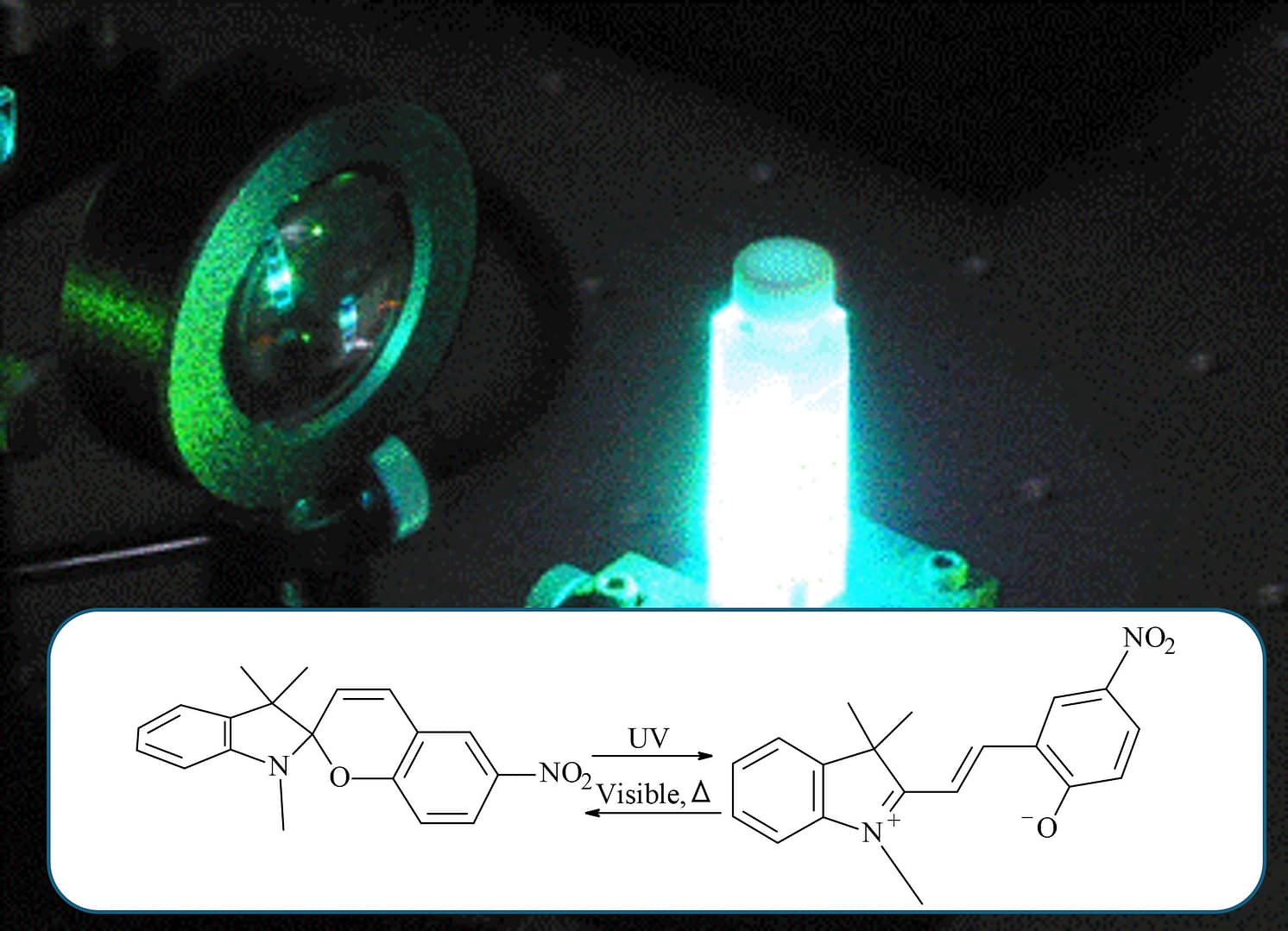
SPは光で 環が開閉し、色のある メロシアニン(MC)などの形に変わる「分子スイッチ」です。
ただし、光化学反応(スイッチ)だけでなく、スイッチに行かずに“熱的に落ち着いてしまう経路”もあり、
効率(量子収率)を上げるには“どこで何が起きているか”の理解が重要です。
研究ハイライト(3報)
1) X線で「見えにくい結合変化」を追う:時間分解X線吸収+シミュレーション(Communications Physics, 2025)
従来の時間分解研究はUV-Vis領域が中心でしたが、この論文は
時間分解X線吸収(N K-edge)と 非断熱ダイナミクス計算を組み合わせ、
SPの“効率を下げる” 光物理緩和の手がかりを狙いました。
一般向けポイント
– SPの環開裂(C–O結合切断)の量子収率は高くない
– 理論的には、別の結合(C–N)の一時的な切断と再形成が“抜け道”として提案されていた
– X線吸収(窒素端)なら、窒素周りの電子状態変化をより直接に捉えられる可能性
– シミュレーションから、C–N切断に対応する 一時的な吸収の赤方シフトが予測され、実験ルートの提案になっている
この論文(添付ファイル内)
– Fransén, L et al.. Tracking photophysical relaxation in spiropyran with simulated time-resolved X-ray absorption spectroscopy. COMMUNICATIONS PHYSICS (2025) 8(1) Article 263. https://doi.org/10.1038/s42005-025-02175-1
2) 3Dプリント材料へ:ペロブスカイト×SPのFRETをfs-TAで検証(Advanced Optical Materials, 2025)
無機ペロブスカイト(CsPbBr₃)を、工業的なポリマー加工(混練・3Dプリント等)に接続し、さらにSPの開環体(MC)との FRET(蛍光共鳴エネルギー移動)で発光色を切り替える研究です。
メカニズム確認に 蛍光寿命と フェムト秒TA(Fs-TA)が使われています。
一般向けポイント
– “研究室材料”を“加工できる材料(3Dデバイス)”へつなぐ発想
– 光照射で 緑↔赤の可逆発光スイッチング(MCが関与)
– FRETの成立を、寿命解析とFs-TAで裏付け
– 応用例として、多段階の偽造防止(暗号化)など「光で書き換える」機能デバイスを示している
この論文(添付ファイル内)
– Liu, Z et al.. Light-Programmable 3D Device Study in Halide Perovskite-Based Photochromic Conjugate. ADVANCED OPTICAL MATERIALS (2025) 13(35). https://doi.org/10.1002/adom.202501538
3) “光で放出”する安定MC:フォトケージ化SPをfs-TA+DFT/TD-DFTで解析(Chemical Science, 2025)
SP/MCの通常の光変換に加え、MCを“光で放出する(de-caging)”設計を導入した研究です。
立体的に嵩高いアダマンタン基などの設計要素が、反応収率・速度にどう効くかを
Fs-TAと DFT/TD-DFTで機構解析しています。
一般向けポイント
– 「光でスイッチする」だけでなく、「光で“安定なMC形”を放出する」機能設計
– 波長に応じた放出挙動(波長依存の光反応)を示す
– 分子設計で、励起状態の水素移動(H移動)障壁などが変わり、反応性が変化しうる
– 化学生物学など、光で機能を“必要な場所・時間だけ”出す応用に向く設計思想
この論文(添付ファイル内)
– Su, YF et al.. Tuning the photocaged spiropyran photoswitch with a sterically hindered adamantane group: releasing the stable merocyanine. CHEMICAL SCIENCE (2025) 16(48) 23121-23128. https://doi.org/10.1039/d5sc06627a
まとめ:この3報から見える「最前線」
- 観測手段の拡張:UV-Visだけでなく、時間分解X線吸収で“鍵の結合変化”を狙う
- 材料化・実装:SPを、FRETやポリマー加工と統合して“動くデバイス”へ
- 設計指針の深化:フォトケージ化+計算+超高速分光で、反応ボトルネックを言語化する
参考文献(SP_TA_Frontier.txt 内)
- Fransén, L et al.. Tracking photophysical relaxation in spiropyran with simulated time-resolved X-ray absorption spectroscopy. COMMUNICATIONS PHYSICS (2025) 8(1) Article 263. https://doi.org/10.1038/s42005-025-02175-1
- Liu, Z et al.. Light-Programmable 3D Device Study in Halide Perovskite-Based Photochromic Conjugate. ADVANCED OPTICAL MATERIALS (2025) 13(35). https://doi.org/10.1002/adom.202501538
- Su, YF et al.. Tuning the photocaged spiropyran photoswitch with a sterically hindered adamantane group: releasing the stable merocyanine. CHEMICAL SCIENCE (2025) 16(48) 23121-23128. https://doi.org/10.1039/d5sc06627a
English (for your website)
Scope (limited to the attached file)
This page is based only on the three papers included in SP_TA_Frontier.txt and introduces “frontier” approaches for understanding spiropyran (SP) photochromism using time-resolved spectroscopy (including femtosecond TA) in an accessible way.
What is transient absorption (TA)?
After photoexcitation, molecules briefly populate excited states and transient intermediates, which slightly change their absorption.
TA tracks this absorption change (ΔA) using a pump (excite) → probe (measure) sequence.
Time-scale intuition
– fs (10⁻¹⁵ s): earliest response right after excitation
– ps (10⁻¹² s): structural/solvent relaxation
– ns–µs: longer-lived states and follow-up processes
Why spiropyran matters
Spiropyrans are molecular switches that undergo ring opening/closing and often form a colored merocyanine (MC) state.
However, not all excitations lead to productive switching; photophysical relaxation pathways can dominate and reduce the switching yield.
Time-resolved methods help identify where and how those competing pathways occur.
Highlights (3 papers)
1) Going beyond UV-Vis: time-resolved X-ray absorption + simulations (Communications Physics, 2025)
This study combines non-adiabatic dynamics simulations with time-resolved X-ray absorption (N K-edge) calculations to explore photophysical relaxation pathways that limit SP switching efficiency.
Key takeaways
– SP ring opening can have a relatively low quantum yield
– A competing pathway involving transient C–N bond cleavage/re-formation has been proposed theoretically
– X-ray absorption at the nitrogen edge can be more sensitive to nitrogen-centered electronic changes
– Simulations predict a transient red shift consistent with C–N bond cleavage, suggesting an experimental route to mechanistic insight
Reference (from the attached file)
– Fransén, L et al.. Tracking photophysical relaxation in spiropyran with simulated time-resolved X-ray absorption spectroscopy. COMMUNICATIONS PHYSICS (2025) 8(1) Article 263. https://doi.org/10.1038/s42005-025-02175-1
2) Toward real devices: perovskite–spiropyran FRET validated by fs-TA (Advanced Optical Materials, 2025)
This work integrates CsPbBr₃ perovskite with polymer processing routes (e.g., blending and 3D-device fabrication) and uses spiropyran/MC to enable reversible luminescence switching via FRET. The mechanism is supported by fluorescence lifetime and femtosecond TA.
Key takeaways
– Bridging lab-scale optoelectronic materials to processable, device-like forms
– Reversible green–red luminescence switching attributed to FRET to/from MC
– fs-TA provides ultrafast evidence supporting the proposed energy-transfer mechanism
– Demonstrated potential for light-programmable, multi-level anti-counterfeiting/encryption concepts
Reference
– Liu, Z et al.. Light-Programmable 3D Device Study in Halide Perovskite-Based Photochromic Conjugate. ADVANCED OPTICAL MATERIALS (2025) 13(35). https://doi.org/10.1002/adom.202501538
3) Photocaged spiropyran releasing stable MC: fs-TA + DFT/TD-DFT mechanism (Chemical Science, 2025)
A “photocaged” design is introduced to release a stable MC-like form upon irradiation. Mechanistic insight is obtained using femtosecond TA and DFT/TD-DFT.
Key takeaways
– Beyond switching: “light-triggered release” of a stable photochromic form
– Wavelength-dependent photorelease behavior
– Structural design (e.g., steric effects) can tune excited-state barriers and reaction yields/rates
– Useful design logic for applications requiring spatiotemporal control (e.g., chemical biology)
Reference
– Su, YF et al.. Tuning the photocaged spiropyran photoswitch with a sterically hindered adamantane group: releasing the stable merocyanine. CHEMICAL SCIENCE (2025) 16(48) 23121-23128. https://doi.org/10.1039/d5sc06627a
References (from SP_TA_Frontier.txt)
- Fransén, L et al.. Tracking photophysical relaxation in spiropyran with simulated time-resolved X-ray absorption spectroscopy. COMMUNICATIONS PHYSICS (2025) 8(1) Article 263. https://doi.org/10.1038/s42005-025-02175-1
- Liu, Z et al.. Light-Programmable 3D Device Study in Halide Perovskite-Based Photochromic Conjugate. ADVANCED OPTICAL MATERIALS (2025) 13(35). https://doi.org/10.1002/adom.202501538
- Su, YF et al.. Tuning the photocaged spiropyran photoswitch with a sterically hindered adamantane group: releasing the stable merocyanine. CHEMICAL SCIENCE (2025) 16(48) 23121-23128. https://doi.org/10.1039/d5sc06627a