日本語(HP用)
このページは何をまとめたもの?
スピロピラン/スピロオキサジン系の「色が変わる瞬間」を 過渡吸収(Transient Absorption; TA)で観測した研究を、一般向けにやさしく紹介します。
まず基礎:過渡吸収(TA)って何?
分子に光を当てると、分子は 一瞬だけ 別の状態(励起状態・中間体)になります。
TAは、その“ほんの一瞬の変化”を ポンプ光(励起)→プローブ光(観測)で追跡する分光法です。
- 測るもの:励起前後の吸収変化 ΔA(デルタA)
- わかること:
- 反応が 何段階で進むか
- 中間体が どれくらいの寿命か
- 溶液/固体など 環境で反応がどう変わるか
時間スケールの目安(イメージ)
- fs(フェムト秒, 10⁻¹⁵ s):反応の“立ち上がり”、最初の電子・構造変化
- ps(ピコ秒, 10⁻¹² s):構造のゆらぎが落ち着く、溶媒の追従、超高速プロトン移動
- ns(ナノ秒, 10⁻⁹ s):比較的長寿命な励起状態(例:三重項)など
- µs(マイクロ秒, 10⁻⁶ s):さらに遅い過程(拡散・反応後過程)など
なぜ「スピロ系」×TAが面白い?
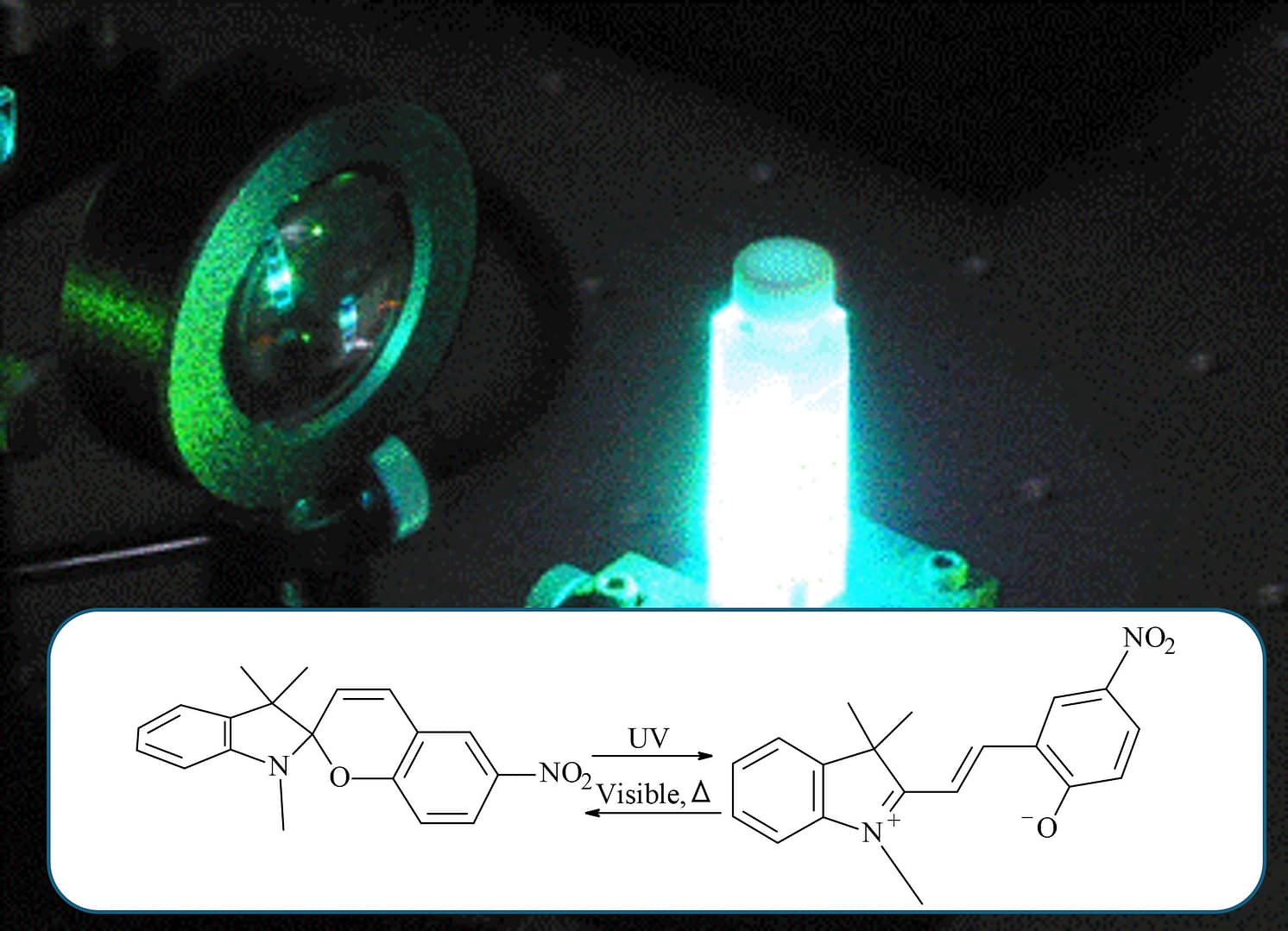
スピロピラン(SP)やスピロオキサジンは、光で 環が開く/閉じる「分子スイッチ」です。
この切り替えは とても速いことが多く、肉眼や通常の測定では“途中経過”が見えません。
→ TAなら、fs〜psの超短時間まで追えるので、
「いつ、どんな中間体ができて、どのくらいで消えるか」が見えてきます。
研究ハイライト
1) 水中でのプロトン移動をフェムト秒で追う(Chem. Eur. J., 2021)
メロシアニン(開環体)が 光でどのようにプロトン(H⁺)を放出するかを、
フェムト秒TAで追跡した研究です。
一般向けポイント
– 似た分子でも、プロトン化される場所が違うと、反応の道筋が変わる
– ある場合は、光反応をきっかけに「あとから酸性度が変わる」タイプ
– ある場合は、励起状態で超短時間(例:1.1 ps)でプロトンを放出するタイプ
– こうした“光で酸性が強くなる分子(フォトアシッド)”は、pH制御などの応用が期待されます
この論文の引用
– Kaiser, C et al.. Proton-Transfer Dynamics of Photoacidic Merocyanines in Aqueous Solution. Chemistry-A European Journal (2021) 27(35) 9160-9173. https://doi.org/10.1002/chem.202100168
2) 2つのスイッチを「波長で選んで」別々に動かす(Angew. Chem. Int. Ed., 2024)
アゾベンゼンとスピロピランを1分子に組み込んだ「ハイブリッド光スイッチ」を合成し、
静的分光+時間分解TA+量子化学計算で、波長選択的に制御できることを示した研究です。
一般向けポイント
– 光スイッチが複数あると多機能化できますが、狙った方だけ動かすのが難しい
– 分子の“つなぎ方”(meta / para)により、
– 互いに干渉しにくい(直交的)
– 吸収がずれて、波長で分けて操作できる
といった性質が変わる
– 材料設計(情報記録・エネルギー貯蔵など)へ向けた指針になります
この論文の引用
– Sassmannshausen, T et al.. Wavelength Selective Photocontrol of Hybrid Azobenzene-Spiropyran Photoswitches with Overlapping Chromophores. Angewandte Chemie-International Edition (2024) 63(10). https://doi.org/10.1002/anie.202314112
3) 固体結晶で「生成物が溜まる問題」を回避して超高速を測る(CrystEngComm, 2016)
固体中の光反応は、同じ場所に生成物が蓄積しやすく、繰り返し測定が難しいことがあります。
この研究は、励起後に波長選択した超短パルスを追加して生成物蓄積を抑え、
薄い結晶中のスピロオキサジンのリングオープン反応をTAで観測しました。
一般向けポイント
– “測るほど試料が変わる”問題に、光パルス設計で対処
– recover before destroy(壊す前に回復させる)という発想
– 他のフォトクロミック分子や、構造解析(回折など)との併用にも展開が期待できます
この論文の引用
– Siddiqui, KM et al.. Synchronised photoreversion of spirooxazine ring opening in thin crystals to uncover ultrafast dynamics. Crystengcomm (2016) 18(38) 7212-7216. https://doi.org/10.1039/c6ce01049k
まとめ(この3報から見えること)
- 溶液(fs TA)では、プロトン移動など“最初の一瞬”まで見える
- 複合スイッチ(TA+計算)では、波長選択で“狙い撃ち”できる設計が可能
- 固体(工夫したTA)でも、生成物蓄積の壁を越えて超高速が測れる可能性がある
参考文献(添付ファイル内)
- Kaiser, C et al.. Proton-Transfer Dynamics of Photoacidic Merocyanines in Aqueous Solution. Chemistry-A European Journal (2021) 27(35) 9160-9173. https://doi.org/10.1002/chem.202100168
- Sassmannshausen, T et al.. Wavelength Selective Photocontrol of Hybrid Azobenzene-Spiropyran Photoswitches with Overlapping Chromophores. Angewandte Chemie-International Edition (2024) 63(10). https://doi.org/10.1002/anie.202314112
- Siddiqui, KM et al.. Synchronised photoreversion of spirooxazine ring opening in thin crystals to uncover ultrafast dynamics. Crystengcomm (2016) 18(38) 7212-7216. https://doi.org/10.1039/c6ce01049k
English (for your website)
Scope (limited to the attached file)
This page is based only on the three papers included in SP_TA_classics.txt and provides an accessible overview of how transient absorption (TA) reveals ultrafast photochromic dynamics in spiropyran/spirooxazine systems.
Transient absorption (TA) in plain words
After light excitation, molecules briefly populate excited states and transient intermediates.
TA tracks these short-lived changes using a pump (excite) → probe (measure) sequence.
- Observable: absorption change ΔA
- It tells you:
- reaction steps and pathways
- lifetimes of intermediates
- how environment (solution vs solid) alters dynamics
Time-scale intuition
- fs (10⁻¹⁵ s): earliest response and “reaction onset”
- ps (10⁻¹² s): structural/solvent relaxation, ultrafast proton transfer
- ns (10⁻⁹ s): longer-lived excited/intermediate states
- µs (10⁻⁶ s): slower post-processes (diffusion, follow-up chemistry)
Why “spiro” photochromic switches + TA?
Spiropyrans/spirooxazines are molecular switches that undergo ring opening/closing (often with a visible color change).
Key steps can occur on ultrafast time scales, making TA ideal to “watch the switch in real time.”
Highlights (3 papers)
1) Femtosecond proton-transfer dynamics in water (Chem. Eur. J., 2021)
A femtosecond TA study tracking how photoacidic merocyanines release protons in aqueous solution.
General-audience takeaways
– Different protonation sites can produce different proton-release pathways
– One behavior resembles a photoacid generator via pKₐ modulation after photoisomerization
– Another site can release a proton on an ultrafast time scale (e.g., 1.1 ps)
– Such photoacids are useful for spatiotemporal pH control and related applications
Reference
– Kaiser, C et al.. Proton-Transfer Dynamics of Photoacidic Merocyanines in Aqueous Solution. Chemistry-A European Journal (2021) 27(35) 9160-9173. https://doi.org/10.1002/chem.202100168
2) Wavelength-selective control of hybrid azo–spiropyran switches (Angew. Chem. Int. Ed., 2024)
A hybrid photoswitch containing azobenzene and spiropyran units studied by steady-state spectroscopy, TA, and quantum-chemical calculations.
General-audience takeaways
– Multi-switch molecules are attractive but require selective addressing
– Meta/para connectivity can alter coupling and spectral separation
– With appropriate wavelengths, the two switching units can be operated more independently
Reference
– Sassmannshausen, T et al.. Wavelength Selective Photocontrol of Hybrid Azobenzene-Spiropyran Photoswitches with Overlapping Chromophores. Angewandte Chemie-International Edition (2024) 63(10). https://doi.org/10.1002/anie.202314112
3) Ultrafast dynamics in thin crystals by minimizing photoproduct build-up (CrystEngComm, 2016)
A strategy using spectrally selected post-excitation ultrashort pulses to reduce photoproduct accumulation (“recover before destroy”), enabling TA studies of spirooxazine ring opening in thin crystals.
General-audience takeaways
– Pulse design can mitigate the “sample changes during measurement” problem in solids
– The approach may extend to other photochromic systems and structural probes
Reference
– Siddiqui, KM et al.. Synchronised photoreversion of spirooxazine ring opening in thin crystals to uncover ultrafast dynamics. Crystengcomm (2016) 18(38) 7212-7216. https://doi.org/10.1039/c6ce01049k
References (from the attached file)
- Kaiser, C et al.. Proton-Transfer Dynamics of Photoacidic Merocyanines in Aqueous Solution. Chemistry-A European Journal (2021) 27(35) 9160-9173. https://doi.org/10.1002/chem.202100168
- Sassmannshausen, T et al.. Wavelength Selective Photocontrol of Hybrid Azobenzene-Spiropyran Photoswitches with Overlapping Chromophores. Angewandte Chemie-International Edition (2024) 63(10). https://doi.org/10.1002/anie.202314112
- Siddiqui, KM et al.. Synchronised photoreversion of spirooxazine ring opening in thin crystals to uncover ultrafast dynamics. Crystengcomm (2016) 18(38) 7212-7216. https://doi.org/10.1039/c6ce01049k