日本語版:DSSC 最前線 ― 電子移動を「デザイン」する研究
このページは、Web of Science からエクスポートした
「DSSC_ET_Frontier.txt」 に含まれる論文だけをもとに構成しています。
対象論文(いずれも 2025 年前後のフロンティア研究):
- Shahat ら:β-シクロデキストリン(β-CD)共増感剤とアントロン系材料を用いた DSSC(J. Inorg. Organomet. Polym. Mater., 2025, Early Access)
- Norouzibazaz ら:Ni–Mn–Co 硫化物@NiCo₂S₄/N ドープカーボンナノチューブ対極(J. Power Sources 647 (2025) 237297)
- Yousef ら:新規フェノチアジン系色素と Ru 色素 N-719 の共増感 DSSC(RSC Adv. 15 (2025) 13896–13907)
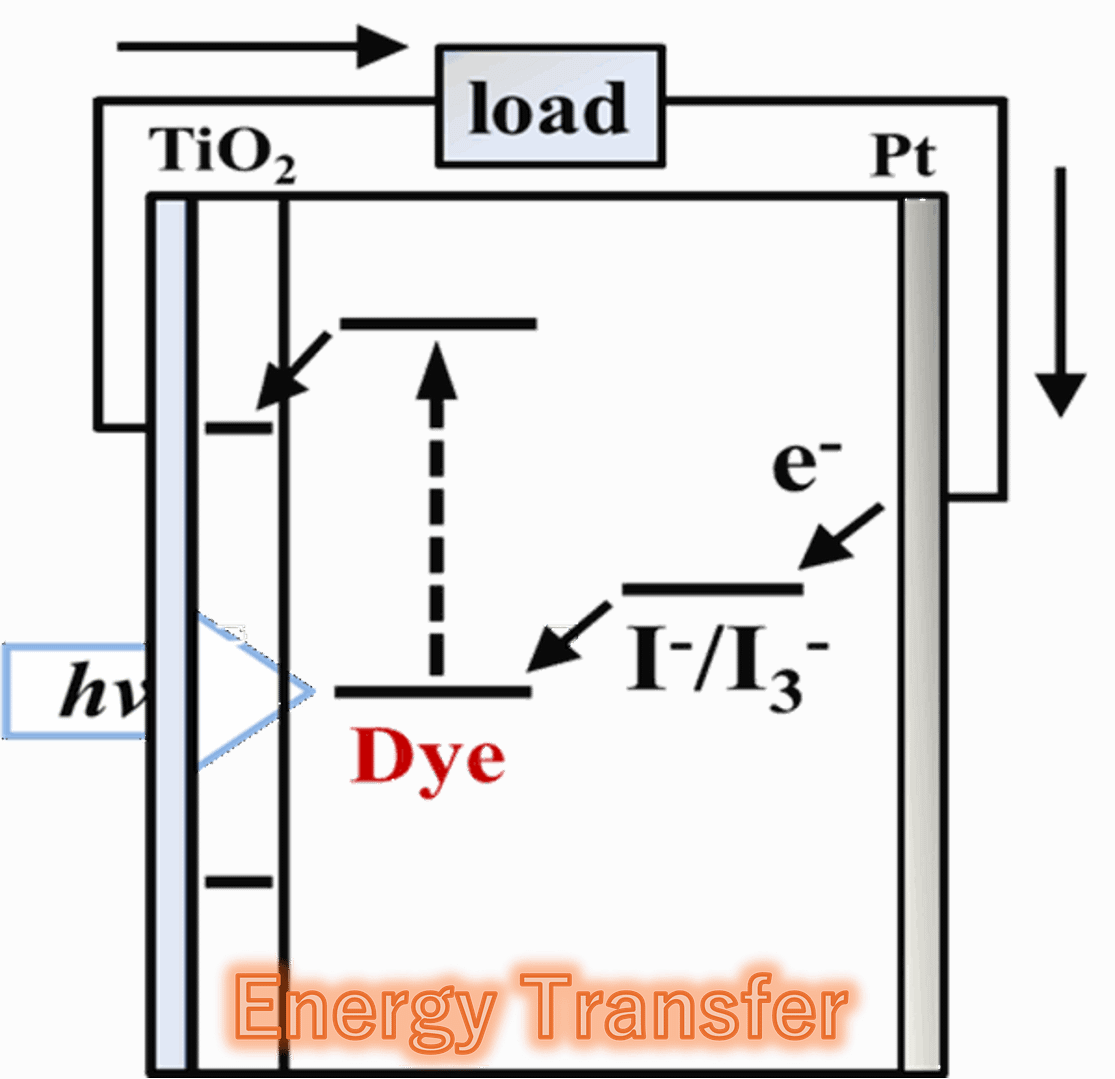
1. まず DSSC のしくみをおさらい
色素増感太陽電池(Dye-Sensitized Solar Cell, DSSC) は、
- ナノ多孔質の酸化チタン(TiO₂)に
- 光を吸収する「色素」をくっつけて
- その電子を TiO₂ → 電極 → 回路 へ流す
ことで発電する太陽電池です。
シリコン太陽電池とくらべて:
- カラフル・透明・曲げられる → デザイン性が高い
- 低照度(室内光など)でも発電しやすい → IoT センサーなどに最適
- 溶液プロセスで作製可能 → 低コスト化の可能性
といった特徴があります。
2. β-シクロデキストリンで「包んで」性能アップ(Shahat ら)
2-1. どんな研究?
Shahat らは、アントロン骨格の有機色素と
β-シクロデキストリン(β-CD) を組み合わせた
新しい 共増感・コンポジット材料 を DSSC に導入しました。
- アントロン誘導体(2-クロロアニリンなど)と β-CD を
包接体(インクルージョンコンプレックス)として設計 - グラフェン酸化物などと組み合わせて
白金フリーの低コスト対極/コンポジット電極として利用 - 微細構造(粗さ・粒径)の変化や UV–Vis、電気特性、J–V 特性を詳細に評価
2-2. 何が良くなった?
β-CD を導入すると、
- 吸収スペクトルがわずかにシフトし、
- バンドギャップが 約 2.59 eV に最適化、
- 表面粗さ・粒径分布が変化し、界面での電子移動がスムーズに。
その結果:
- 変換効率:2.65 → 4.12 % に向上
- 短絡電流密度 Jsc:9.63 → 12.41 mA/cm²
- 電荷移動抵抗 Rct:30.26 → 27.81 Ω に減少
など、電子移動が速くなり、再結合が抑えられたことが示されています。
2-3. 高校生向けワンポイント
- β-CD は「分子のカプセル」のような存在で、
- 色素や有機分子を包み込んで安定化し、並び方や距離を整えることで、
- 電子が動きやすい「分子の通り道」をつくっている、とイメージすると分かりやすいです。
3. Ni–Mn–Co 硫化物×N-CNT:高性能 Pt フリー対極(Norouzibazaz ら)
3-1. どんな研究?
Norouzibazaz らは、DSSC の 対極(カウンター電極) に注目しました。
ここでは、電解質の I₃⁻ を I⁻ に還元する反応が起こり、
触媒活性が高いと電池の性能が向上します。
開発した材料は:
- Ni–Mn–Co 硫化物@NiCo₂S₄ の中空ヨークシェル構造
- それを N ドープカーボンナノチューブ(N-CNT) 上に固定したハイブリッド
- ハイドロサーマル法+ソニケーションで合成
3-2. 性能はどのくらい?
白金対極と比較すると:
- Pt 対極 DSSC:6.81 %
- Ni–Mn–Co sulfides@NiCo₂S₄/N-CNT 対極 DSSC:9.18 %
と、白金を超える変換効率を達成しています。
理由としては、
- Ni–Mn–Co 硫化物と NiCo₂S₄ の相乗効果
- N-CNT による高い電気伝導性と大きな比表面積
- N-CNT と硫化物構造の強いカップリングによる
電子移動のしやすさと触媒活性の向上
が挙げられています。
3-3. ポイント
- 高価な白金を使わずに高効率を出せる → コストダウンに直結
- ナノ構造と複合化により、電子の流れやすさをデザインするという発想が重要です。
4. フェノチアジン系色素と Ru 色素の「共増感」(Yousef ら)
4-1. どんな研究?
Yousef らは、DSSC の色素そのものを工夫しました。
- 新しい フェノチアジン系有機色素 SR1–SR6 を合成
- それぞれ単独色素として、また Ru 色素 N-719 との
共増感(co-sensitization) 系として評価 - TiO₂ に吸着させたときのスペクトルシフトや吸収帯の広がりを測定
- 電気化学測定から HOMO/LUMO レベルを評価し、
電子注入や色素再生に適したエネルギー配置であることを確認
4-2. 効率はどうなった?
- フェノチアジン単独系では、SR1 が 4.22 %(Jsc = 11.96 mA/cm²)と最高
- N-719 との共増感系では、SR6 + N-719 が
9.77 %(Jsc = 21.63 mA/cm²)まで向上
さらに、インピーダンス測定(EIS)から、
- 共増感デバイスでは電荷移動抵抗 Rct が大きくなり、
- 逆に電子の再結合が抑制されていることが示唆されています。
4-3. 高校生向けイメージ
- 「色素を 1 種類だけ」よりも、「役割の少し違う色素を 2 種類組み合わせる」ことで、
- より広い波長の光をキャッチでき、
- 電子の動きも効率よく整理できる → チームプレイで高効率化、というイメージです。
5. 3 本の論文から見える DSSC 研究の今後
これら 3 本のフロンティア論文から、DSSC 研究のトレンドとして次のような点が見えてきます。
- 分子レベルの設計(β-CD 包接体・共増感)
- 分子の形や距離を制御して、電子移動と再結合をコントロール。
- ナノ複合対極で Pt フリー&高効率
- 硫化物ナノ構造 × 導電性カーボンで、白金を超える触媒活性を実現。
- 新規有機色素+Ru 色素の共増感
- 光吸収範囲を広げつつ、エネルギーレベルと界面抵抗を最適化。
DSSC はすでに「成熟した技術」に見えますが、
電子移動と界面のデザインを工夫することで、
今もなお効率と機能が更新され続けていることがわかります。
6. 用語ミニ解説
- 共増感(co-sensitization)
複数種類の色素を同じ電極に吸着させて、光吸収範囲を広げたり電子移動を調整する方法。 - 対極(counter electrode)
電解質のイオンを還元(あるいは酸化)して、回路全体の電荷バランスをとる電極。触媒活性が重要。 - 電荷移動抵抗 Rct
界面で電荷が移動するときの「抵抗」の指標。小さいほど電子が流れやすい。
7. 参考文献(DSSC_ET_Frontier.txt に含まれる論文)
- Shahat, M. A.; Dardeer, H. M.; Rashwan, G. M.; Ghitas, A.; Taha, A. G.
Unveiling the Synergistic Effects of Novel β-Cyclodextrin Co-sensitizers on Anthrone-Based Dye-Sensitized Solar Cells (DSSCs) with Microstructural Modifications.
Journal of Inorganic and Organometallic Polymers and Materials, Early Access, 2025. DOI: 10.1007/s10904-025-03944-9. - Norouzibazaz, M.; Gholivand, M. B.; Taherpour, A. A.
Design and fabrication of Ni-Mn-Co sulfides@NiCo₂S₄ structure anchored on nitrogen-doped carbon nanotubes as a sufficient and promising counter electrode for high-efficiency dye-sensitized solar cells.
Journal of Power Sources, 647 (2025) 237297. DOI: 10.1016/j.jpowsour.2025.237297. - Yousef, S. H.; Abdel-Latif, E.; Badawy, S. A.; Elmorsy, M. R.
Novel phenothiazine-based sensitizers for high-performance dye-sensitized solar cells: enhanced photovoltaic properties through strategic co-sensitization with N-719.
RSC Advances, 15 (2025) 13896–13907. DOI: 10.1039/d5ra00694e.
English Version: Frontier DSSCs – Designing Electron Transfer
This English section gives a concise overview of the same three frontier papers
for international readers and students.
1. Background
Dye-sensitized solar cells (DSSCs) generate electricity by:
- attaching dye molecules to nanostructured TiO₂,
- letting the dye absorb light and inject electrons into TiO₂,
- and collecting these electrons through an external circuit.
The frontier studies in DSSC_ET_Frontier.txt focus on how to design and improve electron transfer via:
- host–guest co-sensitizers based on β-cyclodextrin,
- advanced Pt-free counter electrodes, and
- new organic sensitizers combined with Ru dyes.
2. β-cyclodextrin co-sensitizers for anthrone-based DSSCs (Shahat et al.)
Shahat et al. introduced anthrone-based composites combined with
β-cyclodextrin (β-CD) as innovative, low-cost, Pt-free components in DSSCs.
Key points:
- β-CD forms inclusion complexes with anthrone derivatives
(e.g., 2-chloroaniline@β-CD), tuning microstructure and optical properties. - Structural and optical analyses (UV–Vis, SEM, roughness) show
improved light harvesting and optimized band gap (~2.59 eV). - Device performance improves markedly:
- efficiency: 2.65 → 4.12 %
- Jsc: 9.63 → 12.41 mA cm⁻²
- Rct decreases, indicating enhanced electron transfer and suppressed recombination.
This work demonstrates how host–guest chemistry (β-CD) can be used to
engineer electron pathways and boost DSSC performance.
3. Ni–Mn–Co sulfides@NiCo₂S₄ on N-doped CNTs as Pt-free counter electrodes (Norouzibazaz et al.)
Norouzibazaz et al. designed a yolk–shell Ni–Mn–Co sulfides@NiCo₂S₄ structure
anchored on N-doped carbon nanotubes (N-CNTs) as a counter electrode.
Highlights:
- Large surface area and high conductivity from N-CNTs.
- Synergistic effects between Ni–Mn–Co sulfides and NiCo₂S₄
provide strong catalytic activity for triiodide reduction. - DSSCs using this CE reach 9.18 % efficiency,
outperforming Pt-based devices (~6.81 %).
This shows that carefully designed nanostructured hybrid catalysts
can replace Pt in DSSCs while improving performance.
4. Phenothiazine-based sensitizers and co-sensitization with N-719 (Yousef et al.)
Yousef et al. synthesized a series of phenothiazine-based organic dyes (SR1–SR6)
and tested them:
- as single sensitizers, and
- in co-sensitization with the classical Ru dye N-719.
Main findings:
- Adsorbed on TiO₂, the dyes show broadened and red-shifted absorption,
indicating strong electronic coupling. - Electrochemical data (GSOP, ESOP) confirm suitable energy level alignment
for electron injection and dye regeneration. - Performance:
- best single-dye cell (SR1): 4.22 %, Jsc = 11.96 mA cm⁻²
- best co-sensitized cell (SR6 + N-719): 9.77 %, Jsc = 21.63 mA cm⁻²
- EIS reveals higher Rct for successful co-sensitized devices,
consistent with reduced recombination and improved interfacial stability.
This illustrates how co-sensitization with tailored organic dyes can
extend the absorption range and optimize interfacial electron transfer.
5. Take-home messages
From these three frontier papers we learn that:
- Molecular and supramolecular design matters
– β-CD inclusion complexes can tune energy levels and microstructure
to facilitate electron transfer. - Pt-free counter electrodes are realistic
– Nanostructured sulfide/N-CNT hybrids already surpass Pt in DSSC efficiency. - Smart co-sensitization boosts efficiency
– Combining new organic dyes with classical Ru dyes allows broader
light harvesting and better control of recombination.
Overall, DSSCs remain a lively research field, where electron transfer at
interfaces is precisely engineered to achieve efficient, stable, and
cost-effective solar energy conversion.
References
- Shahat, M. A.; Dardeer, H. M.; Rashwan, G. M.; Ghitas, A.; Taha, A. G.
Unveiling the Synergistic Effects of Novel β-Cyclodextrin Co-sensitizers on Anthrone-Based Dye-Sensitized Solar Cells (DSSCs) with Microstructural Modifications.
Journal of Inorganic and Organometallic Polymers and Materials, Early Access, 2025. DOI: 10.1007/s10904-025-03944-9. - Norouzibazaz, M.; Gholivand, M. B.; Taherpour, A. A.
Design and fabrication of Ni-Mn-Co sulfides@NiCo₂S₄ structure anchored on nitrogen-doped carbon nanotubes as a sufficient and promising counter electrode for high-efficiency dye-sensitized solar cells.
Journal of Power Sources, 647 (2025) 237297. DOI: 10.1016/j.jpowsour.2025.237297. - Yousef, S. H.; Abdel-Latif, E.; Badawy, S. A.; Elmorsy, M. R.
Novel phenothiazine-based sensitizers for high-performance dye-sensitized solar cells: enhanced photovoltaic properties through strategic co-sensitization with N-719.
RSC Advances, 15 (2025) 13896–13907. DOI: 10.1039/d5ra00694e.