DSSC_20260308
① p型色素を“接着剤&修復剤”として活用 — 逆構造ペロブスカイト太陽電池 (Small, 2026, Early Access)
論文:Zhao et al.「A P‑Type Organic Dye as Interface Layer for Efficient and Stable Inverted Perovskite Solar Cells」
– ポイント:p型DSSCで使われる有機色素(TPA‑CN)を、NiOₓとペロブスカイトの界面単分子膜(SAM)として利用し、電荷移動の橋渡しと欠陥のパッシベーションを同時に実現。
– なぜ効く? TPA‑CNのカルボキシル基がNi³⁺欠陥を、シアノ基がペロブスカイト中のPb²⁺未配位サイトをそれぞれ化学的に“埋める”ことで、トラップが減って電流が流れやすくなる。
– 効果:未改質の21.80%に対し、PCE 25.54%まで向上。未封止でも大気下1800時間で初期の89.2%、1 sun連続500時間で95.3%を保持。DSSC発の色素分子設計を次世代太陽電池へ横展開できる好例。
② “棒状チタン酸化物”の作り時間がキモ — TiO₂ナノロッドDSSC (ChemPhotoChem, 2026)
論文:Yadav et al.「Optimizing TiO₂ Nanorods Synthesis for High‑Performance Dye‑Sensitized Solar Cells」
– 背景:DSSCの発電は光を受ける電極(フォトアノード)で決まる部分が大きく、電子がまっすぐ流れやすい構造が有利。TiO₂ナノロッドはその有力候補。
– 発見:加水熱反応の時間を4〜9時間で比較すると、8時間で配列の良いナノロッドができ、結晶性↑/欠陥↓/適正バンドギャップ(≈2.98 eV)が揃って再結合損失が減少。
– 結果:8時間条件のDSSCが効率0.97%で最良。“作る時間”の最適化が自然色素系DSSCの性能鍵になることを示した。
③ 色素の“つけ置き時間”で性能が変わる — TiO₂/ZnOハイブリッドDSSC (Materia, 2026)
論文:Nunes et al.「Study of the dye sensitizing time effect on TiO₂/ZnO photoanode for solar cell」
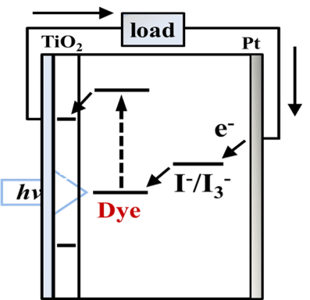
– ねらい:定番色素N719の吸着(感作)時間を変えると、発電電流(Jsc)や変換効率はどう変わる?
– 答え:長めの感作でJscと効率が向上。本研究では電流の最適は約6時間、効率の最適は約4時間。電極材料はTiO₂/ZnOのハイブリッド。
– 示唆:研究室や工場でのプロセス時間の見直しだけでも、コストを増やさずに性能改善できる可能性。
🇬🇧 English Version
1) Borrowing a p‑DSSC dye for perovskites (Small, 2026, Early Access)
- Idea: A p‑type organic dye (TPA‑CN)—typical in p‑type DSSCs—is repurposed as a self‑assembled monolayer at the NiOₓ/perovskite interface, simultaneously bridging charge transport and passivating defects.
- How it works: Carboxyl groups passivate Ni³⁺ defects in NiOₓ, while cyano groups bind under‑coordinated Pb²⁺ in the buried perovskite, cutting trap density and facilitating hole extraction.
- Outcome: PCE 25.54% vs. 21.80% (control); unencapsulated devices retain 89.2% of initial PCE after 1800 h at ambient (ISOS‑D‑1) and 95.3% after 500 h continuous 1‑sun. A blueprint for translating DSSC dye chemistry into next‑gen solar cells.
2) Time matters for TiO₂ nanorods (ChemPhotoChem, 2026)
- Context: DSSC efficiency heavily depends on the photoanode. TiO₂ nanorods help direct electrons and suppress recombination.
- Finding: 8 h hydrothermal growth on FTO yields highly aligned rods with better crystallinity, lower defect density, and an optimal bandgap (~2.98 eV), minimizing recombination.
- Performance: The 8 h device reached 0.97% efficiency—highlighting that precise growth time control is key, especially for natural‑dye DSSCs.
3) Simply soaking longer can help—up to a point (Materia, 2026)
- Question: How does dye‑sensitization time with N719 affect a TiO₂/ZnO photoanode?
- Answer: Longer sensitization generally improved Jsc and efficiency; here, ~6 h maximized current and ~4 h maximized efficiency.
- Takeaway: Process-time tuning can boost DSSC performance without extra material cost.
文献 / References
- Zhao, M. M.; Wu, L. M.; Gong, K.; Gu, W. M.; Wei, P. Q.; Jiang, K. J.; Liu, D. Z.; Zhou, X. Q. A P‑Type Organic Dye as Interface Layer for Efficient and Stable Inverted Perovskite Solar Cells. Small (Early Access, 2026). DOI: 10.1002/smll.72953.
- Yadav, S. C.; Tiwari, M. K.; Ohshita, Y.; Lee, H.; Ogura, A.; Shirage, P. M.Optimizing TiO₂ Nanorods Synthesis for High‑Performance Dye‑Sensitized Solar Cells: An Experimental Study on Time‑Dependent Growth and Characterization. ChemPhotoChem 10 (2), Feb 2026, e202500187. DOI: 10.1002/cptc.202500187.
- Nunes, V. F.; de Andrade, C. F.; Freire, F. N. A.; Sombra, A. S. B. Study of the dye sensitizing time effect on TiO₂/ZnO photoanode for solar cell. Materia (Rio de Janeiro) 31 (2026), Article 20250903. DOI: 10.1590/1517-7076-RMAT-2025-0903.
免責 / Disclaimer:本資料は一般向け解説です。装置設計や量産条件の最終判断は原著論文を参照し、専門家の監督の下で行ってください。Abstract本文は直接記載していません。