作成日: 2026-02-07
日本語版(HP向け)
どんなテーマ?
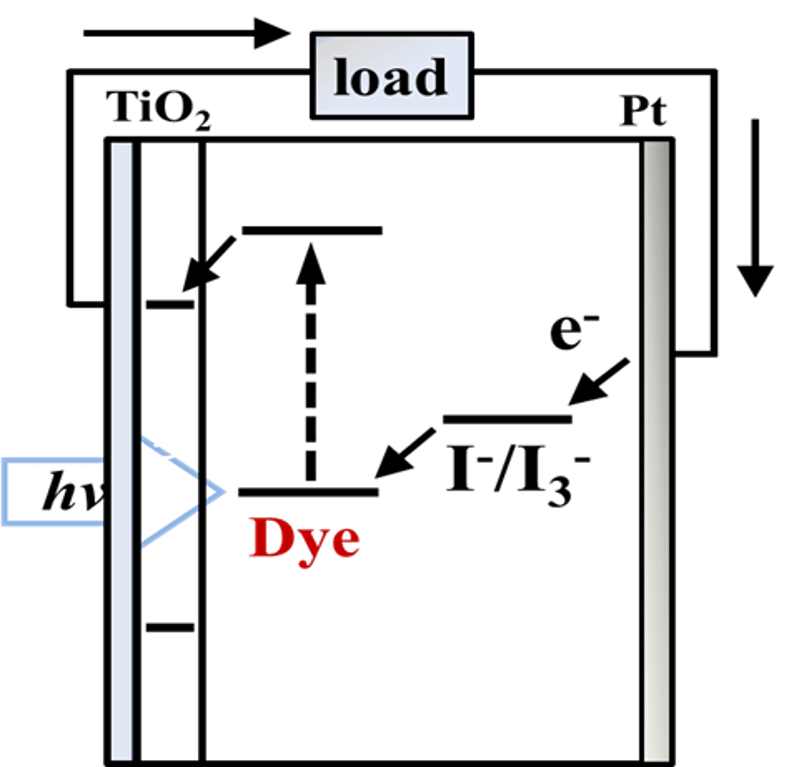
色素増感太陽電池(DSSC)は、色素が光を吸収して電子を励起し、TiO₂などの酸化物半導体へ電子を注入することで発電するデバイスです。
性能を左右する主な要素は、(1) 光電極(TiO₂構造)、(2) 電解質(安定性・伝導性)、(3) 対極(触媒性・導電性)、そして(4) 色素(光吸収・電荷移動)です。
以下では、これらの要素に関わる研究を3本紹介します。
ピックアップ論文
1. Sustainable integration of poly(ethylene oxide)-polyacrylonitrile (PEO-PAN) gel electrolytes with mesoporous TiO₂ nanostructures for green energy dye-sensitized solar cells
- 掲載誌: SUSTAINABLE ENERGY TECHNOLOGIES AND ASSESSMENTS(JIF 2024: 7.0)
- 年: 2026
- 著者: Gilani, SEH; Farooq, M; Nazar, R; Younas, M; Mehmood, U
- DOI: 10.1016/j.seta.2026.104830
やさしい解説(Abstractの要点を整理:本文の転載なし)
– DSSCの高効率化と長期安定化には、光電極(TiO₂)だけでなく電解質(特に液漏れしにくい準固体化)も同時に最適化する必要があります。
– 本研究は、(1) メソポーラスで電子輸送経路を改善したTiO₂ナノ構造(インターディジテッド形状)と、(2) PEO–PANブレンドのゲル電解質(PBGE)を組み合わせる“二本立て”戦略を提案しました。
– 分子動力学(MD)計算でブレンドの相溶性を評価し、実験でも形態・結晶性を確認して、最適比としてPAN:PEO=40:60を選定。
– Taguchi法で塩組成などを最適化し、イオン伝導度を高め、EIS/CVでレドックス反応の可逆性やイオン移動の改善を示しました。
– 最適化セルは、液体電解質セルより高いPCE(例:6.13%)と、準固体系としての実用性(漏れにくさ・安定性)を示したと報告しています。
2. Transparent Cu-Pd decorated MoS2@functionalized carbon nanofiber composite counter electrodes: Efficient bifacial dye-sensitized solar cell
- 掲載誌: JOURNAL OF ALLOYS AND COMPOUNDS(JIF 2024: 6.3)
- 年: 2026
- 著者: Upadhyay, S; Balachandran, M
- DOI: 10.1016/j.jallcom.2026.186168
やさしい解説
– DSSCの対極(カウンター電極)には、電解質中のI₃⁻/I⁻反応を速く進める触媒性と、導電性が必要です。透明化できれば両面(バイフェイシャル)DSSCに有利です。
– 本研究は、MoS2を基盤にしつつ、カーボンナノファイバー(CNF)で導電経路と活性点を増やし、さらにCu–Pdの二元金属ナノ粒子で触媒性を強化した透明対極を作製しました。
– CV・Tafel・EISで触媒特性を評価し、電荷移動抵抗(Rct)が低下することで反応性が向上することを示しました(複合化が効く)。
– セル性能では、MoS2単独やPt対極と比べて短絡電流密度と変換効率が改善し、前面照射で最大7.77%程度の効率を達成したと報告しています。
– 背面照射でも動作できる点から、窓面などへの応用を想定した両面DSSC構成に向く材料設計として位置づけられます。
3. Spectroscopic and DFT studies of a quinazolinone heterocycle for DSSC energy and CCHF antiviral applications
- 掲載誌: JOURNAL OF MOLECULAR STRUCTURE(JIF 2024: 4.7)
- 年: 2026
- 著者: Sulaiman, DD; Muhammad, MM; Ibrahim, MK; Dawood, AA; Mohammed, SR
- DOI: 10.1016/j.molstruc.2026.145325
やさしい解説
– 新しい色素候補をDSSCに使うには、光吸収(遷移)や電荷移動特性、分子軌道などを総合的に評価する必要があります。
– 本研究は、キナゾリノン系ヘテロ環化合物を合成し、IR/NMR/HRMS等で構造確認した上で、DFT/TD‑DFTで電子状態と光学特性を解析しました。
– TD‑DFTから、π→π*遷移が強く、溶媒中での光捕集効率(LHE)が良いことを示し、DSSC感光色素としての可能性を議論しています。
– 加えて分子ドッキングにより、がん関連タンパク質やCCHFウイルス関連標的に対する結合可能性も評価し、医薬リードとしての側面も示しました。
– DSSC視点では、吸収強度・電荷移動(ICT)・安定性の指標をまとめ、次段階(電極吸着・素子評価)につながる基礎データを提供しています。
English version (for website)
What is this topic about?
Dye‑sensitized solar cells (DSSCs) generate electricity when a dye absorbs light, injects electrons into a semiconductor (often TiO₂), and a redox electrolyte regenerates the dye.
Key performance levers include (1) TiO₂ photoanode architecture, (2) electrolyte conductivity/stability, (3) counter‑electrode catalysis/conductivity, and (4) dye absorption and charge‑transfer properties.
Below are three highlighted papers from the attached file.
1. Sustainable integration of poly(ethylene oxide)-polyacrylonitrile (PEO-PAN) gel electrolytes with mesoporous TiO₂ nanostructures for green energy dye-sensitized solar cells
- Journal: SUSTAINABLE ENERGY TECHNOLOGIES AND ASSESSMENTS (2024 JIF: 7.0)
- Year: 2026
- Authors: Gilani, SEH; Farooq, M; Nazar, R; Younas, M; Mehmood, U
- DOI: 10.1016/j.seta.2026.104830
Plain-language bullets (paraphrased from the abstract; no verbatim text)
– Improving both efficiency and durability in DSSCs requires concurrent optimization of the TiO2 photoanode and the electrolyte (especially leakage‑resistant quasi‑solid systems).
– This study combines (i) an interdigitated mesoporous TiO2 nanostructure for better light harvesting/transport and (ii) a sustainable PEO–PAN blend gel electrolyte (PBGE).
– Molecular dynamics (MD) evaluates blend miscibility and guides composition; experiments support an optimal PAN:PEO = 40:60 ratio with favorable amorphous/homogeneous morphology.
– A Taguchi design‑of‑experiments approach optimizes salt/composition to maximize ionic conductivity; EIS/CV indicate improved ion mobility and redox reversibility.
– The optimized DSSC achieves higher PCE (e.g., 6.13%) than a conventional liquid‑electrolyte cell while supporting enhanced stability for quasi‑solid‑state devices.
2. Transparent Cu-Pd decorated MoS2@functionalized carbon nanofiber composite counter electrodes: Efficient bifacial dye-sensitized solar cell
- Journal: JOURNAL OF ALLOYS AND COMPOUNDS (2024 JIF: 6.3)
- Year: 2026
- Authors: Upadhyay, S; Balachandran, M
- DOI: 10.1016/j.jallcom.2026.186168
Plain-language bullets (paraphrased from the abstract; no verbatim text)
– DSSC counter electrodes must catalyze the I3−/I− redox reaction while maintaining high conductivity; transparency benefits bifacial DSSCs.
– This work builds a transparent counter electrode based on MoS2, enhanced by carbon nanofibers (CNF) for conductivity/active sites and bimetallic Cu–Pd nanoparticles for stronger electrocatalysis.
– Electrochemical tests (CV, Tafel, EIS) show reduced charge‑transfer resistance (Rct) and improved catalytic kinetics upon forming the composite.
– Device tests report higher Jsc and efficiency than bare MoS2 and Pt, reaching up to ~7.77% under front illumination for the best composite.
– Rear‑illumination compatibility highlights potential for practical bifacial DSSC configurations (e.g., window‑integrated photovoltaics).
3. Spectroscopic and DFT studies of a quinazolinone heterocycle for DSSC energy and CCHF antiviral applications
- Journal: JOURNAL OF MOLECULAR STRUCTURE (2024 JIF: 4.7)
- Year: 2026
- Authors: Sulaiman, DD; Muhammad, MM; Ibrahim, MK; Dawood, AA; Mohammed, SR
- DOI: 10.1016/j.molstruc.2026.145325
Plain-language bullets (paraphrased from the abstract; no verbatim text)
– Evaluating a new DSSC sensitizer requires understanding absorption strength, charge‑transfer character, and molecular orbital features.
– This work synthesizes a quinazolinone heterocycle and confirms its structure by IR/NMR/HRMS, then applies DFT/TD‑DFT to analyze electronic and optical properties.
– TD‑DFT indicates strong π→π* transitions and favorable light‑harvesting efficiency (LHE) in solution, suggesting potential as a DSSC sensitizer.
– Molecular docking additionally probes binding to cancer‑related and CCHF virus targets, highlighting possible medicinal‑chemistry relevance.
– From a DSSC standpoint, it provides a theoretical/experimental foundation (ICT, stability, absorption) for subsequent electrode adsorption and device testing.
参考文献 / References
- Gilani, SEH; Farooq, M; Nazar, R; Younas, M; Mehmood, U (2026). Sustainable integration of poly(ethylene oxide)-polyacrylonitrile (PEO-PAN) gel electrolytes with mesoporous TiO2 nanostructures for green energy dye-sensitized solar cells. SUSTAINABLE ENERGY TECHNOLOGIES AND ASSESSMENTS 86 Article 104830. doi:10.1016/j.seta.2026.104830
- Upadhyay, S; Balachandran, M (2026). Transparent Cu-Pd decorated MoS2@functionalized carbon nanofiber composite counter electrodes: Efficient bifacial dye-sensitized solar cell. JOURNAL OF ALLOYS AND COMPOUNDS 1053 Article 186168. doi:10.1016/j.jallcom.2026.186168
- Sulaiman, DD; Muhammad, MM; Ibrahim, MK; Dawood, AA; Mohammed, SR (2026). Spectroscopic and DFT studies of a quinazolinone heterocycle for DSSC energy and CCHF antiviral applications. JOURNAL OF MOLECULAR STRUCTURE 1358 Article 145325. doi:10.1016/j.molstruc.2026.145325