date: “2026-01-05”
CDフロンティア:シクロデキストリンが「溶けない・効かせる・測る」を変える(最新3報のやさしい解説)
まず結論(1分でわかる)
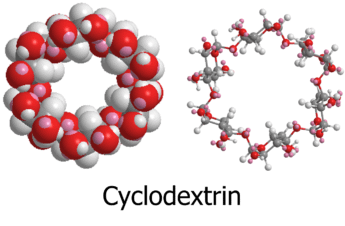
シクロデキストリン(CD)は、ドーナツ型の“分子の入れ物”です。水に溶けにくい成分を中に入れる(包接する)ことで、次のような役割を果たせます。fileciteturn3file0
- 溶けやすくする/安定にする(薬のデリバリー)
- 必要なときだけ放出させる(刺激で放出)
- 狙った分子だけを“見分ける”センサーの部品になる
ここでは、添付ファイル(CD_Frontier.txt)に入っている最新3報を、一般向けにやさしく解説します。
研究①:CDで“安定なNO放出剤”を作る(医療材料)
論文:Wang et al., Materials & Design (2026). DOI: 10.1016/j.matdes.2025.115274
何が課題?
一酸化窒素(NO)は生体で重要な信号分子ですが、NOを出す材料は保存安定性や水への溶けにくさが課題になりがちです。
CDで何をした?(アイデア)
疎水性のNOドナー(SNAT)を、ヒドロキシプロピル-β-CDで包みこみ、さらに特徴的な “サンドイッチ型”包接複合体(CD-SNAT)として安定化しました。
何がすごい?(結果のポイント)
– 水に溶けやすくなり、生理的pHでも安定
– システイン(体内のチオール)や UV光でNO放出をトリガーできる
– 固体の複合体が室温6か月保存でも90%超が保持と報告
一般向けに言うと
CDは「中身を守るケース」になり、“必要なときにだけスイッチON”でNOを出せる素材に近づけています。
研究②:α-CDを使った“薬の検出センサー”(分子認識)
論文:Roushani et al., International Journal of Electrochemical Science (2026). DOI: 10.1016/j.ijoes.2025.101265
何が課題?
血液などの複雑な試料から、薬(ここでは diroximel fumarate)を選択的に検出すること。
CDで何をした?(アイデア)
α-CDをモノマーとして電極上に重合し、標的分子を“型”にして作る 分子インプリントポリマー(MIP)センサーを構築しました。
何がすごい?(結果のポイント)
– 0.01–1300 nM の範囲で直線応答
– 検出限界(LOD)0.0033 nM と報告
– 実試料での適用や、HPLCでの確認も記載
一般向けに言うと
CDは「分子がはまりやすい形」を持つので、MIPと組み合わせると “この分子だけ反応しやすい電極”を作りやすくなります。
研究③:β-CDポリマーで“コレステロール異常”に挑む(疾患モデル)
論文:Kubohira et al., Carbohydrate Polymers (2026). DOI: 10.1016/j.carbpol.2025.124676
何が課題?
ニーマン・ピック病C型(NPC)などでは、細胞内のコレステロール蓄積が問題になり、神経症状とも関係します。
CDで何をした?(アイデア)
エピクロロヒドリンで架橋した水溶性β-CDポリマー(β-CDP)を用い、体内での滞在時間(循環時間)や安全性の改善を狙っています。
何がすごい?(結果のポイント)
– コレステロールが蓄積した細胞で、遊離コレステロール低下とオートファジー機能の改善を報告
– マウス(NPCモデル)で、皮下投与後に循環時間の長さや、コレステロール蓄積の低下を観察
一般向けに言うと
CDを「単体」で使うだけでなく、ポリマー化して“長持ちするCD”にすることで、体内で働く時間を伸ばす発想です。
3報をつなぐ:CDの“3つの強み”
- 溶けない問題を解決(疎水性分子を包む)
- 守って、合図で放す(刺激応答の設計がしやすい)
- 見分ける(分子認識)(選択性の部品になれる)
参考文献(添付ファイル内の3報のみ)
- Wang, X. Y. et al. Novel stable “sandwich” cyclodextrin inclusion of a lipophilic S-nitrosothiol for controlled delivery of nitric oxide. Materials & Design (2026). DOI: 10.1016/j.matdes.2025.115274.
- Roushani, M. et al. Electrochemical detection of diroximel fumarate using an α-cyclodextrin-based molecularly imprinted polymer sensor in human serum. International Journal of Electrochemical Science (2026). DOI: 10.1016/j.ijoes.2025.101265.
- Kubohira, Y. et al. A water-soluble β-cyclodextrin polymer reduces cholesterol accumulation and autophagy dysfunction in vitro and in Niemann-Pick type C disease model mice. Carbohydrate Polymers (2026). DOI: 10.1016/j.carbpol.2025.124676.
Cyclodextrin Frontier: How CDs Improve Solubility, Delivery, and Sensing (a plain-language guide to three recent papers)
Take-home message (in 1 minute)
Cyclodextrins (CDs) are donut-shaped molecular hosts. By “including” (encapsulating) hydrophobic guests, CDs can help:
- Increase apparent solubility and stability
- Enable triggered release (by light or biomolecules)
- Add molecular recognition to sensors
Below is a plain-language guide to three recent papers contained in the attached file (CD_Frontier.txt).
Paper 1: A stable, triggerable NO-delivery platform using CD inclusion
Paper: Wang et al., Materials & Design (2026). DOI: 10.1016/j.matdes.2025.115274 fileciteturn3file0
Problem: Many nitric-oxide (NO) donor systems struggle with poor water compatibility and limited storage stability.
CD idea: The authors formed a “sandwich” inclusion complex (CD–SNAT) using hydroxypropyl-β-cyclodextrin to host a highly lipophilic S-nitrosothiol (SNAT).
Key outcomes (as reported)
– Improved aqueous solubility and stability at physiological pH
– NO release can be triggered by cysteine (thiols) or UV light
– The solid complex reportedly remained >90% intact after 6 months at room temperature
Paper 2: An α-CD based molecularly imprinted electrochemical sensor
Paper: Roushani et al., Int. J. Electrochemical Science (2026). DOI: 10.1016/j.ijoes.2025.101265
Problem: Selective detection of a drug (diroximel fumarate) in complex samples.
CD idea: An electrochemical sensor was built by electropolymerizing α-cyclodextrin as a monomer in a molecularly imprinted polymer (MIP) format on a glassy carbon electrode.
Key outcomes (as reported)
– Linear response from 0.01 to 1300 nM
– Limit of detection (LOD) 0.0033 nM
– Application to a real sample and confirmation by HPLC are described
Paper 3: A water-soluble β-CD polymer for cholesterol-related pathology models
Paper: Kubohira et al., Carbohydrate Polymers (2026). DOI: 10.1016/j.carbpol.2025.124676
Problem: Cholesterol accumulation is implicated in Niemann–Pick type C (NPC) and is discussed in relation to neurodegeneration.
CD idea: A water-soluble β-cyclodextrin polymer (β-CDP) cross-linked by epichlorohydrin was evaluated to improve circulation time and safety.
Key outcomes (as reported)
– Reduced free cholesterol and improved autophagy dysfunction in cholesterol-loaded cells
– After subcutaneous administration in NPC model mice, longer circulation time and reduced cholesterol accumulation were observed
One theme across all three papers: what CDs are good at
- Solubilizing hydrophobic guests
- Protecting and enabling triggered release
- Providing molecular recognition for sensing
References (only the three papers in the attached file)
- Wang, X. Y. et al. Materials & Design (2026). DOI: 10.1016/j.matdes.2025.115274.
- Roushani, M. et al. International Journal of Electrochemical Science (2026). DOI: 10.1016/j.ijoes.2025.101265.
- Kubohira, Y. et al. Carbohydrate Polymers (2026). DOI: 10.1016/j.carbpol.2025.124676.