このページでわかること
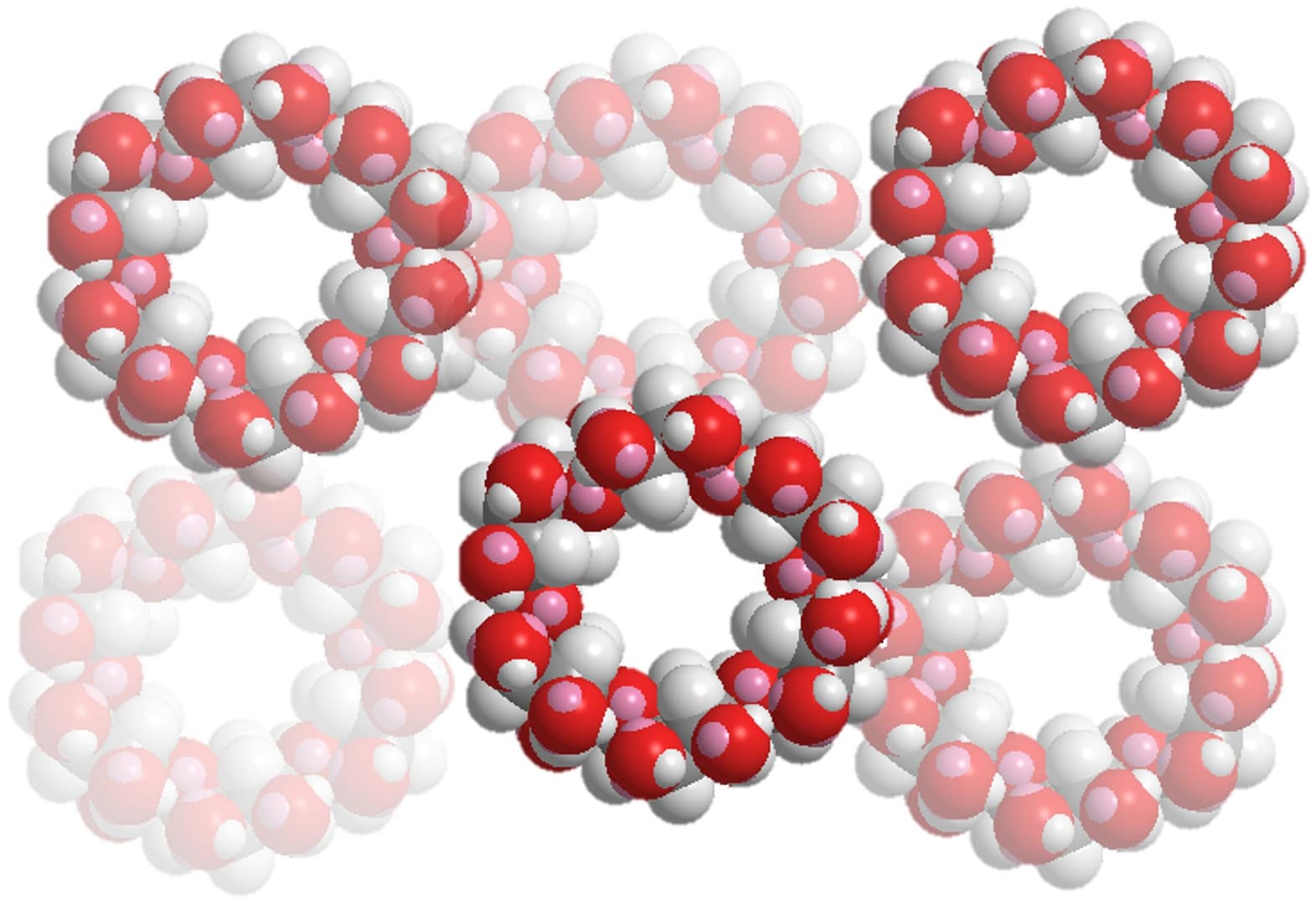
シクロデキストリン(Cyclodextrin; CD)は、分子を“空洞”に取り込む ホスト–ゲスト(包接) で有名な環状分子です。
CDを高分子化した CDポリマー(CDP)は、CDの分子認識を保ちつつ、水溶性・安定性・薄膜形成・体内滞留性 などを強化できるため、応用研究が急速に広がっています。
このページは、添付ファイル CD_Polymer_Frontier.txt に含まれる 3本の論文のみ を使い、一般向けに要点をまとめたものです。
まず:CDポリマーって何がうれしいの?
CDポリマーは、単分子のCDよりも次の点で“実用寄り”になります。
- 水に溶けやすくしやすい(設計しだいで水溶化・分散性を調整)
- 大きくなって機能が長持ち(体内滞留、材料としての耐久性)
- 表面・界面に固定しやすい(センサー電極、コーティング、複合材料など)
- 多数のCD空洞を一括で提供(“取り込み点”を多点化できる)
論文1(レビュー):農業で「狙って届けて、環境負荷を減らす」分子認識ナノ材料
Coordination bond-driven rational design of biorecognition nanomaterials for precision localization and environmental safety in agriculture
– 種別:Review(総説)
– 雑誌:Coordination Chemistry Reviews(2026)551, 217439
– DOI:10.1016/j.ccr.2025.217439
何をまとめたレビュー?
農薬・肥料などを「必要な場所にだけ」届けるために、分子認識(biorecognition) を使ったナノ材料を整理しています。
認識に使う“目印(リガンド)”として、糖鎖・ペプチド・抗体・核酸などが紹介され、多糖類の一つとしてCDも関連語として登場します。
CDポリマー的に読むと(OLEDではなく“材料設計”の視点)
- 分子認識材料は、表面の設計が命(何を、どこに、どの強さで結合させるか)
- CD(やCDを含む高分子)は、分子を取り込む/放すという可逆性を持つため、
「狙って届ける」「必要な時に放す」という発想と相性が良い - さらに、レビューではAI支援設計にも触れており、今後は “設計→試作→最適化” が加速する流れが示唆されます
論文2:水溶性β-CDポリマーで、コレステロール蓄積を減らす(疾患モデル)
A water-soluble β-cyclodextrin polymer reduces cholesterol accumulation and autophagy dysfunction in vitro and in Niemann-Pick type C disease model mice
– 種別:Article
– 雑誌:Carbohydrate Polymers(2026)374, 124676
– DOI:10.1016/j.carbpol.2025.124676
何をした研究?
神経系でコレステロールが異常にたまる疾患(ニーマン・ピック病C型など)のモデルで、水溶性β-CDポリマーが
– 細胞内の遊離コレステロールを下げる
– オートファジー(細胞内の“掃除・分解システム”)の異常を改善する
– 動物モデルでもコレステロール蓄積の低下が見える
…という可能性を示しています。
なぜ「CDポリマー」なの?
単分子CDでもコレステロールに作用しますが、ポリマー化により
– 安全性や血中での滞留時間が改善しうる
– “CDの空洞”が多点化して、作用が安定しやすい
といった利点が期待されます。
論文3:α-CDを“鋳型”に使った分子認識センサー(血清中の薬を検出)
Electrochemical detection of diroximel fumarate using an α-cyclodextrin-based molecularly imprinted polymer sensor in human serum
– 種別:Article
– 雑誌:International Journal Of Electrochemical Science(2026)21(1), 101265
– DOI:10.1016/j.ijoes.2025.101265
何をした研究?
多発性硬化症の治療薬として使われる diroximel fumarate を、血清サンプル中で検出するために、
分子インプリント高分子(MIP) を電極上で作り、電気化学的に測るセンサーを提案しています。
分子インプリント(MIP):
先に“型(テンプレート分子)”を入れて重合 → 型を抜くと、その分子だけがはまりやすい“穴”が残る、という人工受容体の作り方。
この研究では、モノマーに α-シクロデキストリン を用い、選択性・感度の高い検出を目指しています。
CD/高分子が効くポイント
- CDは分子認識に強く、MIPと組み合わせることで 「見分ける力」 を底上げできる
- 電極上でのポリマー化は、センサーとして固定化しやすい(実装に近い)
3本をまとめると:CDポリマー研究の「広がり」が見える
このファイルの3本は分野がバラバラですが、共通して
- 分子認識(取り込む/見分ける)
- 高分子化による実用性(安定・固定・長持ち)
- “狙って働く”設計(デリバリー/治療/センシング)
という、CDポリマーの強みがはっきり見えます。
参考文献(添付ファイル内の3報)
- Senosy, I, Gbiliy, A, Gao, YY et al.. Coordination bond-driven rational design of biorecognition nanomaterials for precision localization and environmental safety in agriculture Coordination Chemistry Reviews 2026, 551, 217439. DOI: 10.1016/j.ccr.2025.217439
- Kubohira, Y, Okano, N, Taharabaru, T et al.. A water-soluble β-cyclodextrin polymer reduces cholesterol accumulation and autophagy dysfunction in vitro and in Niemann-Pick type C disease model mice Carbohydrate Polymers 2026, 374, 124676. DOI: 10.1016/j.carbpol.2025.124676
- Roushani, M, Karazan, ZM, Abdulkahim, HJ. Electrochemical detection of diroximel fumarate using an α-cyclodextrin-based molecularly imprinted polymer sensor in human serum International Journal Of Electrochemical Science 2026, 21(1), 101265. DOI: 10.1016/j.ijoes.2025.101265
CD Polymer Frontier (English)
What you’ll learn on this page
Cyclodextrins (CDs) are cyclic molecules known for host–guest inclusion—they can “hold” other molecules inside a cavity.
CD polymers (CDPs) retain this molecular recognition while improving practical properties such as water solubility, stability, surface immobilization, and persistence.
This page is written using only the three papers contained in the attached file CD_Polymer_Frontier.txt.
Why CD polymers are attractive
Compared with monomeric CDs, CD polymers can offer:
– tunable water solubility / dispersion,
– improved durability and residence time (in materials or in vivo),
– easier immobilization on surfaces (electrodes, coatings, composites),
– multiple CD cavities for multivalent binding.
Paper 1 (Review): Biorecognition nanomaterials for precision localization in agriculture
Coordination bond-driven rational design of biorecognition nanomaterials for precision localization and environmental safety in agriculture
– Type: Review
– Journal: Coordination Chemistry Reviews (2026) 551, 217439
– DOI: 10.1016/j.ccr.2025.217439
Plain-language takeaway
The review maps strategies to deliver agricultural inputs “to the right place” using biorecognition ligands (carbohydrates, peptides, antibodies, nucleic acids, etc.).
Cyclodextrin appears among the carbohydrate-related concepts.
How it connects to CD polymers
CD-based motifs can support reversible recognition, enabling ideas like “targeted delivery” and “triggered release.”
The paper also highlights AI-supported design—suggesting faster cycles of design and optimization.
Paper 2: Water-soluble β-CD polymer for reducing cholesterol accumulation (disease models)
A water-soluble β-cyclodextrin polymer reduces cholesterol accumulation and autophagy dysfunction in vitro and in Niemann-Pick type C disease model mice
– Type: Article
– Journal: Carbohydrate Polymers (2026) 374, 124676
– DOI: 10.1016/j.carbpol.2025.124676
Plain-language takeaway
A water-soluble β-cyclodextrin polymer is evaluated as a candidate therapy for disorders involving abnormal cholesterol accumulation.
The study reports reduced free cholesterol and improved autophagy-related dysfunction in cells, plus effects in a mouse model.
Why “polymer” matters
Polymerization can improve practical aspects such as safety and circulation time, and provides multivalent CD cavities, potentially stabilizing the effect.
Paper 3: α-CD–based molecularly imprinted polymer (MIP) electrochemical sensor
Electrochemical detection of diroximel fumarate using an α-cyclodextrin-based molecularly imprinted polymer sensor in human serum
– Type: Article
– Journal: International Journal Of Electrochemical Science (2026) 21(1), 101265
– DOI: 10.1016/j.ijoes.2025.101265
Plain-language takeaway
The authors build an electrochemical sensor for a drug (diroximel fumarate) using a molecularly imprinted polymer (MIP) on an electrode.
MIP in one sentence: polymerize around a “template” molecule, remove it, and you get cavities that preferentially re-bind that molecule.
Using α-cyclodextrin as a monomer aims to enhance selectivity and sensitivity.
Summary
Across three different application areas—agriculture, biomedical therapy, and sensing—these papers highlight a shared theme:
CD recognition + polymer engineering = practical, targeted functions.
References (the 3 papers in the attached file)
- Senosy, I, Gbiliy, A, Gao, YY et al.. Coordination Chemistry Reviews 2026, 551, 217439. DOI: 10.1016/j.ccr.2025.217439
- Kubohira, Y, Okano, N, Taharabaru, T et al.. Carbohydrate Polymers 2026, 374, 124676. DOI: 10.1016/j.carbpol.2025.124676
- Roushani, M, Karazan, ZM, Abdulkahim, HJ. International Journal Of Electrochemical Science 2026, 21(1), 101265. DOI: 10.1016/j.ijoes.2025.101265