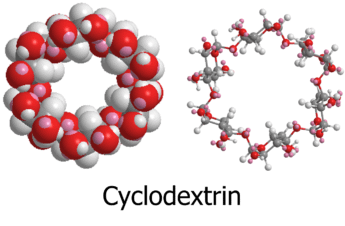
このページは、シクロデキストリン(Cyclodextrin; CD)が「小さな穴(空洞)」で分子を包み込むことで、化学の基礎研究(分子マシン)→医療材料(ドラッグデリバリー)→分離材料(膜)へと広がっていく流れを、一般向けにまとめたものです。
まず結論:CDは「分子サイズのカップ」
CDは、デンプン由来の環状オリゴ糖で、外側は水になじみやすく、内側は疎水性の空洞を持つことが多い分子です。
この「空洞」にゲスト分子が入る(包接)と、次のような効果が起きやすくなります。
- 溶けにくい分子が溶けやすくなる(水中での“居場所”ができる)
- 動きやすい分子の動きを“ガイド”できる(リングとして働く)
- 材料の微細な隙間や相互作用を調整できる(膜や複合材料で役立つ)
以下では、CDが活躍する代表的な3つの舞台を、3本の論文で見ていきます。
論文1:分子マシンの「輪っか」としてのCD(ロタキサン)
何がポイント?
分子マシンでは、分子の部品同士が“物理的に絡み合う”構造(カテナン/ロタキサン)が重要になります。
ロタキサンは簡単に言うと、輪っか(リング)が棒(軸)に通って抜けない構造です。
CDがどう関係する?
CDはちょうど良いサイズのリング状分子なので、水中などで「輪っか」部品として使われ、
外部刺激(例:光)で動きを制御する分子システムの文脈でも登場します。
生活に例えると
- ストロー(軸)に、ドーナツ(輪っか)が通って、端にストッパーが付いているイメージ
- “輪っか”の材質がCDだと、水の中でも比較的扱いやすいケースがある
論文2:ドラッグデリバリー材料としてのCD(CD–キトサン)
何がポイント?
薬の効き方は、薬そのものだけでなく「どこで・どれくらいの時間・どのように留まるか」に強く左右されます。
そのため、粘膜(口腔、鼻腔、消化管など)に付着しやすいムコアドヒーシブ(粘膜付着)材料が注目されます。
キトサンにCDを組み合わせると?
キトサンは生体適合性が高い一方で、中性〜塩基性での溶解性などが課題になることがあります。
レビューでは、課題を改善するための多様な化学修飾が整理されており、その中にcyclodextrin–chitosan(CD–キトサン)も含まれます。
CDを導入すると、CDの空洞が薬を一時的に“収納”しやすくなり、材料設計の選択肢が広がります。
生活に例えると
- キトサン=「貼り付くシート」
- CD=「小さなポケット」
- シートにポケットを付けると、成分を入れておけて“渡し方”を設計できる
論文3:ガスを分ける「混合膜(Mixed-Matrix Membranes)」とCD
何がポイント?
工業的なガス分離では、薄い膜で“通りやすさ”の違いを利用します。
その膜材料として、ポリマーに多孔質材料(MOFなど)を混ぜ込む「混合膜(MMM)」が研究されています。
CDはどこに効く?
このレビューでは、MOFなどの多孔質フィラーだけでなく、分子添加剤の活用も議論され、その文脈でβ-シクロデキストリンがキーワードとして登場します。
CDのような分子は、材料内部の相互作用や微細構造(すき間)に影響し、
ガスの通り道や選択性に関わる設計要素になり得ます。
生活に例えると
- 目の細かい“ふるい”を、材料の中に分散させてガスを選別するイメージ
- CDは「分子サイズの部品」として、材料の性質を微調整する可能性がある
3本をつなぐ理解:CDは「化学の共通言語」になれる
3つの領域は一見バラバラに見えますが、共通しているのは、
- 分子のサイズ感(空洞の大きさ)
- どの分子が入りやすいか(相性)
- 周りの環境(水、ポリマー、添加剤)で挙動が変わる
という“包接”の基本です。
CDはこの基本を軸に、動かす/運ぶ/分けるという機能に接続できる、汎用性の高い分子といえます。
よくある質問(FAQ)
Q1. CDは「何でも」包みますか?
A. いいえ。空洞のサイズとゲスト分子の形・疎水性などに依存します。
Q2. CDを入れると必ず溶解性が上がりますか?
A. 条件次第です。相性が良いと溶解性が改善しやすい一方、競合包接や濃度依存で挙動が変わることがあります。
Q3. 研究室での“次の一歩”は?
A. まずは「どのCD(α/β/γ、誘導体)」が対象分子に合うかを、簡易溶解試験や分光測定で確かめるところから始めるのが定石です。
参考文献(添付ファイル内の3報のみ)
- Sauvage, J.-P. From Chemical Topology to Molecular Machines (Nobel Lecture). Angewandte Chemie International Edition (2017). DOI: 10.1002/anie.201702992
- Ways, T. M. M.; Lau, W. M.; Khutoryanskiy, V. V. Chitosan and Its Derivatives for Application in Mucoadhesive Drug Delivery Systems. Polymers (2018). DOI: 10.3390/polym10030267
- Dechnik, J.; Gascon, J.; Doonan, C. J.; Janiak, C.; Sumby, C. J. Mixed-Matrix Membranes. Angewandte Chemie International Edition (2017). DOI: 10.1002/anie.201701109
CD_classics: How cyclodextrins “capture molecules” and unlock functions (3 papers, explained)
This page uses only the references contained in CD_classics.txt to explain—at an accessible level—how cyclodextrins (CDs) spread across very different fields, from molecular machines to drug delivery materials and separation membranes.
Bottom line: CDs are “molecular-sized cups”
Cyclodextrins are cyclic oligosaccharides (often starch-derived) that frequently feature a hydrophilic outside and a hydrophobic cavity.
When a guest molecule sits in that cavity (inclusion/host–guest complexation), it can lead to:
- Improved apparent solubility for poorly soluble molecules (a better “home” in water)
- Guided molecular motion (CD can act as a ring component)
- Tuning of material microstructure and interactions (useful in composites and membranes)
Below, we connect these ideas through three papers in the attached file.
Paper 1: CDs as the “ring” in molecular machines (rotaxanes)
Key idea
Many molecular machines rely on mechanically interlocked architectures such as catenanes and rotaxanes.
A rotaxane is, simply, a ring threaded on an axle and prevented from slipping off by stoppers.
Where CDs come in
Because CDs are naturally ring-shaped, they appear as macrocyclic components in aqueous systems and in the broader context of stimuli-controlled motion (including light-driven control discussed in molecular machine research).
Everyday analogy
A donut (ring) on a straw (axle), with caps on both ends.
Paper 2: CDs in drug-delivery materials (cyclodextrin–chitosan)
Key idea
Drug performance depends not only on the molecule itself but also on where it stays and for how long.
That’s why mucoadhesive (mucus-adhering) materials are attractive for delivery through oral/nasal/GI mucosa.
Why combine chitosan with CDs?
Chitosan is widely used but can face issues such as limited solubility at neutral/basic pH.
The review organizes many chemical modifications, including cyclodextrin–chitosan, as routes to improve functionality.
Adding CDs can introduce “pockets” that temporarily host drugs, expanding formulation options.
Everyday analogy
A sticky sheet (chitosan) with tiny pockets (CD cavities) that can hold and release ingredients.
Paper 3: Gas separation with mixed-matrix membranes (MMMs) and CDs
Key idea
Industrial gas separations often use thin polymer membranes that exploit differences in gas permeation.
“Mixed-matrix membranes” embed porous fillers (e.g., MOFs) into polymers to enhance performance.
Where CDs fit
This review also discusses molecular additives, and β-cyclodextrin appears as a keyword in that context.
CD-like molecules can influence polymer–filler compatibility and microstructure, potentially affecting transport pathways and selectivity.
Everyday analogy
Dispersing fine “sieves” into a plastic film to sort gases—CDs can act as molecular-scale tuning parts.
One unifying view
Across these three areas, the shared foundation is:
- Cavity size vs. guest size
- Affinity and selectivity of inclusion
- Environment dependence (water, polymers, additives)
That is why CDs can bridge “move / deliver / separate” functions as a versatile supramolecular platform.
References (only the 3 papers in CD_classics.txt)
- Sauvage, J.-P. From Chemical Topology to Molecular Machines (Nobel Lecture). Angewandte Chemie International Edition (2017). DOI: 10.1002/anie.201702992
- Ways, T. M. M.; Lau, W. M.; Khutoryanskiy, V. V. Chitosan and Its Derivatives for Application in Mucoadhesive Drug Delivery Systems. Polymers (2018). DOI: 10.3390/polym10030267
- Dechnik, J.; Gascon, J.; Doonan, C. J.; Janiak, C.; Sumby, C. J. Mixed-Matrix Membranes. Angewandte Chemie International Edition (2017). DOI: 10.1002/anie.201701109