日本語(JP)
シクロデキストリンはなぜ「溶けにくい薬」を溶かせるの?(超入門)
ポイント: シクロデキストリン(Cyclodextrin; CD)は、薬の構造を変えずに“水に溶けやすい形”へ見かけ上変えてくれることがあります。
まず結論(1分でわかる)
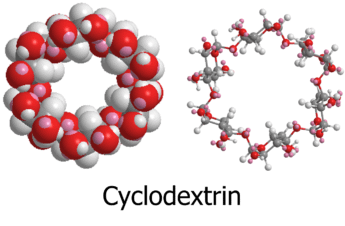
- CDはブドウ糖が輪になった分子(環状オリゴ糖)で、薬分子を中に取り込む「包接(ホスト–ゲスト)」ができます。
- その結果、水に溶けにくい薬でも、水中で扱いやすい(溶けやすい)状態にできる場合があります。
- ただし万能ではなく、CD自身の溶けやすさ・添加量・他の添加剤(賦形剤)との相互作用を考える必要があります。
仕組みをイメージで
CDを「外側は水になじむ、内側は油っぽい空間をもつドーナツ」だと思ってください。
薬の“油っぽい部分”がCDの空洞に入ると、外側は水となじみやすいので、全体として水中で分散・溶解しやすくなります。
総説(Saokham ら, Molecules 2018)が押さえる重要点
この分野の総説では、次の点が特に重要だとまとめられています。
1) 複合体(薬/CD)は1:1が多い
2) 天然CDは水中で集合(凝集)しやすく、溶解性が制限されることがある
3) 置換基を導入したCD(誘導体)で溶解性や包接能を高められるが、置換基の種類・置換度に依存する
4) 水溶性の薬/CD複合体は膜透過(吸収)を助けうるが、CD添加量は最適化が必要
5) 高分子・保存料・界面活性剤などの賦形剤が可溶化能に影響し、薬と賦形剤の“競合包接”にも注意
実務のミニチェックリスト(研究・製剤設計の出発点)
- CDの種類(天然CDか、誘導体か)で「そもそも溶けやすさ」が変わる
- 添加量:多ければ良いとは限らない(膜透過や平衡が関係)
- 賦形剤の影響:界面活性剤や高分子が入ると挙動が変わる(競合包接も含めて設計)
よくある質問(FAQ)
Q1. CDを入れると必ず溶けやすくなりますか?
A. 必ずではありません。薬の形・相性、CDの種類、溶液中での集合などで結果が変わります。
Q2. 天然CDより誘導体のほうが良い?
A. 誘導体化で溶解性や包接能が高まることがありますが、置換基の種類・置換度に依存します。
Q3. ほかの添加剤(界面活性剤など)と一緒に使っていい?
A. 可能ですが、可溶化能が変化し、薬と添加剤がCDを取り合う「競合包接」も起こり得ます。
参考文献(本ページの根拠)
- Saokham P, Muankaew C, Jansook P, Loftsson T. Solubility of Cyclodextrins and Drug/Cyclodextrin Complexes. Molecules (2018) 23(5):1161. DOI: 10.3390/molecules23051161
English (EN)
Why can cyclodextrins “dissolve poorly soluble drugs”? (A quick primer)
Key idea: Cyclodextrins (CDs) can sometimes improve the apparent aqueous solubility of poorly soluble drugs without changing the drug molecule itself.
The one‑minute takeaway
- CDs are ring‑shaped oligosaccharides that can form host–guest inclusion complexes with drug molecules.
- By “encapsulating” hydrophobic parts of a drug, CDs may help the drug become more workable in water (higher apparent solubility / better dispersion).
- They are not magic: performance depends on CD solubility, CD amount, and excipients present in the formulation.
A simple picture
Think of a CD as a “donut”: the outside is water‑friendly, and the inside cavity can accommodate hydrophobic motifs.
When a drug forms a complex with CD, the overall system can behave as if it is more water‑compatible, improving handling in aqueous media.
Practical points highlighted in the 2018 review (Saokham et al.)
The review emphasizes the following formulation‑relevant facts:
1) Drug/CD complexes are most often 1:1.
2) Natural CDs can self‑assemble/aggregate in water, which may limit their solubility.
3) Derivatization can improve CD solubility and complexation, but it depends on substituent type and degree of substitution.
4) Water‑soluble drug/CD complexes may increase membrane permeation, so the amount of CD must be optimized.
5) Excipients (e.g., water‑soluble polymers, preservatives, surfactants) can change solubilization; competitive complexation should be considered.
A mini checklist to start with
- Choose the CD type (natural vs derivative) with CD solubility in mind
- Optimize the CD concentration (more is not always better)
- Re‑check behavior when adding excipients (competition for the CD cavity can matter)
Reference (source used on this page)
- Saokham P, Muankaew C, Jansook P, Loftsson T. Solubility of Cyclodextrins and Drug/Cyclodextrin Complexes. Molecules (2018) 23(5):1161. DOI: 10.3390/molecules23051161