date: 2026-01-04
[DEm, DAE, diarylethene, photochromic, perovskite, passivation, UV, radiochromic, dosimetry, polymer film]
最終更新:2026-01-04
本ページは、添付ファイル(Web of Science 出力)に含まれる論文だけを対象に、一般の方にもわかりやすい形で要点をまとめた研究紹介です。
※今回の添付ファイルには2報が収録されていたため、2報で解説しています。
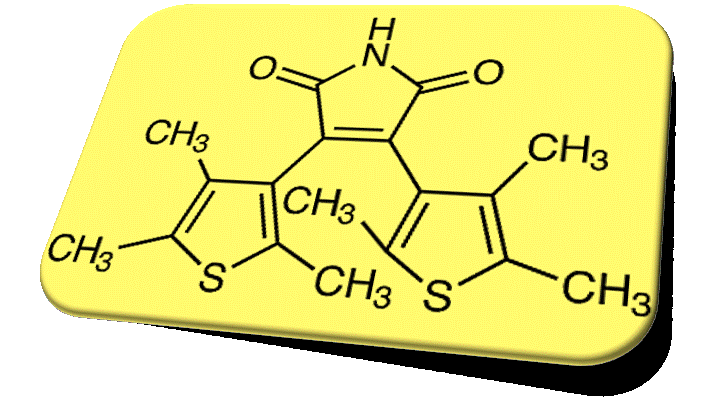
DEm(ジアリールエテン系マレイミド)とは?
DEm(Diarylethene maleimide / DAE系)は、光を当てると分子の形(構造)が変わり、色や性質が切り替わるフォトクロミック分子の一種です。
「光でスイッチできる」性質は、材料の劣化を防ぐ、計測に使うなど、さまざまな場面で役立ちます。
この2報で見える“2つの使い方”
- 太陽電池(ペロブスカイト)の耐久性向上:欠陥を抑えて、紫外光による劣化を防ぐ
- 放射線の線量計測(ラジオクロミック):放射線で色(吸収)が変化する薄膜を作る
論文ごとのやさしい解説
1) 紫外光に強いペロブスカイト太陽電池モジュールへ(ACS Energy Letters, 2022)
ペロブスカイト太陽電池は高効率ですが、連続照射(特に紫外光)で劣化しやすい点が課題です。
この研究は、ジアリールエテン系分子(DAE)を用いた“パッシベーション(欠陥の埋め合わせ)”で、紫外光下での劣化を抑える戦略を示しています。
小面積セルで高い変換効率、モジュール(25 cm²)でも高効率を示し、さらに長期のUV照射でも性能維持を目指しています。
一般向けポイント
– 太陽電池の世界では「効率」だけでなく、屋外でどれだけ長く持つか(耐久性)が重要。
– 分子(添加剤)を上手に使って欠陥を減らすと、劣化のきっかけを減らせます。
2) 放射線で色が変わる有機薄膜(Nuclear Instruments and Methods A, 2020)
PMMA(アクリル樹脂)薄膜に、フォトクロミック分子(2,3-bis(2,4,5-trimethyl-3-thienyl) maleimide)を混ぜたフィルムを作り、放射線照射での吸収変化(ラジオクロミズム)を評価した研究です。
分子濃度に応じて吸収変化の度合いが増え、さらに蛍光性有機化合物を加えると感度が向上することが示されています。
つまり、放射線量を“色(吸収)”として読み取る材料としての可能性を示しています。
一般向けポイント
– 放射線量を測る方法にはいろいろありますが、「色の変化」を使うと目で見て確認しやすい利点があります。
– フォトクロミック分子は光だけでなく、条件次第で放射線でも状態が変わることがあります。
参考文献(添付ファイル内の2報のみ)
- Tautomeric Passivation Strategy-Assisted Photostable Perovskite Solar Modules
Wang, Y, Yang, H, Zhang, K, Tao, MQ, Li, MZ, Song, YL
ACS ENERGY LETTERS, 2022, 7(10), 3646–3652
DOI: 10.1021/acsenergylett.2c01648 - Radiochromic properties of organic films based on a diarylethene molecule
Asai, K, Koshimizu, M, Fujimoto, Y, Asai, K
NUCLEAR INSTRUMENTS & METHODS IN PHYSICS RESEARCH SECTION A-ACCELERATORS SPECTROMETERS DETECTORS AND ASSOCIATED EQUIPMENT, 2020, 954, 161828
DOI: 10.1016/j.nima.2019.01.054
English Version
DEm(2,3-Bis(2,4,5-trimethyl-3-thienyl)maleimide): A Light-Switchable Molecule for Photostable Perovskite Modules and Radiation Dosimetry (Based on 2 Papers in the Attached File)
Last updated: 2026-01-04
This page is a plain‑language research summary based only on the papers included in the attached Web of Science export.
Note: the attached file contains 2 papers, so the summary covers 2 papers.
What is DEm (diarylethene maleimide)?
DEm (a diarylethene maleimide, often discussed as a DAE‑type photochromic molecule) can switch its molecular structure upon light irradiation, changing optical and electronic properties.
This “light‑switch” behavior can be leveraged for stabilizing functional materials or for sensing/measurement.
Two use‑cases highlighted by the attached papers
- Photostable perovskite solar modules: molecular defect passivation and UV‑related stability improvement
- Radiochromic polymer films: radiation‑induced absorbance change for dosimetry
Plain‑language summaries
1) UV‑photostable perovskite solar modules (ACS Energy Letters, 2022)
Perovskite solar modules can degrade under continuous illumination, especially UV. This paper proposes a passivation strategy using a diarylethene‑type molecule (DAE) to mitigate defects and suppress UV‑driven degradation, aiming for both high efficiency and long‑term photostability.
– Takeaway: molecular additives that reduce defects can improve durability, not just efficiency.
2) Radiochromic organic films for dosimetry (Nuclear Instruments and Methods A, 2020)
PMMA films containing a photochromic diarylethene maleimide are fabricated and evaluated for radiation‑induced absorbance changes. The absorbance change scales with the dye concentration, and sensitization with a fluorescent organic compound enhances response—supporting the concept of color/absorbance‑based radiation dose readout.
– Takeaway: photochromic molecules can serve as functional components in radiation‑sensing polymer films.
References (only the 2 papers in the attached file)
- Tautomeric Passivation Strategy-Assisted Photostable Perovskite Solar Modules
Wang, Y, Yang, H, Zhang, K, Tao, MQ, Li, MZ, Song, YL
ACS ENERGY LETTERS, 2022, 7(10), 3646–3652
DOI: 10.1021/acsenergylett.2c01648 - Radiochromic properties of organic films based on a diarylethene molecule
Asai, K, Koshimizu, M, Fujimoto, Y, Asai, K
NUCLEAR INSTRUMENTS & METHODS IN PHYSICS RESEARCH SECTION A-ACCELERATORS SPECTROMETERS DETECTORS AND ASSOCIATED EQUIPMENT, 2020, 954, 161828
DOI: 10.1016/j.nima.2019.01.054