- 20260215
日本語
1) まずは全体像(DSSCって何?)
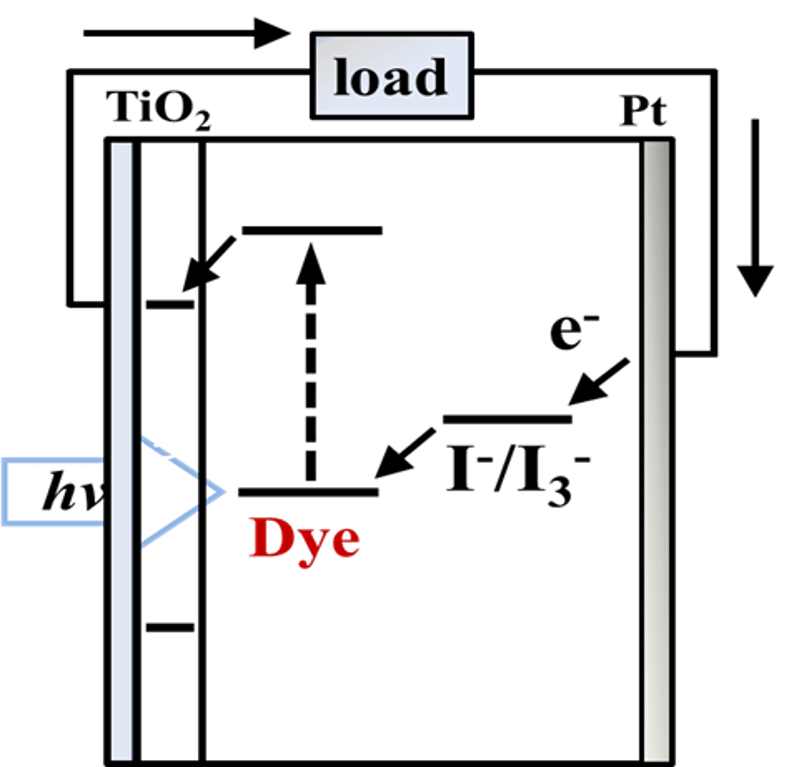
- DSSC(色素増感太陽電池)は、色素が光を吸収して電子を作り、電極材料(多孔質TiO₂など)へ電子を渡すことで発電する方式です。
- 高価な材料(例:白金)を減らしたり、色素や電極の設計を工夫したりすることで、低コスト化・性能向上が進んでいます。
An impressive efficiency exceeding 12% for dye-sensitized solar cells: Diverse metal sulfide nanocomposites as exceptional cathode materials
– Journal: Inorganic Chemistry Communications (2026)
– DOI: 10.1016/j.inoche.2026.116209
何をした研究?(ポイント)
– DSSCの「対極(カウンター電極)」でよく使われる白金(Pt)の代替を狙った研究。
– コバルト硫化物(CoSx)を基材に、La³⁺やNi²⁺を組み合わせて触媒活性を上げる設計を行った。
– 電気化学測定(EIS、CV、Tafelなど)で、電荷移動抵抗の低下や反応性の改善を確認。
結果を一言で
– 最適組成の電極で、Ptに近い(あるいは匹敵する)性能を示し、Pt代替の可能性を具体的に示した。
一般向けミニ解説
– DSSCでは、電解質(例:I₃⁻/I⁻)の反応を助ける「対極の触媒性」が発電性能に効きます。
そのため「Ptの代わりに何を使うか」は、コストと性能の両面で重要なテーマです。
Synthesized biocarbon-based sepia ink and its application as a counter electrode for dye-sensitized solar cell
– Journal: Materials Chemistry and Physics (2026)
– DOI: 10.1016/j.matchemphys.2026.132125
何をした研究?(ポイント)
– 海洋由来バイオマス(イカ墨由来)を炭素材料にして、DSSCの対極へ応用。
– KOH活性化で比表面積を大きくしつつ、孔(ポア)の作り方がイオン移動を邪魔する問題も見つけた。
– そこで2種類の炭素材料を混ぜた複合電極で、触媒性と物質輸送(イオンの通りやすさ)の両立を狙った。
結果を一言で
– 単独材料より大きく性能が改善し、Pt対極に近い水準に迫ることを示した(報告PCEは約2.4%)。
一般向けミニ解説
– 「表面積が大きい=いつも良い」ではなく、電解質が出入りする道(孔構造)が大事。
バイオ炭素でも、設計しだいで性能が上がることが分かります。
Paper C
Design of Novel Iminocoumarins for D-π-A System DSSCs: A (TD)DFT Study
– Journal: ACS Omega (2026)
– DOI: 10.1021/acsomega.5c09063
何をした研究?(ポイント)
– 新しい「色素(増感剤)」候補(イミノクマリン系)を、計算化学(DFT/TD-DFT)で評価。
– 吸収波長・光吸収の強さ・電子注入のしやすさ・色素再生の可能性などを、既知の参照色素と比較。
– 分子設計の指標として、可視光遷移双極子モーメント(TDM)が有効だと提案。
結果を一言で
– いくつかの候補が強い光吸収や有利な電荷移動特性を示し、次世代色素設計の道筋を与えた。
一般向けミニ解説
– 実験前に「計算」で有望分子を絞り込めると、開発が速くなります。
DSSCの色素は“分子の設計”そのものが性能を左右するため、計算評価は強力な武器です。
参考文献(ファイル内から)
- Inorganic Chemistry Communications, 2026. An impressive efficiency exceeding 12% for dye-sensitized solar cells: Diverse metal sulfide nanocomposites as exceptional cathode materials. DOI: 10.1016/j.inoche.2026.116209
- Materials Chemistry and Physics, 2026. Synthesized biocarbon-based sepia ink and its application as a counter electrode for dye-sensitized solar cell. DOI: 10.1016/j.matchemphys.2026.132125
- ACS Omega, 2026. Design of Novel Iminocoumarins for D-π-A System DSSCs: A (TD)DFT Study. DOI: 10.1021/acsomega.5c09063
English (for your website)
1) Quick overview: What is a DSSC?
- A dye-sensitized solar cell (DSSC) generates electricity when a dye absorbs light and injects electrons into a semiconductor electrode (typically porous TiO₂).
- Current research focuses on (i) replacing expensive Pt counter electrodes, and (ii) designing better dyes and interfaces to improve efficiency and stability.
Top 3 papers selected (highest Journal Impact Factor, JCR 2024)
Paper A (Impact Factor 5.4)
An impressive efficiency exceeding 12% for dye-sensitized solar cells: Diverse metal sulfide nanocomposites as exceptional cathode materials
– Journal: Inorganic Chemistry Communications (2026)
– DOI: 10.1016/j.inoche.2026.116209
What did they do? (bullet summary)
– Developed Pt-free counter electrodes based on cobalt sulfide (CoSx) and metal-ion tuning (La³⁺/Ni²⁺).
– Evaluated catalytic and charge-transfer behavior via electrochemical tests (EIS/CV/Tafel).
– Identified an optimized composition with low charge-transfer resistance and strong catalytic activity for the I₃⁻/I⁻ redox couple.
Take-home message
– Demonstrates a realistic pathway toward high-performance Pt substitutes for DSSC counter electrodes.
Paper B (Impact Factor 4.7)
Synthesized biocarbon-based sepia ink and its application as a counter electrode for dye-sensitized solar cell
– Journal: Materials Chemistry and Physics (2026)
– DOI: 10.1016/j.matchemphys.2026.132125
What did they do? (bullet summary)
– Used marine biomass (sepia ink) to produce activated biocarbon for DSSC counter electrodes.
– Showed that pore architecture and mineral residues can limit ion transport, even with very high surface area.
– Proposed a composite carbon electrode to balance catalytic sites and electrolyte transport.
Take-home message
– Sustainable carbons can approach Pt-like performance when pore structure and transport pathways are co-designed.
Paper C (Impact Factor 4.3)
Design of Novel Iminocoumarins for D-π-A System DSSCs: A (TD)DFT Study
– Journal: ACS Omega (2026)
– DOI: 10.1021/acsomega.5c09063
What did they do? (bullet summary)
– Screened new iminocoumarin dye candidates using DFT/TD-DFT calculations.
– Compared absorption properties, electron-injection feasibility, and dye-regeneration energetics with a benchmark dye.
– Suggested the transition dipole moment (TDM) as a practical descriptor for rational dye design.
Take-home message
– Provides computational design rules to accelerate next-generation DSSC sensitizer development.
References (from the provided file)
- Inorganic Chemistry Communications, 2026. An impressive efficiency exceeding 12% for dye-sensitized solar cells: Diverse metal sulfide nanocomposites as exceptional cathode materials. DOI: 10.1016/j.inoche.2026.116209
- Materials Chemistry and Physics, 2026. Synthesized biocarbon-based sepia ink and its application as a counter electrode for dye-sensitized solar cell. DOI: 10.1016/j.matchemphys.2026.132125
- ACS Omega, 2026. Design of Novel Iminocoumarins for D-π-A System DSSCs: A (TD)DFT Study. DOI: 10.1021/acsomega.5c09063