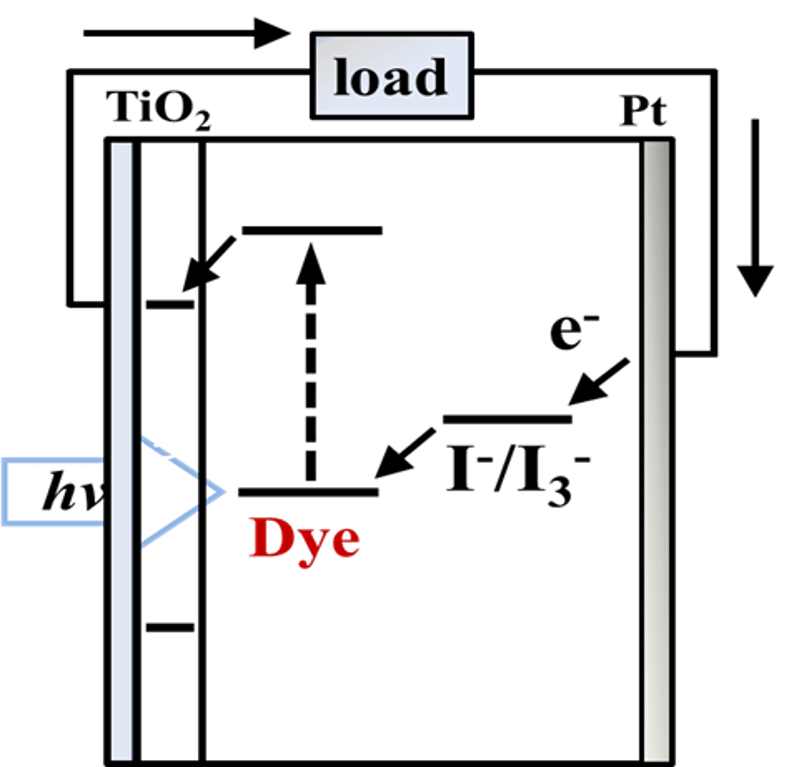
Dye-Sensitize Solar Cell Cyclodextrin
| Publication Year | Author | Title | Publication Title | DOI | Url | Pages | Num Pages | Issue | Volume |
|---|---|---|---|---|---|---|---|---|---|
| 2020 | Hara, Michihiro; Takeshita, Tatsuya; Umeda, Takao | Effect of cyclodextrin cavity size on the photovoltaic performance of unanchored ruthenium(II) polypyridine complex-containing dye-sensitized solar cells | Journal of Photonics for Energy | 10.1117/1.JPE.10.045503 | https://www.spiedigitallibrary.org/journals/journal-of-photonics-for-energy/volume-10/issue-4/045503/Effect-of-cyclodextrin-cavity-size-on-the-photovoltaic-performance-of/10.1117/1.JPE.10.045503.full | 045503 | 4 | 10 | |
| 2017 | Takeshita, Tatsuya; Umeda, Takao; Hara, Michihiro | Fabrication of a dye-sensitized solar cell containing a noncarboxylated spiropyran-derived photomerocyanine with cyclodextrin | Journal of Photochemistry and Photobiology A: Chemistry | 10.1016/j.jphotochem.2016.10.017 | https://www.sciencedirect.com/science/article/pii/S1010603016305925 | 87-91 | 333 | ||
| 2015 | Selvam, S.; Balamuralitharan, B.; Karthick, S. N.; Savariraj, A. Dennyson; Hemalatha, K. V.; Kim, Soo-Kyoung; Kim, Hee-Je | Novel high-temperature supercapacitor combined dye sensitized solar cell from a sulfated β-cyclodextrin/PVP/MnCO3 composite | Journal of Materials Chemistry A | 10.1039/C5TA01792K | https://pubs.rsc.org/en/content/articlelanding/2015/ta/c5ta01792k | 10225-10232 | 19 | 3 | |
| 2015 | Chen, C.-C.; , Chang ,F.-C.; , Peng ,C.Y.; and Wang, H. Paul | Conducting glasses recovered from thin film transistor liquid crystal display wastes for dye-sensitized solar cell cathodes | Environmental Technology | 10.1080/09593330.2014.982206 | https://doi.org/10.1080/09593330.2014.982206 | 3008-3012 | 23 | 36 | |
| 2015 | Saleh, Na’il; Al-Trawneh, Salah; Al-Dmour, Hmoud; Al-Taweel, Samir; Graham, John P. | Effect of Molecular-Level Insulation on the Performance of a Dye-Sensitized Solar Cell: Fluorescence Studies in Solid State | Journal of Fluorescence | 10.1007/s10895-014-1479-8 | https://doi.org/10.1007/s10895-014-1479-8 | 59-68 | 1 | 25 |
DSSCとシクロデキストリンの応用に関する研究概要
1. 非カルボン酸型スピロピランとCM-β-CDの協働効果
- 使用材料: 非カルボン酸型スピロピラン(SP)1,3,3-トリメチルインドリノ-β-ナフトピリロスピラン(1)とカルボキシメチル化β-シクロデキストリンナトリウム塩(CM-β-CD)。
- 主な発見:
- 光異性体であるPMCとCM-β-CDの包接錯体がTiO₂表面に吸着し、IPCE(光電流変換効率)を向上。
- 570 nmで最大11.1%のIPCEを記録(CM-β-CDあり)。
- 可視光照射によりIPCEが低下、PMC異性化による影響が示唆された。
- 意義: CDの包接効果により、光応答性と変換効率を同時に制御可能。
2. 硫酸化β-CD/PVP/MnCO₃複合材料のDSSCカウンター電極応用
- 材料構成: 硫酸化β-CDをPVPと熱架橋し、MnCO₃ナノ粒子を複合化。
- 成果:
- DSSCのカウンター電極として利用し、5.57%のエネルギー変換効率を達成。
- 202.6 F/gのキャパシタンスと197.96 Wh/kgのエネルギー密度も示され、高温安定性(200°Cで70%)を実現。
3. CDの空孔サイズとルテニウム色素の包接による変換効率の比較
- 対象色素: [Ru(bpy)₃]²⁺
- CDの種類とIPCE結果:
- α-CD: 8.8%
- β-CD: 8.9%
- γ-CD: 11.2%
- 考察: γ-CDは空孔サイズが大きく、非平面構造の金属錯体色素との相互作用に優れることが変換効率向上に寄与。
4. Ni@C/CD複合体を用いた低コストカソードの開発
- 製法: Ni²⁺-β-CDの炭化処理によりNi@Cを作製。
- 応用: ITOとPtの代替としてDSSC電極に利用し、2.54%の変換効率を達成。
- 経済性: 回収ガラスとNi@CによりDSSC製造コストが24%以上削減可能。
5. L1色素とβ-CDの包接によるエネルギー変換性能の改善
- 色素: 5-[4-(ジフェニルアミノ)フェニル]チオフェン-2-シアノアクリル酸(L1)
- 成果:
- β-CDによる包接でTiO₂上の吸着状態が変化し、Vocが0.7 V → 0.8 Vに向上。
- 時間分解蛍光とTD-DFTにより、固体状態での光物性を精密に解析。
総合的考察:
シクロデキストリン(CD)は、DSSCにおける以下の点で有効であることが示されました。
- 光変換効率の向上(包接錯体による色素安定性と配置制御)
- 電極材料の改善(CDを前駆体とした新素材合成)
- 機能性拡張(温度耐性、光応答性、コスト削減)
今後は、CDの化学修飾・多環式色素との組み合わせ・可逆的応答系の開発などが期待されます。
Overview of DSSCs and Cyclodextrin Applications
1. Photovoltaic Performance Enhanced by Noncarboxylated Spiropyran and CM-β-CD
- Materials Used: Noncarboxylated spiropyran 1,3,3-trimethylindolino-β-naphthopyrylospiran (1) and carboxymethyl-β-cyclodextrin sodium salt (CM-β-CD).
- Key Findings:
- The photomerocyanine (PMC) form of spiropyran forms inclusion complexes with CM-β-CD on TiO₂ surfaces.
- The inclusion of CM-β-CD significantly enhanced incident photon-to-current conversion efficiency (IPCE), achieving up to 11.1% under 570 nm light.
- Visible light treatment reduced IPCE, attributed to isomerization of PMC.
- Significance: Demonstrates simultaneous control of photovoltaic performance and photo-responsivity via cyclodextrin inclusion.
2. Sulfated β-CD/PVP/MnCO₃ Composite for DSSC Counter Electrode
- Composite Structure: Sulfated β-cyclodextrin thermally crosslinked with PVP and embedded with MnCO₃ nanoparticles.
- Performance:
- Applied as a counter electrode in DSSC, achieving a conversion efficiency of 5.57%.
- Exhibited high capacitance (202.6 F/g) and energy density (197.96 Wh/kg), with thermal stability up to 200 °C (70% performance retained).
3. Effect of Cyclodextrin Cavity Size on Ruthenium-Based DSSCs
- Photosensitizer: Tris(2,2′-bipyridyl)ruthenium(II), [Ru(bpy)₃]²⁺.
- IPCE Results by CD Type:
- α-CD: 8.8%
- β-CD: 8.9%
- γ-CD: 11.2%
- Conclusion: The larger cavity of γ-CD enhances host–guest interaction with nonplanar dyes like [Ru(bpy)₃]²⁺, boosting DSSC efficiency.
4. Cost-Effective DSSC Cathode with Ni@C Prepared from β-CD
- Preparation: Carbonization of Ni²⁺-β-CD complex to form Ni@C nanoparticles.
- Application: Used as a Pt/ITO alternative for DSSC electrodes, achieving 2.54% efficiency.
- Cost Benefit: DSSC production cost was reduced by at least 24% using recycled glass and Ni@C.
5. Enhanced DSSC Performance via Encapsulation of L1 Dye with β-CD
- Dye: 5-[4-(Diphenylamino)phenyl]thiophene-2-cyanoacrylic acid (L1).
- Effect:
- Encapsulation in β-CD led to better molecular insulation and improved open-circuit voltage (from 0.7 to 0.8 V).
- Characterized using time-resolved fluorescence and TD-DFT calculations.
General Conclusion
Cyclodextrins (CDs) serve as valuable functional materials in DSSCs by:
- Enhancing photovoltaic efficiency via host–guest complexation.
- Enabling the development of advanced counter electrode materials.
- Providing thermal stability, photo-responsiveness, and cost reduction.
Future work could explore functionalized CDs, smart photoresponsive systems, and multi-dye co-sensitization strategies for further performance improvements.