作成日: 2026-02-01
そもそもDSSC(色素増感太陽電池)とは?
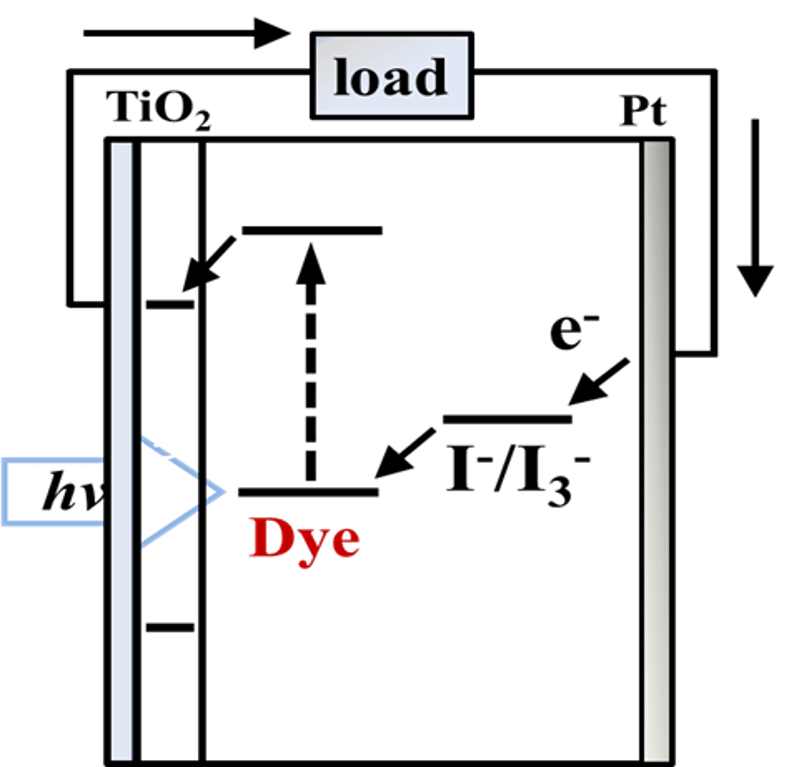
色素が光を吸収して電子を動かし、その電子を酸化物半導体(例:TiO₂)に注入して電気を取り出すタイプの太陽電池です。
近年は「色素(分子設計)」「電極(触媒)」「電解質(イオン輸送)」の3点を工夫して、効率と耐久性を高める研究が盛んです。
1. Sustainable management of PET waste via oxygen plasma-enriched PET/ rGO/TiO2 counter electrodes in DSSCs
- 掲載誌: JOURNAL OF ENVIRONMENTAL MANAGEMENT(JIF 2024: 8.4)
- 年: 2026
- 著者: Aladim, AK; Sebak, MA; Shahat, MA
- DOI: 10.1016/j.jenvman.2026.128549
やさしい解説
– 「PETごみ(ペットボトル等)」を材料にして、DSSCの対極(カウンター電極)へアップサイクルする研究。
– 酸素プラズマ処理時間(0〜12分)を変え、表面の官能基・粗さ・ぬれ性を調整して触媒活性と界面の電荷移動を改善。
– 材料評価(SEM/FTIR/XRD/接触角/EISなど)から、導電性や界面抵抗の改善を確認。
– 発電性能は最大で約7.9%と、白金(Pt)対極に近い値まで到達(高価なPt代替の可能性)。
– 廃プラ削減とエネルギーデバイス製造を両立する「循環型材料」の好例。
2. Synthesis, photophysical characterization, and DSSC application of 3,6-carbazole-based incorporating fused dipyrrolo-phenazine substitution as novel auxiliary donors
- 掲載誌: JOURNAL OF PHOTOCHEMISTRY AND PHOTOBIOLOGY A-CHEMISTRY(JIF 2024: 4.7)
- 年: 2026
- 著者: Hasan, HA; Alrazzak, NA; Abdulrada, NJ; Mohammed, MA; Mashyakhi, T; Mahmoud, HMA; Abdulkareem-Alsultan, G; Abdulmalek, E; Nassar, MF
- DOI: 10.1016/j.jphotochem.2025.116683
やさしい解説
– カルバゾール骨格をベースにした有機色素(3種類)を設計・合成し、DSSCへの応用を検討。
– 分子設計(πブリッジにチオフェン/フラン等)で、可視光吸収を約480–508 nm付近へ拡張。
– DFT/TD‑DFT計算と分光測定で、エネルギー準位や電荷移動(ICT)の特徴を整理。
– セル評価では、3色素で約5.6〜7.6%程度の効率を報告し、分子構造が再結合や寿命に影響することを示す。
– 色素の“凝集しにくさ(アンチアグリゲーション)”が性能に効く、という設計指針が読み取れる。
3. Rational design of triphenylamine-based D-π-A dyes high-performance bifacial and tandem DSSCs under outdoor and indoor illumination
- 掲載誌: JOURNAL OF MOLECULAR STRUCTURE(JIF 2024: 4.7)
- 年: 2026
- 著者: Alhalafi, ZH
- DOI: 10.1016/j.molstruc.2026.145248
やさしい解説
– トリフェニルアミン(TPA)系の有機色素2種を、N719などと組み合わせる共増感(コセンシタイゼーション)で高性能化。
– 両面受光(バイフェイシャル)DSSCで、光の取り込みと再結合抑制を両立する設計を検討。
– 最適条件で、片面効率が約10%超、両面受光指標(bifaciality)も高い値を報告。
– タンデム構造(上下で色素を分担)も試し、屋外だけでなく室内照明(1000 lx)でも高い効率を示す。
– 「屋外×室内」「片面×両面」を同じ設計思想で狙う、応用展開が広いタイプの研究。
English version (for website)
What is a DSSC?
A dye‑sensitized solar cell (DSSC) generates electricity by letting a dye absorb light and inject electrons into a semiconductor (often TiO₂).
Current research improves performance by engineering (1) dyes, (2) electrodes/catalysts, and (3) electrolytes/ion transport, while suppressing recombination and enhancing stability.
Selected papers
1. Sustainable management of PET waste via oxygen plasma-enriched PET/ rGO/TiO2 counter electrodes in DSSCs
- Journal: JOURNAL OF ENVIRONMENTAL MANAGEMENT (2024 JIF: 8.4)
- Year: 2026
- Authors: Aladim, AK; Sebak, MA; Shahat, MA
- DOI: 10.1016/j.jenvman.2026.128549
Plain-language bullets (paraphrased from the abstract; no verbatim text)
– This work upcycles PET plastic waste into counter electrodes for dye‑sensitized solar cells (DSSCs).
– Oxygen‑plasma treatment (0–12 min) tunes surface chemistry/roughness/wettability to enhance electrocatalysis and interfacial charge transport.
– Characterization (e.g., SEM, FTIR, XRD, contact angle, EIS) supports improved conductivity and reduced charge‑transfer resistance.
– The best device reaches ~7.9% efficiency, approaching the platinum (Pt) benchmark—suggesting a lower‑cost alternative.
– A representative example of linking waste valorization with renewable‑energy device engineering.
2. Synthesis, photophysical characterization, and DSSC application of 3,6-carbazole-based incorporating fused dipyrrolo-phenazine substitution as novel auxiliary donors
- Journal: JOURNAL OF PHOTOCHEMISTRY AND PHOTOBIOLOGY A-CHEMISTRY (2024 JIF: 4.7)
- Year: 2026
- Authors: Hasan, HA; Alrazzak, NA; Abdulrada, NJ; Mohammed, MA; Mashyakhi, T; Mahmoud, HMA; Abdulkareem-Alsultan, G; Abdulmalek, E; Nassar, MF
- DOI: 10.1016/j.jphotochem.2025.116683
Plain-language bullets (paraphrased from the abstract; no verbatim text)
– Three carbazole‑based organic dyes were designed/synthesized and evaluated as DSSC sensitizers.
– By tuning auxiliary donor units and π‑bridges (e.g., thiophene/furan), absorption is extended to roughly 480–508 nm.
– DFT/TD‑DFT plus spectroscopy clarifies energy levels and intramolecular charge transfer (ICT) behavior.
– Device testing reports efficiencies in the ~5.6–7.6% range and links molecular structure to recombination/lifetime trends.
– The study highlights how anti‑aggregation design can translate into better charge collection.
3. Rational design of triphenylamine-based D-π-A dyes high-performance bifacial and tandem DSSCs under outdoor and indoor illumination
- Journal: JOURNAL OF MOLECULAR STRUCTURE (2024 JIF: 4.7)
- Year: 2026
- Authors: Alhalafi, ZH
- DOI: 10.1016/j.molstruc.2026.145248
Plain-language bullets (paraphrased from the abstract; no verbatim text)
– Two triphenylamine (TPA) D–π–A dyes are explored as co‑sensitizers with N719 to boost performance.
– The study targets bifacial DSSCs, aiming to broaden absorption while suppressing charge recombination.
– Optimized compositions report >10% front‑side efficiency and a high bifaciality factor.
– A tandem bifacial configuration further improves output and shows strong performance under indoor lighting (1000 lx).
– A practical direction for devices that must work well both outdoors and indoors.
参考文献 / References
- Aladim, AK; Sebak, MA; Shahat, MA (2026) Sustainable management of PET waste via oxygen plasma-enriched PET/ rGO/TiO2 counter electrodes in DSSCs JOURNAL OF ENVIRONMENTAL MANAGEMENT 398 128549 doi:10.1016/j.jenvman.2026.128549
- Hasan, HA; Alrazzak, NA; Abdulrada, NJ; Mohammed, MA; Mashyakhi, T; Mahmoud, HMA; Abdulkareem-Alsultan, G; Abdulmalek, E; Nassar, MF (2026) Synthesis, photophysical characterization, and DSSC application of 3,6-carbazole-based incorporating fused dipyrrolo-phenazine substitution as novel auxiliary donors JOURNAL OF PHOTOCHEMISTRY AND PHOTOBIOLOGY A-CHEMISTRY 471 116683 doi:10.1016/j.jphotochem.2025.116683
- Alhalafi, ZH (2026) Rational design of triphenylamine-based D-π-A dyes high-performance bifacial and tandem DSSCs under outdoor and indoor illumination JOURNAL OF MOLECULAR STRUCTURE 1357 145248 doi:10.1016/j.molstruc.2026.145248
Journal Impact Factor (2024) sources (for transparency)
- Journal of Environmental Management: shown on the publisher page (ScienceDirect).
- Journal of Photochemistry and Photobiology A: Chemistry: shown on the publisher page (ScienceDirect).
- Journal of Molecular Structure: shown on the publisher page (ScienceDirect).