2026-02-15
TADFとは?(超ざっくり)
- 有機ELでは、電気のエネルギーが「励起子(れいきし)」になって光に変わります。
- その励起子には 一重項(S) と 三重項(T) があり、通常は一重項だけが光りやすい(光になりやすい)と考えられます。
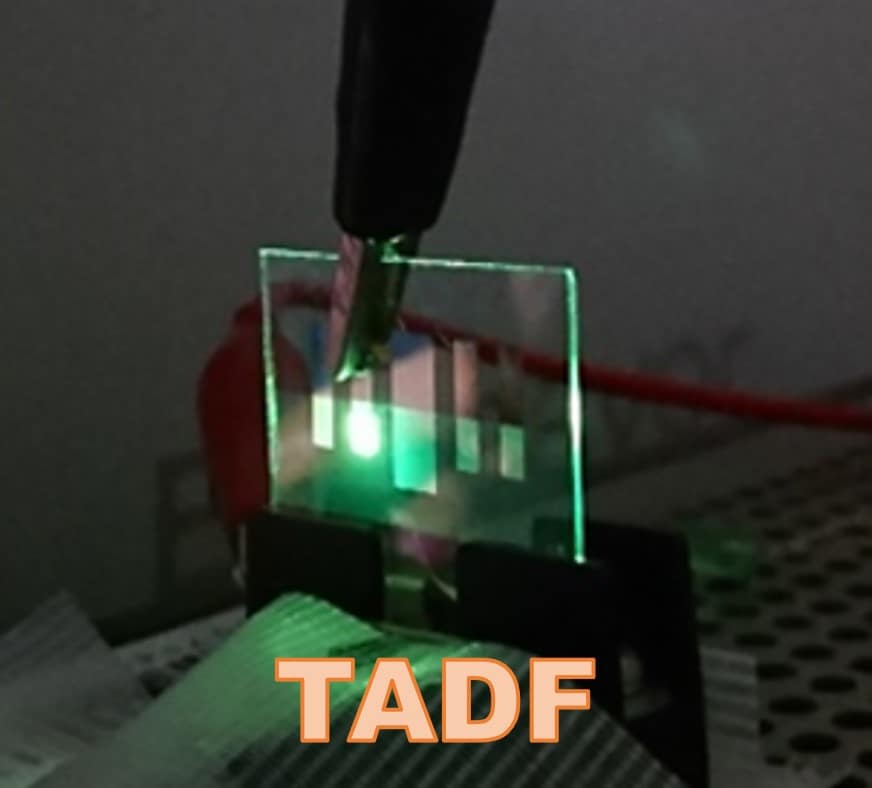
- TADF(Thermally Activated Delayed Fluorescence) は、三重項(T)を“熱の助け”で一重項(S)へ戻し(RISC)、光として取り出す設計です。
- ねらい:高効率(電気→光のロスを減らす)と、色の純度や寿命の改善。
High-efficiency sky-blue multi-resonance TADF through fine-tuning of twisted configurations
– 掲載誌:Chemical Engineering Journal(2026)
– DOI:10.1016/j.cej.2026.173264
何をした?(要点)
– MR-TADF(多共鳴型TADF)で課題になりやすい「S–Tエネルギー差が大きくてRISCが進みにくい」点に注目。
– 分子の“ねじれ角(twist)”を細かく調整する設計で、RISCが進みやすい状態を狙いました。
何が新しい?
– メチル置換などでねじれを制御し、狭い発光帯(30–33 nm程度) と 速いRISC を両立する設計を示した点。
結果(一般向けに言うと)
– 追加の増感材を使わないOLEDで、空色(sky-blue)で高効率を実現。
– 代表素子では EQE_max 23.5%、発光ピーク 482 nm、FWHM 26 nm と「色がにじみにくい青」を狙える性能。
この研究が役立つ場面
– 高精細ディスプレイ向けの「狭帯域の青」材料設計の指針になる。
Balancing charge transport and C–N bond strength in stability-oriented host design for blue TADF-OLEDs
– 掲載誌:Journal of Materials Chemistry C(2026)
– DOI:10.1039/d5tc04350f
何をした?(要点)
– 青色TADF-OLEDの寿命が短くなりやすい原因(高エネルギー励起子・ポーラロンによる結合切断)に着目。
– カルバゾール–ビフェニル系ホストを一連で設計し、電荷輸送(両極性〜電子輸送優勢) を変えながら、劣化要因を系統的に比較。
結果(一般向けに言うと)
– うまく組み合わせると EQE最大18%、効率の落ち込みも小さい条件が得られた。
– さらに、同一条件での寿命評価(1000 cd/m²)では、N-フェニル化したホストが寿命(LT50)で1.6〜12倍優位。
“なぜ長寿命?”の説明(かみ砕き)
– 計算(DFT)から、劣化につながりやすい 外側C–N結合の強さ(BDE) が鍵と示唆。
– N-フェニル化で電子(LUMO)の偏りを調整し、陰イオン状態での結合切断を起こしにくくした、という設計指針。
この研究が役立つ場面
– 「青の高効率」と「寿命」の両立に向けた、ホスト材料の“壊れにくさ”設計の考え方を与える。
TADF polymers with well-defined structures to explore structure–performance correlation
– 掲載誌:Journal of Materials Chemistry C(2026)
– DOI:10.1039/d5tc04059k
何をした?(要点)
– 塗布プロセス(溶液プロセス)向きの TADF高分子 に注目。
– これまで多かった「ランダム共重合(構造がばらつく)」だと、性能との関係が見えにくい問題がある。
– そこで、TADFユニットとカルバゾール鎖を 交互に並ぶように合成し、「構造が分かりやすいTADF高分子」を作った。
結果(一般向けに言うと)
– カルバゾール部分を長くすると、発光の効率(PLQY)が 62% → 89% と向上(波長はほぼ同じ)。
– 無ドープ・溶液プロセスOLEDで、EQE_max 19.7%、低い点灯開始電圧(2.5 V) を達成。
この研究が役立つ場面
– 印刷・塗布で作るOLED(将来の低コスト製造)に向けて、「どんな分子配置が効くか」を整理しやすい材料設計の例になる。
参考文献
- Wei, Z. X.; Li, X. Y.; Liu, T.; et al. High-efficiency sky-blue multi-resonance thermally activated delayed fluorescence through fine-tuning of twisted configurations. Chemical Engineering Journal (2026). DOI: 10.1016/j.cej.2026.173264
- Berenis, D.; Puidokas, G.; Bagdonas, K.; et al. Balancing charge transport and C–N bond strength in stability-oriented host design for blue TADF-OLEDs. Journal of Materials Chemistry C (2026). DOI: 10.1039/d5tc04350f
- Li, X. T.; Hao, H. M.; Kang, B. X.; et al. Thermally activated delayed fluorescence polymers with well-defined structures to explore structure–performance correlation. Journal of Materials Chemistry C (2026). DOI: 10.1039/d5tc04059k
English (for general readers)
What is TADF? (very short)
- In OLEDs, electrical energy forms excitons that can emit light.
- Excitons come in singlets (S) and triplets (T); many organic emitters use singlets efficiently, while triplets can be “dark”.
- TADF (Thermally Activated Delayed Fluorescence) is designed to convert triplets back to singlets via RISC (reverse intersystem crossing), assisted by thermal energy.
- Goal: higher efficiency, better color purity, and potentially longer device lifetime.
Top 3 papers selected by journal impact factor (JCR 2024 data)
1) Chemical Engineering Journal (IF 13.2)
2) Journal of Materials Chemistry C (IF 5.2)
3) Journal of Materials Chemistry C (IF 5.2)
Paper 1 (CEJ, IF 13.2)
High-efficiency sky-blue multi-resonance TADF through fine-tuning of twisted configurations
– Journal: Chemical Engineering Journal (2026)
– DOI: 10.1016/j.cej.2026.173264
Key points (bullet summary)
– Targets a common MR-TADF issue: a relatively large S–T gap can slow down RISC.
– Demonstrates a design strategy that fine-tunes molecular “twist” (e.g., via methyl substitution) to promote RISC while keeping narrow emission.
Highlights
– Narrow-band emission (around 30–33 nm in FWHM region) and fast RISC.
– Sensitizer-free OLEDs reach EQE_max 23.5%, peak at 482 nm, with FWHM 26 nm (sky-blue, high color purity).
Paper 2 (J. Mater. Chem. C, IF 5.2)
Balancing charge transport and C–N bond strength in stability-oriented host design for blue TADF-OLEDs
– Journal: Journal of Materials Chemistry C (2026)
– DOI: 10.1039/d5tc04350f
Key points (bullet summary)
– Addresses lifetime limitations in blue TADF-OLEDs caused by high-energy excitons/polarons and bond cleavage in host materials.
– Uses a host series with controlled charge-transport character to study charge balance and degradation systematically.
Highlights
– Up to 18% EQE with low roll-off in optimized host–dopant pairs.
– Under the same architecture (1000 cd m⁻²), N-phenylated hosts show 1.6–12× longer LT50 than non-phenylated analogs.
– DFT links improved stability to higher anionic-state C–N bond dissociation energy, suggesting a practical host design guideline.
Paper 3 (J. Mater. Chem. C, IF 5.2)
TADF polymers with well-defined structures to explore structure–performance correlation
– Journal: Journal of Materials Chemistry C (2026)
– DOI: 10.1039/d5tc04059k
Key points (bullet summary)
– Focuses on solution-processable TADF polymers, attractive for scalable OLED manufacturing.
– Builds “well-defined” alternating polymer structures to clarify structure–property relationships (instead of random copolymers).
Highlights
– Photoluminescence quantum yield improves from 62% to 89% as spacing units increase, with nearly unchanged emission (~543 nm).
– Non-doped, solution-processed OLED achieves EQE_max 19.7% with 2.5 V turn-on voltage.
References (limited to the file)
- Wei, Z. X.; Li, X. Y.; Liu, T.; et al. Chemical Engineering Journal (2026). DOI: 10.1016/j.cej.2026.173264
- Berenis, D.; Puidokas, G.; Bagdonas, K.; et al. Journal of Materials Chemistry C (2026). DOI: 10.1039/d5tc04350f
- Li, X. T.; Hao, H. M.; Kang, B. X.; et al. Journal of Materials Chemistry C (2026). DOI: 10.1039/d5tc04059k