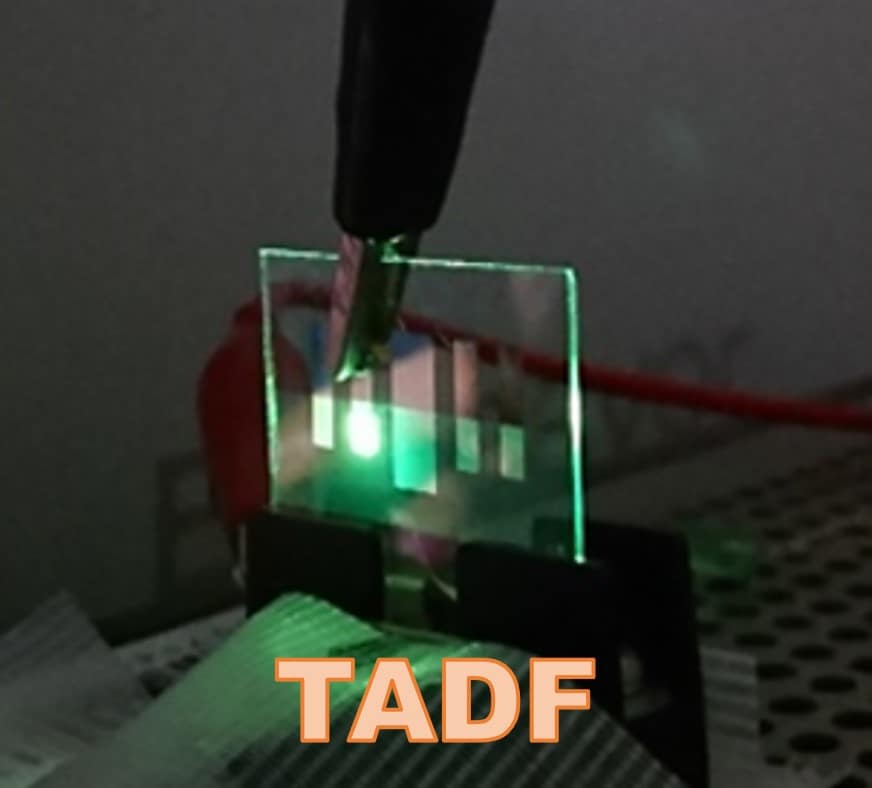
OLED (TADF) Paper Highlights
日本語(一般向け)
1) まずは超入門:TADFとは?(OLEDで何が嬉しいの?)
- TADF(熱活性化遅延蛍光)は、電気で作られる「三重項(トリプレット)」励起子も熱エネルギーで一重項(シングレット)へ戻して発光に使う考え方です。
- 目的は、OLEDの発光効率を上げること(理想的には励起子の利用率を高める)と、色純度や寿命との両立です。
- 最近は、
- MR-TADF(多重共鳴型):狭帯域で高色純度(特に青)
- ハイパーフルオレッセンス:TADF増感→高色純度蛍光へエネルギー移動
- Purcell効果(共振器):光学設計で寿命や放射過程を制御などが大きな流れです。
2) 1. ADVANCED MATERIALS(26.8 (JIF 2024))
- 論文タイトル:B―O-Bond-Mediated π-Extension Enables Concurrent High Efficiency and Spectral Purity Toward BT.2020-Standard Deep-Blue MR-TADF OLEDs
- 著者:Ye, ZY, Zhang, ZH, Xu, XL, et al.
- 年:2026
- DOI:10.1002/adma.202520889
- この研究のねらい(かみ砕き)
- 次世代ディスプレイ規格(BT.2020)で要求される“深青”は、発光が難しく、効率・色純度・安定性の同時達成が課題。
- そこで、MR-TADFの分子設計(π拡張、B–O結合を介した構造設計)で、高効率と狭帯域(高色純度)を両立させる方向性を示した研究です。
- ポイント
- 分子構造の工夫により、深青発光に必要なエネルギー設計を実現。
- スペクトルが細い(色が濁りにくい)ことを重視した設計指針。
- 実用規格に近い“色座標”を狙うという実装志向が強い。
- 「分子設計→色純度→規格(BT.2020)まで見据える」流れを示す代表例。青OLED設計の“教科書的”論点が詰まっています。
2. CHEM(19.6 (JIF 2024))
- 論文タイトル:Fast reverse intersystem crossing over 107 s-1 via near-enantiomeric charge-transfer transitions
- 著者:Zhang, H, Huang, TY, Zhou, JP, et al.
- 年:2026
- DOI:10.1016/j.chempr.2025.102685
- この研究のねらい(かみ砕き)
- TADF材料で鍵となるのは、三重項→一重項へ戻るRISC(逆項間交差)の速さ。
- 本研究は、RISCが極めて高速(10⁷ s⁻¹級)に進む条件を整理し、遅延成分を“速く戻す”設計を議論しています。
- ポイント
- スピン変換(RISC)を加速する要因(分子・振動・エネルギー差など)を、実験/理論の観点で扱う。
- “速いRISC”は、高輝度駆動時の効率ロールオフ抑制や寿命の観点で重要。
- TADF材料探索の判断基準(評価軸)を与えるタイプの研究。
- 「TADFの本質(RISC)」を、速度論の言葉で整理してくれるので、研究紹介にも教育にも使いやすいです。
3. ADVANCED FUNCTIONAL MATERIALS(19.0 (JIF 2024))
- 論文タイトル:The Effect of Purcell Cavities on the Lifetime of Thermally Activated Delayed Fluorescent Emitters
- 著者:Paul, S, Zhao, HN, Muniz, CN, et al.
- 年:2026
- DOI:10.1002/adfm.202522114
- この研究のねらい(かみ砕き)
- Purcell効果(共振器に入れると放射速度が変わる)を利用すると、発光寿命や放射/非放射のバランスが変化します。
- 本研究は、TADF発光体をPurcell cavityに配置したときに、寿命や効率がどう変わるかを定量的に検討する内容です。
- ポイント(Abstractを写さず要約)
- 有機材料側(TADF)の設計だけでなく、光学設計(共振器)で発光過程を制御。
- “材料×デバイス構造”の最適化が、効率と安定動作の両方に効くことを示唆。
- ディスプレイ・照明の光取り出し設計にもつながる視点。
- 材料研究に“光学キャビティ”の視点を足すと何が起きるか、外部の方にも説明しやすいテーマです。
English (for a general audience)
1) Quick primer: What is TADF in OLEDs?
- TADF (Thermally Activated Delayed Fluorescence) is a strategy to convert normally non‑emissive triplet excitons back to singlet excitons using thermal energy, so they can contribute to light emission.
- The goal is higher device efficiency, while keeping color purity and operational stability.
- Key recent directions include:
- MR‑TADF (multi‑resonance TADF) for narrowband, high‑purity emission (especially deep‑blue)
- Hyperfluorescence, combining TADF sensitizers with fluorescent emitters
- Optical cavities / Purcell effect to tune radiative processes via device optics
2) Top 3 papers (sorted by Journal Impact Factor, JIF 2024)
Paper 1. ADVANCED MATERIALS (26.8 (JIF 2024))
- Title: B―O-Bond-Mediated π-Extension Enables Concurrent High Efficiency and Spectral Purity Toward BT.2020-Standard Deep-Blue MR-TADF OLEDs
- Authors: Ye, ZY, Zhang, ZH, Xu, XL, et al.
- Year: 2026
- DOI: 10.1002/adma.202520889
- Why it matters (plain language)
- Achieving deep‑blue OLEDs that meet BT.2020 standards is difficult because efficiency, color purity, and stability must all be satisfied.
- This work presents an MR‑TADF molecular design approach (π‑extension mediated by B–O bonding) to target high efficiency together with narrow emission bandwidth (high spectral purity).
- Key takeaways
- Demonstrates design principles for deep‑blue MR‑TADF emitters.
- Emphasizes narrowband emission to avoid “washed‑out” blue.
- Strongly application‑oriented (aiming at practical color standards).
Paper 2. CHEM (19.6 (JIF 2024))
- Title: Fast reverse intersystem crossing over 107 s-1 via near-enantiomeric charge-transfer transitions
- Authors: Zhang, H, Huang, TY, Zhou, JP, et al.
- Year: 2026
- DOI: 10.1016/j.chempr.2025.102685
- Why it matters (plain language)
- The performance of TADF emitters depends heavily on RISC (reverse intersystem crossing)—how quickly triplets return to singlets.
- This paper discusses conditions enabling very fast RISC (~10^7 s^-1), which is relevant for suppressing efficiency roll‑off and improving stability at high brightness.
- Key takeaways
- Clarifies factors that accelerate spin‑conversion dynamics.
- Provides a practical “evaluation axis” for selecting/optimizing TADF materials.
Paper 3. ADVANCED FUNCTIONAL MATERIALS (19.0 (JIF 2024))
- Title: The Effect of Purcell Cavities on the Lifetime of Thermally Activated Delayed Fluorescent Emitters
- Authors: Paul, S, Zhao, HN, Muniz, CN, et al.
- Year: 2026
- DOI: 10.1002/adfm.202522114
- Why it matters (plain language)
- The Purcell effect in optical cavities can modify radiative rates and effective lifetimes.
- This work examines how placing TADF emitters in Purcell cavities changes lifetime/efficiency, highlighting the synergy of materials design + optical device design.
- Key takeaways
- Shows that device optics can be an additional knob beyond chemistry.
- Relevant to light‑outcoupling and cavity‑assisted OLED architectures.
References (from the attached file)
- Ye, ZY, Zhang, ZH, Xu, XL, et al.. B―O-Bond-Mediated π-Extension Enables Concurrent High Efficiency and Spectral Purity Toward BT.2020-Standard Deep-Blue MR-TADF OLEDs. ADVANCED MATERIALS (2026). DOI: 10.1002/adma.202520889
- Zhang, H, Huang, TY, Zhou, JP, et al.. Fast reverse intersystem crossing over 107 s-1 via near-enantiomeric charge-transfer transitions. CHEM (2026). DOI: 10.1016/j.chempr.2025.102685
- Paul, S, Zhao, HN, Muniz, CN, et al.. The Effect of Purcell Cavities on the Lifetime of Thermally Activated Delayed Fluorescent Emitters. ADVANCED FUNCTIONAL MATERIALS (2026). DOI: 10.1002/adfm.202522114