作成日: 2026-02-07
日本語版(HP向け)
どんなテーマ?
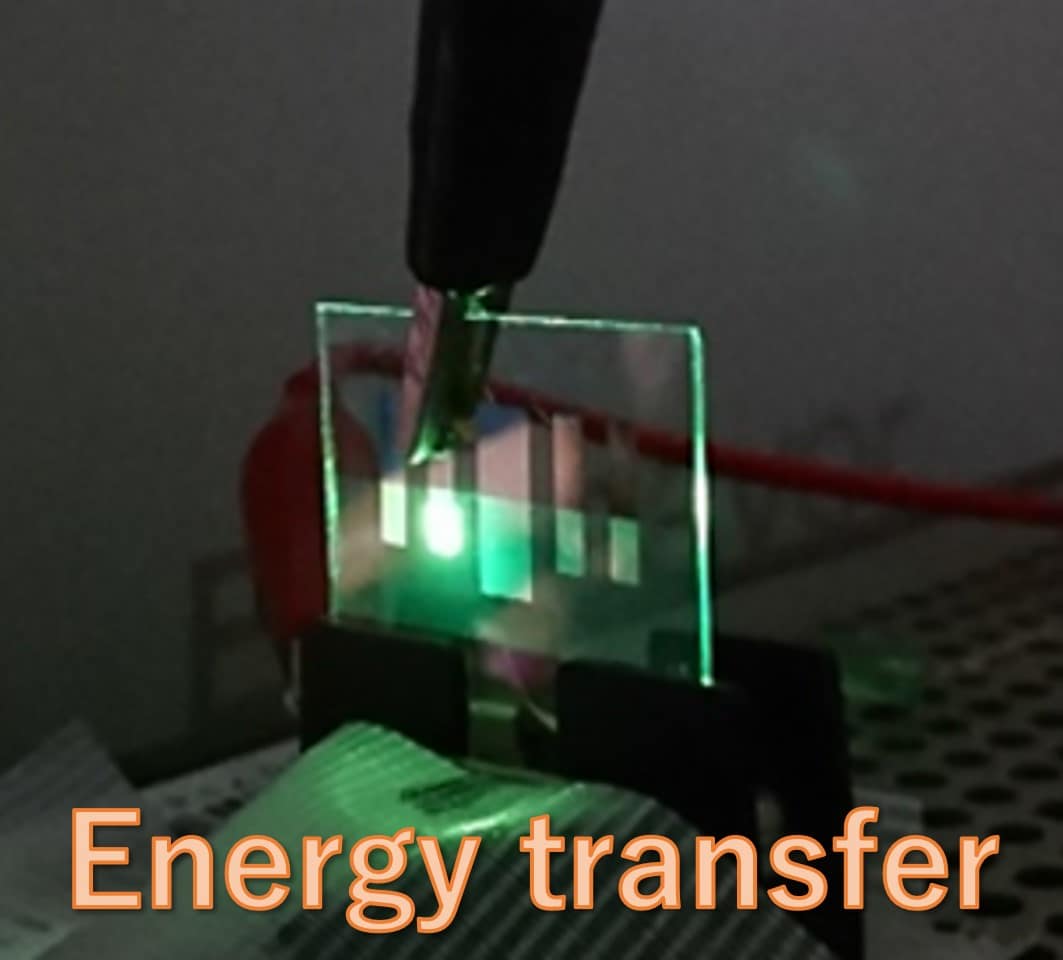
OLEDなどの有機発光デバイスでは、励起子(エネルギー)をどこで作り、どこへ渡し、どこで光らせるか(エネルギー移動・励起子マネジメント)が性能を左右します。
一方で、有機オプトエレクトロニクス全体では、DFT/TD‑DFTのような計算化学で「分子設計→性能予測」を行う流れも重要です。
ここでは、青色PS‑OLED(共発光)・Pt錯体発光体設計・分子設計計算という、“エネルギー移動”に関わる3つの視点から論文を紹介します。
1. High-Performance Coemissive Blue Organic Light-Emitting Diodes Combining Phosphorescence and Multiresonance Fluorescence
- 掲載誌: ACS APPLIED MATERIALS & INTERFACES(JIF 2024: 8.2)
- 年: 2026(JAN 28)
- 著者: Wang, YQ; Dai, YQ; Wang, WH; Zhang, C; Hang, XC; Xia, QH; Tang, Y; Liu, TF; Yang, JB
- DOI: 10.1021/acsami.5c20813
やさしい解説
– 青色OLEDは高効率化が進む一方で、色純度(狭帯域)と寿命を両立する設計が難しいという課題があります。
– 本研究は、青色のPt(II)リン光錯体(狭帯域発光)と、MR‑TADF(多共鳴型TADF)発光体を同一素子で“共発光(coemission)”させる、phosphor‑sensitized OLED(PS‑OLED)の設計を検討しました。
– 複数のリン光体とMR‑TADF発光体の組合せで、エネルギー移動と発光寄与を系統的に比較し、最適な組み合わせを導出しています。
– 新規の青色Pt(II)リン光体(PtON‑PTB)と、重水素化メチルで安定化したMR‑TADF(M‑t‑DABNA‑d)を導入すると、効率・耐久性・色純度が大きく向上したと報告。
– 底面発光デバイスでEQE最大21.3%、1000 cd/m²での色度(CIE 約0.14, 0.19)と寿命指標(LT90 55 h)を達成。
さらに上面発光ではEQE最大24.2%、LT90 93 h、CIE 約0.12, 0.10を示したとしています。
– 蛍光(MR‑TADF)とリン光(Pt錯体)の“役割分担”で青色領域の性能を底上げするアプローチとして、材料設計とエネルギー移動制御の観点から参考になります。
2. Design and Characterization of a New Phenoxypyridine-Bipyridine-Based Tetradentate Pt(II) Complex Toward Stable Blue Phosphorescent Emitters
- 掲載誌: MOLECULES(JIF 2024: 4.6)
- 年: 2026(JAN 20)
- 著者: Lim, D; Lim, JH; Ryu, CH; Lee, KM; Kang, Y
- DOI: 10.3390/molecules31020373
やさしい解説
– リン光OLED(PhOLED)は高効率ですが、蛍光OLEDに比べて寿命が短いことが課題として残っています。
– 本研究は、フェノキシピリジンとビピリジンからなる四座配位子をもつ新規Pt(II)錯体(LL‑O)を合成し、青緑色領域の発光体(ドーパント)候補として評価しました。
– 計算(構造最適化)から、Pt(II)周りが歪んだ正方平面構造をとることを示し、発光の起源を電子遷移解析で整理しています。
– 実験では、約490 nmと518 nm付近にピークをもつ発光を示す一方、量子収率は低く、無輻射失活が支配的であることが示唆されています。
– 自然遷移軌道(NTO)解析により、LC/LLCT/MLCT成分が混ざった三重項状態由来の発光である点を説明しています。
– 分解温度が高いなど熱安定性が良く、HOMO準位もデバイス設計に使いやすい範囲として、材料設計の指針を提供します。
3. Unveiling the potential of π-conjugated 2TT-R non-fullerene alternatives for multifunctional optoelectronic applications: A first-principles study
- 掲載誌: JOURNAL OF MOLECULAR GRAPHICS & MODELLING(JIF 2024: 3.0)
- 年: 2026(MAY)
- 著者: Manzoor, S; Raza, N; Abbas, F
- DOI: 10.1016/j.jmgm.2026.109285
やさしい解説
– 有機太陽電池(OSC)や有機ELなどの有機オプトエレクトロニクス材料では、分子設計の段階で光吸収・電荷移動・エネルギー準位を予測できると開発が加速します。
– 本研究は、フラーレン代替として注目される非フューズド環アクセプター(NFRA)系のπ共役分子(2TT‑1A~2TT‑5A)をDFT/TD‑DFTで系統評価しました。
– HOMO–LUMOギャップ、吸収スペクトル、双極子モーメント、励起エネルギーなどを比較し、溶媒中で吸収が長波長側へシフトする傾向を示しています。
– 候補の中では2TT‑5Aが、最も小さいギャップや長波長吸収など、電荷移動と励起子解離に有利な指標を示すと報告。
– Voc推定レンジも提示し、光起電材料としての可能性を議論しています。
– さらに非線形光学(NLO)特性やOLED発光特性の観点も触れ、“多機能”候補として実験合成を促す位置づけです。
English version (for website)
What is this topic about?
In OLEDs and related organic photonic devices, performance is strongly governed by where excitons are formed, how energy is transferred, and where emission occurs (exciton / energy‑transfer management).
In parallel, computational design (DFT/TD‑DFT) is widely used to predict optoelectronic properties before synthesis.
Below are three papers from the attached file, offering complementary viewpoints.
Selected papers (sorted by 2024 JIF; up to top 3)
1. High-Performance Coemissive Blue Organic Light-Emitting Diodes Combining Phosphorescence and Multiresonance Fluorescence
- Journal: ACS APPLIED MATERIALS & INTERFACES (2024 JIF: 8.2)
- Year: 2026 (JAN 28)
- Authors: Wang, YQ; Dai, YQ; Wang, WH; Zhang, C; Hang, XC; Xia, QH; Tang, Y; Liu, TF; Yang, JB
- DOI: 10.1021/acsami.5c20813
Plain-language bullets (paraphrased from the abstract; no verbatim text)
– Deep‑blue OLEDs must balance efficiency, narrow emission, and operational stability—often with trade‑offs.
– This study explores phosphor‑sensitized OLEDs (PS‑OLEDs) that combine narrowband Pt(II) phosphorescent complexes with multiresonance TADF (MR‑TADF) emitters to achieve coemission.
– By varying sets of phosphors and MR‑TADF emitters, it systematically analyzes emission contributions and energy‑transfer pathways to identify better pairings.
– A new tetradentate blue Pt(II) phosphor (PtON‑PTB) and a deuterated MR‑TADF emitter (M‑t‑DABNA‑d) are introduced, improving efficiency, lifetime, and color purity.
– Reported performances include bottom‑emission devices with EQEmax 21.3% and LT90 55 h at 1000 cd/m² (CIE ~0.14, 0.19), and top‑emission devices with EQEmax 24.2% and LT90 93 h (CIE ~0.12, 0.10).
– Overall, it demonstrates an effective strategy to integrate fluorescent and phosphorescent components via controlled energy transfer for high‑performance blue emission.
2. Design and Characterization of a New Phenoxypyridine-Bipyridine-Based Tetradentate Pt(II) Complex Toward Stable Blue Phosphorescent Emitters
- Journal: MOLECULES (2024 JIF: 4.6)
- Year: 2026 (JAN 20)
- Authors: Lim, D; Lim, JH; Ryu, CH; Lee, KM; Kang, Y
- DOI: 10.3390/molecules31020373
Plain-language bullets (paraphrased from the abstract; no verbatim text)
– PhOLEDs offer high efficiency, but their operational lifetimes can lag behind fluorescent OLEDs.
– This paper synthesizes a new Pt(II) complex (LL‑O) with a tetradentate bipyridine/phenoxypyridine ligand and evaluates it as a potential PhOLED dopant.
– Geometry optimization suggests a distorted square‑planar Pt(II) environment; electronic analyses are used to rationalize photophysics.
– The complex shows bluish‑green emission (peaks near 490 and 518 nm) but a low photoluminescence quantum yield, attributed to dominant non‑radiative decay.
– Natural transition orbital analysis indicates mixed triplet LC, LLCT, and MLCT character in the emitting state.
– High thermal stability and suitable HOMO level make it informative for Pt‑complex design even when efficiency needs improvement.
3. Unveiling the potential of π-conjugated 2TT-R non-fullerene alternatives for multifunctional optoelectronic applications: A first-principles study
- Journal: JOURNAL OF MOLECULAR GRAPHICS & MODELLING (2024 JIF: 3.0)
- Year: 2026 (MAY)
- Authors: Manzoor, S; Raza, N; Abbas, F
- DOI: 10.1016/j.jmgm.2026.109285
Plain-language bullets (paraphrased from the abstract; no verbatim text)
– In organic optoelectronics, early‑stage prediction of absorption, charge transfer, and energy levels helps accelerate material discovery.
– This study uses DFT/TD‑DFT to assess π‑conjugated non‑fused ring acceptor (NFRA) molecules (2TT‑1A to 2TT‑5A) as fullerene alternatives.
– It compares HOMO–LUMO gaps, absorption spectra, dipole moments, and excitation energies, noting solvent‑induced red‑shifts in absorption.
– Among the set, 2TT‑5A stands out with a narrow gap and long‑wavelength absorption, consistent with efficient charge transfer and exciton dissociation.
– Predicted open‑circuit voltage ranges are provided to gauge photovoltaic potential.
– The work also discusses nonlinear optical and OLED‑relevant properties, positioning 2TT‑5A as a multifunctional candidate for experimental validation.
参考文献 / References(ファイル内・選定分)
- Wang, YQ; Dai, YQ; Wang, WH; Zhang, C; Hang, XC; Xia, QH; Tang, Y; Liu, TF; Yang, JB (2026). High-Performance Coemissive Blue Organic Light-Emitting Diodes Combining Phosphorescence and Multiresonance Fluorescence. ACS APPLIED MATERIALS & INTERFACES 18(3) 5598-5607. doi:10.1021/acsami.5c20813
- Lim, D; Lim, JH; Ryu, CH; Lee, KM; Kang, Y (2026). Design and Characterization of a New Phenoxypyridine-Bipyridine-Based Tetradentate Pt(II) Complex Toward Stable Blue Phosphorescent Emitters. MOLECULES 31(2) Article 373. doi:10.3390/molecules31020373
- Manzoor, S; Raza, N; Abbas, F (2026). Unveiling the potential of π-conjugated 2TT-R non-fullerene alternatives for multifunctional optoelectronic applications: A first-principles study. JOURNAL OF MOLECULAR GRAPHICS & MODELLING 144 Article 109285. doi:10.1016/j.jmgm.2026.109285
Impact Factor (2024) sources (for transparency)
- ACS Applied Materials & Interfaces: 2024 JIF 8.2 (journal metric listings).
- Molecules: Impact Factor 4.6 (2024 JCR; MDPI journal page).
- Journal of Molecular Graphics and Modelling: Impact Factor 3.0 (ScienceDirect journal page).