OLED_Energy transfer20260228
日本語版(一般向け解説)
① TADF(熱活性化遅延蛍光)材料のOLED応用(Coord. Chem. Rev.)
- TADF材料は、シングレットとトリプレットの両方の励起子を利用でき、ほぼ100%の内部量子効率が可能。
- 分子設計で重要なのは:ドナー–アクセプター構造、剛直化、多重共鳴構造、空間的電荷移動など。
- OLEDデバイスでは、ホスト-ゲスト相互作用、電荷バランス、安定性向上などが重要。
- 新潮流として:円偏光TADF、室温燐光TADFハイブリッド、AIによる材料設計が進む。
- 一般向け説明:TADFは「捨てられていたトリプレット光」を活かす技術で、明るく省エネのOLEDに不可欠。
② デュアル・エキシプレックスによる色可変OLED(Adv. Opt. Mater.)
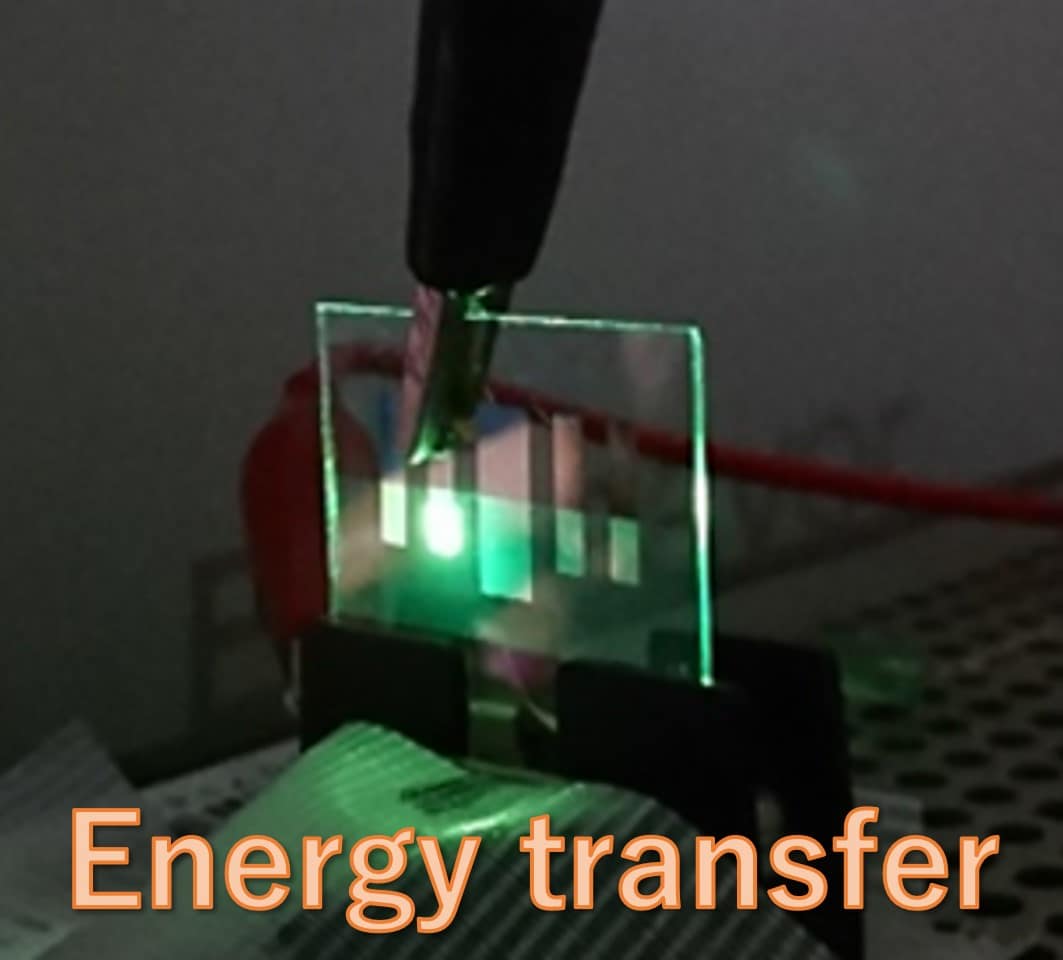
- 2種のドナー(mCP・TCTA)+1種のアクセプター(PO‑T2T)で 2種類のエキシプレックス発光を同時生成。
- 電圧によりホスト→ゲストのエネルギー移動量が変化し、色が変わるOLEDを実現。
- 別のドナー(TAPC、TPD)に入れ替えることで、さらに広範な色調整が可能。
- 一般向け説明:電圧だけで色が自由に変わる「次世代ディスプレイ」や「偽造防止技術」に使える。
English Version
① TADF materials for high‑efficiency OLEDs (Coord. Chem. Rev.)
- TADF enables nearly 100% internal quantum efficiency by harvesting both singlet and triplet excitons.
- Key molecular strategies: donor–acceptor engineering, structural rigidification, multiple resonance, through‑space charge transfer.
- Device‑level improvements rely on host–guest interactions, charge/exciton balance, and stability.
- Emerging directions include circularly polarized TADF, RTP–TADF hybrids, and AI‑guided material discovery.
- In simple terms: TADF lets OLEDs use “wasted” triplet energy, enabling brighter and more energy‑efficient devices.
② Dual‑exciplex architecture for color‑tunable OLEDs (Adv. Opt. Mater.)
- Two donors (mCP/TCTA) and one acceptor (PO‑T2T) produce two exciplex emissions simultaneously.
- Voltage‑dependent energy transfer switches emission between host and guest → electrically tunable colors.
- Replacing TCTA with TAPC or TPD broadens the tunable color range.
- In simple terms: A new OLED design enabling color change by voltage, useful for advanced displays and anti‑counterfeiting.
文献 / References
- Palem et al., Coordination Chemistry Reviews, 2026.
- Shen et al., Advanced Optical Materials, 2026.