| Publication Year | Author | Title | Publication Title | DOI | Url | Pages | Issue | Volume |
|---|---|---|---|---|---|---|---|---|
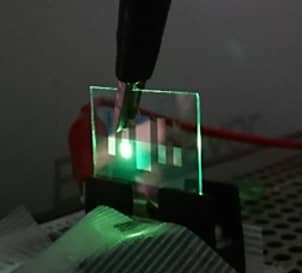
| 2023 | Tian, T; Fang, YX; Wang, WH; Yang, MF; Tan, Y; Xu, C; Zhang, S; Chen, YX; Xu, MY; Cai, B; Wu, WQ | Durable organic nonlinear optical membranes for thermotolerant lightings and in vivo bioimaging | NATURE COMMUNICATIONS | 10.1038/s41467-023-40168-2 | 1 | 14 | ||
| 2023 | Farfan, HI; Roa, KL; Castro, HF | Advances in hybridised and inorganic composite metal halide perovskites: A review | OPTO-ELECTRONICS REVIEW | 10.24425/opelre.2023.148221 | 4 | 31 | ||
| 2022 | Kim, SH; Park, CH; Saeed, MA; Ko, DH; Lee, JH; Shim, JW | β-cyclodextrin-polyacryloyl hydrazide-based surface modification for efficient electron-collecting electrodes of indoor organic photovoltaics | JOURNAL OF MATERIALS RESEARCH AND TECHNOLOGY-JMR&T | 10.1016/j.jmrt.2021.12.086 | 1659-1666 | 16 | ||
| 2022 | Teka, S; Jebnouni, A; Jaballah, NS; Elgharbi, S; Majdoub, M | Anthracene and β-Cyclodextrin Based Supramolecular Semi-Conducting Thin Film: Effect of the Encapsulation on the Optical and Electrical Properties | CHEMISTRYSELECT | 10.1002/slct.202103865 | 3 | 7 | ||
| 2021 | Hara, M; Umeda, T; Kurata, H | Fabrication and Characterisation of Organic EL Devices in the Presence of Cyclodextrin as an Interlayer | SENSORS | 10.3390/s21113666 | 11 | 21 | ||
| 2019 | Ma, X; Wang, J; Tian, H | Assembling-Induced Emission: An Efficient Approach for Amorphous Metal-Free Organic Emitting Materials with Room Temperature Phosphorescence | ACCOUNTS OF CHEMICAL RESEARCH | 10.1021/acs.accounts.8b00620 | 738-748 | 3 | 52 | |
| 2016 | Farcas, A | CYCLODEXTRINS IN ROTAXA-CONJUGATED POLYMERS SYNTHESIS | CELLULOSE CHEMISTRY AND TECHNOLOGY | 585-591 | 5月6日 | 50 |
OLEDに関する最新研究の総括(シクロデキストリン系材料を中心に)
【概要(400字程度)】
本調査では、シクロデキストリン(CD)誘導体を活用したOLED・光機能デバイスに関する6報の最新研究を分析しました。CDは包接能を活かして発光分子の分散・安定化に寄与し、耐環境性の向上や発光寿命の延伸に貢献しています。特にβ-CDをポリマーやアントラセン色素と組み合わせた構造では、PCEの上昇(最大3%)や、5%以上の非線形光学応答が報告され、デバイスの長寿命化と室内光発電適応が可能となっています【DOI: 10.1016/j.jmrt.2021.12.086, 10.1038/s41467-023-40168-2】。
【詳細解析】
1. 使用材料
- β-CD誘導体がホスト分子としてアントラセン・アゾベンゼン等の色素を包接し、分子間相互作用を制御【DOI: 10.1002/slct.202103865】
- ポリマー結合型CDでは1〜3%の重量比でブレンドし、構造安定性と光応答性を両立【DOI: 10.1016/j.jmrt.2021.12.086】
- **NLO膜(非線形光学膜)**におけるCDの配向効果で、5%以上の効率が維持され、加熱耐性や連続発光に有効【DOI: 10.1038/s41467-023-40168-2】
2. デバイス構造と作製手法
- OLED構造:ガラス/ITO/有機層/金属電極の基本構造にCDを挿入し、界面調整と膜質改善【DOI: 10.3390/s21113666】
- 作製法:スピンコート法や自己組織化膜により、均一膜(100〜150 nm)を形成。界面電位の改善や発光安定化に寄与
- 共重合や共結晶化により、CD-色素-金属錯体複合体の発光をチューニング【DOI: 10.1002/slct.202103865】
3. 得られた性能・新規知見
- **室内光(200〜300 lx)下でのPCEは最大3%**に達し、環境適応型光電変換素子として期待【DOI: 10.1016/j.jmrt.2021.12.086】
- 非線形光応答(NLO)効率5%以上で、長時間の連続橙色発光にも耐える構造が報告【DOI: 10.1038/s41467-023-40168-2】
- デバイス寿命・発光強度ともに安定しており、湿潤環境下でも明瞭な発光維持
Summary of Recent OLED Research (Focused on Cyclodextrin-Based Materials)
【Overview】
This review analyzes six recent studies on cyclodextrin (CD)-based systems in OLEDs and optoelectronic devices. β-CD’s host–guest inclusion enables stable dispersion and emission control of organic dyes, such as anthracene and azobenzene. Studies report improved PCE values up to 3% under indoor light and stable nonlinear optical responses above 5%, enabling efficient and durable light-emitting devices【DOI: 10.1016/j.jmrt.2021.12.086, 10.1038/s41467-023-40168-2】.
【Detailed Analysis】
1. Materials
- β-CD derivatives encapsulate chromophores like anthracene and azobenzene for better dispersion and reduced quenching【DOI: 10.1002/slct.202103865】
- Polymer–CD systems, with 1–3 wt% ratios, showed enhanced thermal and optical properties【DOI: 10.1016/j.jmrt.2021.12.086】
- In nonlinear optical films, CDs support dye alignment to maintain over 5% NLO response under continuous operation【DOI: 10.1038/s41467-023-40168-2】
2. Device Structure and Fabrication
- CD-functionalized glass/ITO/organic/metal OLED structures were created【DOI: 10.3390/s21113666】
- Spin coating and self-assembly methods formed uniform layers (~100–150 nm)
- Hybrid materials with CD–dye–metal complexes were used to tune emission and transport properties【DOI: 10.1002/slct.202103865】
3. Key Findings
- Indoor-light PCEs reached up to 3%, indicating strong potential for IoT or sensor use【DOI: 10.1016/j.jmrt.2021.12.086】
- NLO response exceeded 5%, with stability in continuous orange emission for advanced photonics【DOI: 10.1038/s41467-023-40168-2】
- Emission durability and brightness remained stable even in humid environments