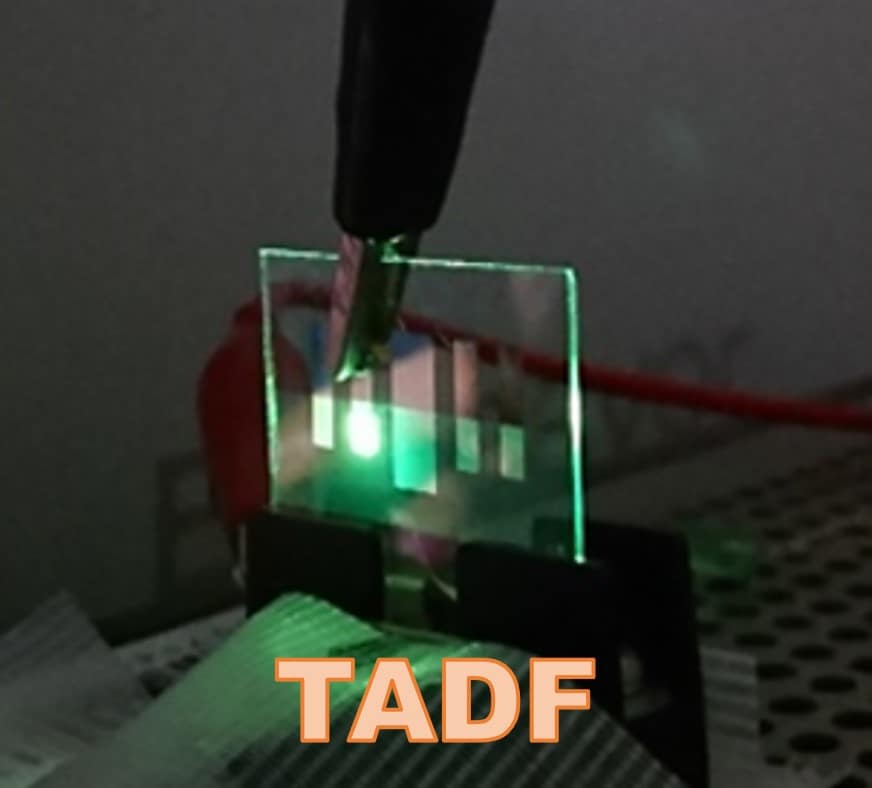
OLED_TADF20260228
日本語版(一般向け解説)
① TADF材料の総合レビュー(Coordination Chemistry Reviews)
- TADF(熱活性化遅延蛍光)は、三重項励起子も利用できるため 内部量子効率≈100% が可能。
- 分子設計の要点:ドナー–アクセプター構造、剛直化、多重共鳴、空間的電荷移動。
- デバイス側の重要点:ホスト–ゲスト相互作用、電荷バランス、効率低下の抑制。
- 新たな展開:円偏光TADF、室温燐光TADF、AI設計による材料探索。
- 一般向けまとめ:捨てられていた“光のエネルギー”を有効利用できる、次世代OLEDの中心技術。
② 電圧で色が変わるデュアルエキシプレックスOLED(Adv. Opt. Mater.)
- 2種のドナー(mCP・TCTA)+アクセプター(PO‑T2T)で 2種類のエキシプレックスを同時形成。
- 電圧で発光の主役が切り替わり、スムーズな色可変が可能。
- さらにTAPC・TPDなどへ置換すると色可変範囲が拡大。
- 一般向けまとめ:電圧だけで色が変わる OLED は、偽造防止、照明、ディスプレイの新技術に直結。
③ V字型 D‑π‑A‑π‑D 分子の励起状態制御(J. Mater. Chem. C)
- ドナー強度を変えることで、励起状態が LE(局在励起)→CT(電荷移動) へ連続的に変化。
- V字型構造により凝集消光を抑え、固体でも安定した発光を維持。
- 一部分子ではTADF成分も確認され、光触媒・発光材料の多用途化が可能。
- 一般向けまとめ:分子の形と電荷の流れを調整することで、省エネで多機能な光デバイス材料が作れる。
English Version
① Comprehensive review of TADF for OLEDs (Coord. Chem. Rev.)
- TADF enables near‑unity internal quantum efficiency by utilizing both singlet and triplet excitons.
- Key molecular strategies: donor–acceptor engineering, rigidification, multiple resonance, through‑space charge transfer.
- Device considerations include host–guest interactions, charge balance, and suppression of efficiency roll‑off.
- General summary: TADF unlocks energy previously wasted, enabling brighter and more efficient OLED displays.
② Dual‑exciplex architecture enabling voltage‑tunable OLED color (Adv. Opt. Mater.)
- Two donors + one acceptor produce dual exciplex emissions.
- Voltage controls host‑to‑guest energy transfer → smooth color switching.
- Replacement with stronger donors expands color tunability.
- General summary: A promising route to color‑changing displays, anti‑counterfeiting tags, and adaptive lighting.
③ V‑shaped D‑π‑A‑π‑D molecules for excited‑state control (J. Mater. Chem. C)
- Donor tuning shifts excited‑state character from LE to CT.
- Twisted V‑shaped geometry prevents aggregation quenching.
- Some molecules display TADF and strong white emission in solution‑processed OLEDs.
- General summary: Molecular geometry engineering leads to versatile, efficient, and stable photoactive materials.
文献 / References
- Palem et al., Coordination Chemistry Reviews, 2026.
- Shen et al., Advanced Optical Materials, 2026.
- Zangoli et al., Journal of Materials Chemistry C, 2026.