作成日: 2026-02-21
どんなテーマ?
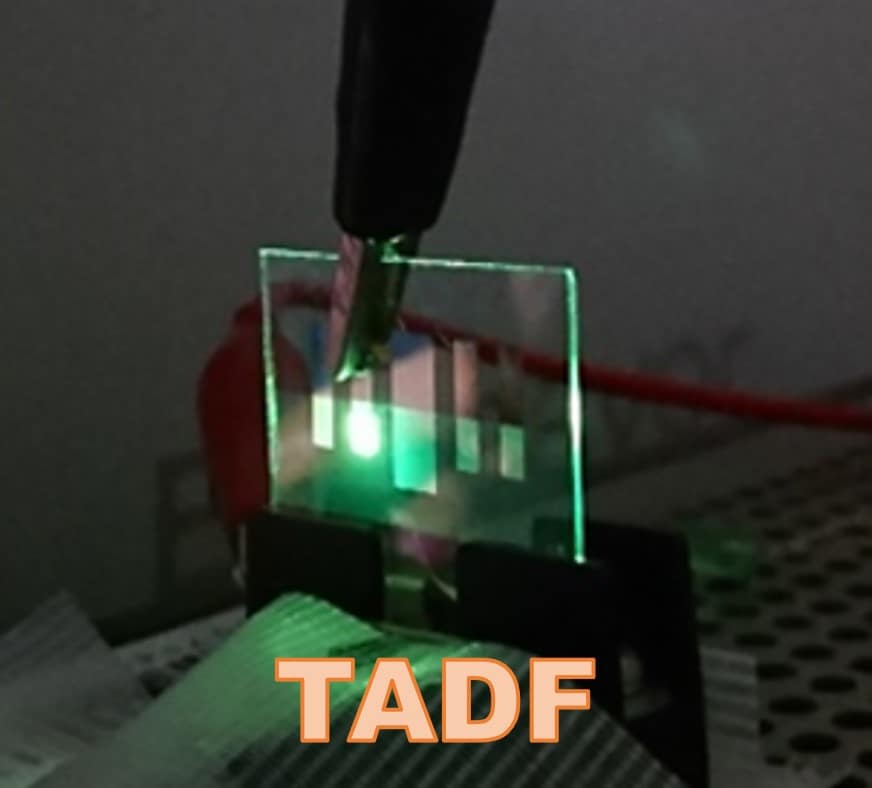
TADF(Thermally Activated Delayed Fluorescence)は、三重項励起子を熱の助けで一重項に戻す(RISC)ことで、発光効率を高める仕組みです。
その中でも MR‑TADF(多共鳴型) は、狭帯域(色純度の高い)発光を狙えるため、次世代ディスプレイ向け材料として注目されています。
The Important Role of Carbonyl in Accelerating Reverse Intersystem Crossing for Selenium-Based Organoboron Narrowband Blue Emitters
- 掲載誌:Angewandte Chemie-International Edition(参考JIF 2024: 16.6)
- 年:2026(2026 FEB 9)
- 著者:Yang, ZH, Chen, YL, Chen, ZJ, Liao, SY, et al.
- DOI:10.1002/anie.5497802
やさしい解説
– 青色MR‑TADFは色純度と高効率が魅力ですが、一般にΔESTが大きく、RISC(逆系間交差)が遅いことがボトルネックになります。
– 本研究は、セレン(Se)を含む有機ボロン系のMR骨格に、カルボニル基を組み込む分子設計を初めて提案し、スピン反転(RISC)を加速する“役割”を検証しています。
– カルボニルの軌道がMRコアへ広がることでΔESTが小さくなり、RISC速度が 10^7 s⁻1級まで高速化できると報告しています。
– 代表発光体 pSeXBN を用いた非増感OLEDで、発光ピーク 478 nm、狭帯域(FWHM 28 nm)、最大EQE 32.6%、1000 cd m⁻2でも 28.4%保持という高性能を示しています。
– さらに2色白色OLEDでも高いEQEを示し、カルボニル導入が“狭帯域ブルー材料”の設計指針になると結論づけています。
Synergistic indolocarbazole stitching and peripheral acceptor engineering enable narrowband green MR-TADF emitters for high-efficiency and long-lifetime OLEDs
- 掲載誌:Chemical Engineering Journal(参考JIF 2024: 13.2)
- 年:2026(FEB 15)
- 著者:Dang, HT, Truong, TT, Abitkar, N, Rajput, A, et al.
- DOI:10.1016/j.cej.2026.173453
やさしい解説
– 狭帯域グリーンMR‑TADFでは、高効率と長寿命の両立が難しく、励起子起因の劣化を抑える“頑健な骨格”設計が重要です。
– 本研究は、インドロカルバゾールを“縫い込む”ように埋め込んだB–N系MR‑TADF(ICz‑BN)発光体群を設計し、外周アクセプターも最適化して分子の安定性を高めています。
– 発光は緑(約522–540 nm)で、狭帯域(FWHM 21–24 nm)かつPLQY>90%を示すと報告されています。
– エキシプレックス共ホストを用いたPSF OLEDで、tBuICzBN‑QがFRETを効率化し、最大EQE 28.9%、5000 cd m⁻2でもEQE 26.2%とロールオフが小さい点が特徴です。
– 寿命指標として LT97=2591 h(@1000 cd m⁻2)を示し、結合解離エネルギー解析から“カチオン状態で壊れにくい設計”が寿命に効くことを示唆しています。
Multiple resonance thermally activated delayed fluorescence emitters containing novel S-based acceptor with narrowed FWHM and enhanced EQE
- 掲載誌:Chemical Engineering Journal(参考JIF 2024: 13.2)
- 年:2026(FEB 15)
- 著者:Xia, XX, Yuan, G, Xie, FM, Zhang, Q, et al.
- DOI:10.1016/j.cej.2026.173722
やさしい解説
– S原子を取り入れたMR‑TADF設計は報告がある一方で、発光帯域が広い/効率が伸びにくいという課題がありました。
– 本研究は、S原子を含む“弱いアクセプター”N2SOを新規に設計し、BCzBN骨格と連結してMR‑TADF材料 N2SOBN を合成しています。
– 溶液中で494 nm発光、ドープ膜でPLQYが最大98%と高い発光効率を示したと報告。
– OLEDでは狭帯域(FWHM 28 nm)と高い EQE_max 28% を同時に達成し、S系MR‑TADFの性能を押し上げています。
– さらに、エナンチオマーが円偏光発光(CPL)を示す点(gPLが10^-4オーダー)も報告し、キラル光学機能を併せ持つ材料設計の可能性を示しています。
English version (for website)
What is this topic about?
TADF (Thermally Activated Delayed Fluorescence) harvests triplet excitons by converting them back to singlets via RISC, boosting OLED efficiency.
MR‑TADF (multi‑resonance TADF) is especially attractive for displays because it can deliver narrowband emission (high color purity).
Top 3 papers (sorted by 2024 JIF)
The Important Role of Carbonyl in Accelerating Reverse Intersystem Crossing for Selenium-Based Organoboron Narrowband Blue Emitters
- Journal: Angewandte Chemie-International Edition (Ref. 2024 JIF: 16.6)
- Year: 2026 (2026 FEB 9)
- Authors: Yang, ZH, Chen, YL, Chen, ZJ, Liao, SY, et al.
- DOI: 10.1002/anie.5497802
Plain-language bullets (paraphrased; no verbatim abstract text)
– Narrowband blue MR‑TADF materials offer high color purity and efficiency, but RISC is often rate‑limiting due to large ΔEST and weak spin–orbit coupling.
– This work introduces carbonyl‑containing, selenium‑doped organoboron MR emitters and clarifies how carbonyl groups can accelerate spin‑flip dynamics and RISC.
– Carbonyl orbital delocalization within the MR core reduces ΔEST and enables ultrafast RISC (10^7 s⁻1 scale) as reported.
– A non‑sensitized OLED using pSeXBN shows 478‑nm emission with a narrow 28‑nm FWHM, EQE_max 32.6%, and 28.4% retained at 1000 cd m⁻2.
– The approach also supports high‑performance two‑color white OLEDs, highlighting carbonyl incorporation as a useful design principle for narrowband blue emitters.
Synergistic indolocarbazole stitching and peripheral acceptor engineering enable narrowband green MR-TADF emitters for high-efficiency and long-lifetime OLEDs
- Journal: Chemical Engineering Journal (Ref. 2024 JIF: 13.2)
- Year: 2026 (FEB 15)
- Authors: Dang, HT, Truong, TT, Abitkar, N, Rajput, A, et al.
- DOI: 10.1016/j.cej.2026.173453
Plain-language bullets (paraphrased; no verbatim abstract text)
– For narrowband green MR‑TADF emitters, simultaneously achieving high efficiency and long lifetime is challenging; robust molecular frameworks are crucial to suppress exciton‑induced degradation.
– This work designs indolocarbazole‑embedded B–N MR‑TADF emitters (ICz‑BN series) and applies peripheral acceptor engineering to improve intrinsic robustness.
– The emitters show green emission (~522–540 nm) with narrow bandwidth (FWHM 21–24 nm) and >90% PL quantum yield.
– In PSF OLEDs with an exciplex co‑host, tBuICzBN‑Q enables efficient FRET and delivers EQE_max 28.9% with strongly suppressed roll‑off (26.2% at 5000 cd m⁻2).
– Operational stability reaches LT97 = 2591 h at 1000 cd m⁻2, and bond‑dissociation‑energy analysis links cationic framework stability to lifetime.
Multiple resonance thermally activated delayed fluorescence emitters containing novel S-based acceptor with narrowed FWHM and enhanced EQE
- Journal: Chemical Engineering Journal (Ref. 2024 JIF: 13.2)
- Year: 2026 (FEB 15)
- Authors: Xia, XX, Yuan, G, Xie, FM, Zhang, Q, et al.
- DOI: 10.1016/j.cej.2026.173722
Plain-language bullets (paraphrased; no verbatim abstract text)
– S‑atom‑based MR‑TADF designs have been explored, but often suffer from broader emission and limited EQE.
– This study designs a new weak S‑containing acceptor (N2SO) and links it to a BCzBN framework to synthesize the MR‑TADF emitter N2SOBN.
– N2SOBN emits at ~494 nm in solution and shows up to 98% PLQY in doped films.
– OLEDs achieve a narrow 28‑nm FWHM together with EQE_max 28%, representing strong performance among S‑based MR‑TADF materials.
– Notably, the enantiomers display circularly polarized photoluminescence (CPL) with gPL on the 10^-4 level, suggesting added chiroptical functionality.
参考文献 / References
- Yang, ZH, Chen, YL, Chen, ZJ, Liao, SY, et al. (2026). The Important Role of Carbonyl in Accelerating Reverse Intersystem Crossing for Selenium-Based Organoboron Narrowband Blue Emitters. Angewandte Chemie-International Edition. doi:10.1002/anie.5497802
- Dang, HT, Truong, TT, Abitkar, N, Rajput, A, et al. (2026). Synergistic indolocarbazole stitching and peripheral acceptor engineering enable narrowband green MR-TADF emitters for high-efficiency and long-lifetime OLEDs. Chemical Engineering Journal. doi:10.1016/j.cej.2026.173453
- Xia, XX, Yuan, G, Xie, FM, Zhang, Q, et al. (2026). Multiple resonance thermally activated delayed fluorescence emitters containing novel S-based acceptor with narrowed FWHM and enhanced EQE. Chemical Engineering Journal. doi:10.1016/j.cej.2026.173722