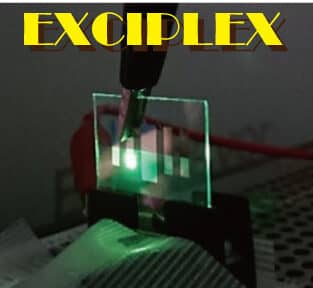
0) エキシプレックスOLEDとは? / What is an exciplex OLED?
日本語
- エキシプレックスは、異なる2分子(電子を渡す側=ドナー、受け取る側=アクセプター)が近づいたときにできる“分子間の電荷移動(CT)状態”です。
- 注入しやすく省電力化に有利な一方、効率や発光の制御が難しいこともあり、材料設計の工夫が重要になります。
English
- An exciplex is an intermolecular charge‑transfer (CT) excited state formed between a donor and an acceptor molecule in close contact.
- Exciplexes can reduce injection barriers (helping low‑power operation), but efficiency and emission control can be challenging—making molecular/device design crucial.
1) 選定した上位3本
- ADVANCED MATERIALS(JIF 26.8)— Multi-Scale Charge Transfer in Organic Electroluminescence — DOI: 10.1002/adma.202519387
- MATERIALS HORIZONS(JIF 10.7)— Ultra-high-power-efficiency organic light-emitting diodes based on a hot-exciton-assisted exciplex (HEAE) system — DOI: 10.1039/d6mh00070c
- ACS APPLIED ELECTRONIC MATERIALS(JIF 4.7)— Molecular Design of Bipolar Acceptors for Ultra-Low Voltage and High-Luminance Red PhOLEDs Based on DPQ Derivatives — DOI: 10.1021/acsaelm.5c02639
2) 解説(日本語)
1. Multi-Scale Charge Transfer in Organic Electroluminescence
- 掲載誌:ADVANCED MATERIALS(JIF 26.8)
- 年:2026
- DOI:10.1002/adma.202519387
ポイント(わかりやすい箇条書き) - 狙い:OLEDの発光効率を左右する「電荷移動(CT)」を、分子内/分子間・短距離/長距離といった“スケール”で整理し、励起子(exciton)の生成と発光にどう効くかを俯瞰する。
- 見どころ:CTにより生じる三重項励起子(triplet)が、最新OLEDの発光に大きく関与するという視点を強調。
- 学べる点:相互作用モードごとの違いを比較し、構造—物性の関係から「次世代材料をどう設計するか」のヒントを与える。
- エキシプレックスとの関係:分子間CTの代表例がエキシプレックスであり、CT状態をどう作り・どう光らせるかの理解の土台になる。
2. Ultra-high-power-efficiency organic light-emitting diodes based on a hot-exciton-assisted exciplex (HEAE) system
- 掲載誌:MATERIALS HORIZONS(JIF 10.7)
- 年:2026
- DOI:10.1039/d6mh00070c
ポイント(わかりやすい箇条書き) - 狙い:エキシプレックスは注入障壁が低く省電力化に有利だが、効率が伸びにくい。そこで「hot-exciton材料をドナーに使い、励起子エネルギーを回収する」HEAE(hot‑exciton‑assisted exciplex)戦略を提案。
- 成果:新しいエキシプレックスOLEDでEQE 19.0%(従来の約2倍)を示す。
- 応用展開:このエキシプレックスをMR発光体のホスト/増感系として使い、狭帯域の感光(sensitized fluorescence)OLEDでEQE最大40.5%、電力効率(PE)230 lm/W超を報告。
- 意義:低消費電力OLEDに向けて、「エキシプレックス×hot-exciton×MR発光」をつなぐ設計の道筋を示した。
3. Molecular Design of Bipolar Acceptors for Ultra-Low Voltage and High-Luminance Red PhOLEDs Based on DPQ Derivatives
- 掲載誌:ACS APPLIED ELECTRONIC MATERIALS(JIF 4.7)
- 年:2026
- DOI:10.1021/acsaelm.5c02639
ポイント(わかりやすい箇条書き) - 狙い:赤色PhOLEDで、低電圧駆動と高輝度、さらに高効率を同時に満たす“ホスト材料”を設計する。
- 方法:DPQ誘導体(受容体)に官能基を変えて導入し、TCTA(供与体)と組み合わせたエキシプレックスホストとして電荷輸送のバランスと準位整合を最適化。
- 成果:TCTA:DPQCN-PhDBF系で点灯電圧1.8 V、最大輝度42,457 cd/m²、EQEmax 16.8%を報告(低電圧と高輝度が特徴)。
- 設計指針:π共役の拡張、分子ねじれ、剛直ユニット(ジベンゾフラン)などがCT状態形成・正孔輸送・膜安定性に効く、という“つくり方”を示す。
3) English Version (Website-ready)
1. Multi-Scale Charge Transfer in Organic Electroluminescence
- Journal: ADVANCED MATERIALS (JIF 26.8)
- Year: 2026
- DOI: 10.1002/adma.202519387
Key points (rephrased; no abstract text copied) - Aim: organize charge‑transfer (CT) in OLED electroluminescence across scales (intra-/intermolecular; short-/long‑range) and connect it to exciton formation and emission efficiency.
- Highlight: emphasizes that CT‑related triplet excitons can decisively affect state‑of‑the‑art OLED performance.
- What you gain: compares interaction modes and develops structure–property insights to guide rational design of next‑generation materials/devices.
- Link to exciplex: exciplex emission is a prototypical intermolecular CT state, so this review provides foundational intuition for exciplex design.
2. Ultra-high-power-efficiency organic light-emitting diodes based on a hot-exciton-assisted exciplex (HEAE) system
- Journal: MATERIALS HORIZONS (JIF 10.7)
- Year: 2026
- DOI: 10.1039/d6mh00070c
Key points (rephrased; no abstract text copied) - Problem: exciplexes can lower injection barriers and help low‑power OLEDs, but efficiency has been a bottleneck.
- Strategy: proposes HEAE (hot‑exciton‑assisted exciplex), using hot‑exciton donors to recover exciton energy and boost exciplex efficiency.
- Key results: an exciplex OLED reaches EQE 19.0% (about twice a conventional exciplex OLED).
- Extension: using the exciplex as a host for MR emitters enables narrowband sensitized‑fluorescence OLEDs with EQE up to 40.5% and power efficiency exceeding 230 lm/W.
- Why it matters: offers a concrete route toward low‑power, high‑efficiency OLED architectures that integrate exciplexes and MR emitters.
3. Molecular Design of Bipolar Acceptors for Ultra-Low Voltage and High-Luminance Red PhOLEDs Based on DPQ Derivatives
- Journal: ACS APPLIED ELECTRONIC MATERIALS (JIF 4.7)
- Year: 2026
- DOI: 10.1021/acsaelm.5c02639
Key points (rephrased; no abstract text copied) - Goal: design host materials for red PhOLEDs that enable low driving voltage, high luminance, and high efficiency.
- Approach: tune DPQ‑based acceptors and pair them with TCTA donors to form exciplex hosts with balanced charge transport and optimized energy‑level alignment.
- Reported performance: turn‑on voltage 1.8 V, maximum luminance 42,457 cd/m², and EQEmax 16.8% for the TCTA:DPQCN‑PhDBF exciplex host system.
- Design message: π‑extension, controlled torsion, and a rigid dibenzofuran unit help CT‑state formation, hole transport, film stability, and energy‑level modulation.
4) 参考文献 / References
- He, Q; Shi, YL; Feng, TT; Ji, SC; Chen, QY; Song, ZX; Shen, XY; Wu, XH; Li, S; Rosei, F; Zhang, JM; Yang, CS; Zhu, RD; Shan, QS; Xue, Q; Huang, W; Xie, GH. Multi-Scale Charge Transfer in Organic Electroluminescence. ADVANCED MATERIALS (2026). DOI: 10.1002/adma.202519387.
- Lou, JL; He, JW; Li, BX; Zhang, H; Chen, YC; Tang, BZ; Wang, ZM. Ultra-high-power-efficiency organic light-emitting diodes based on a hot-exciton-assisted exciplex (HEAE) system. MATERIALS HORIZONS (2026). DOI: 10.1039/d6mh00070c.
- Yang, YR; Su, KY; Lai, PY; Huang, YJ; Chuang, TH; Lu, CW; Chang, CH. Molecular Design of Bipolar Acceptors for Ultra-Low Voltage and High-Luminance Red PhOLEDs Based on DPQ Derivatives. ACS APPLIED ELECTRONIC MATERIALS (2026). DOI: 10.1021/acsaelm.5c02639.