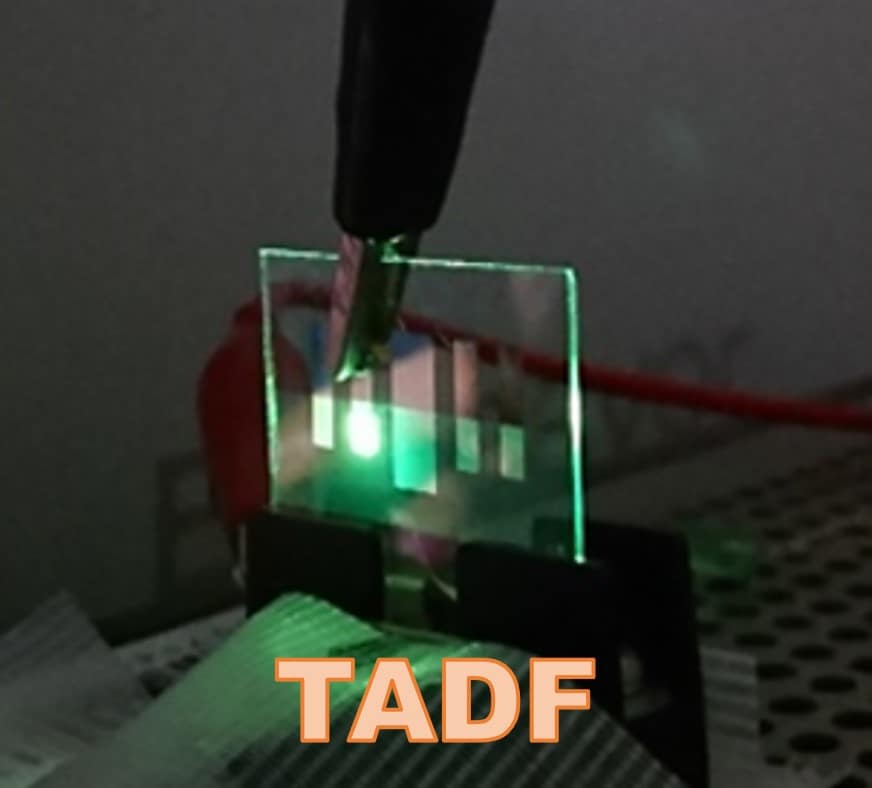
0) TADFとは?(超要約) / What is TADF? (Quick primer)
日本語
- TADF(熱活性化遅延蛍光)は、光に変換されにくい三重項励起子(triplet)を“熱”で一重項へ戻し、発光に再利用して効率を上げる考え方です。
- 近年は、MR‑TADFなどにより「色のにじみを抑えた狭帯域発光(特に青)」と「高効率」を同時に狙う研究が進んでいます。
English
- TADF (thermally activated delayed fluorescence) improves OLED efficiency by thermally up‑converting triplet excitons back to singlets so they can emit light.
- Recent work (e.g., MR‑TADF) aims to combine high efficiency with narrowband emission (especially in blue) to improve display color purity.
1) 選定した上位3本
- ADVANCED MATERIALS(JIF 26.8)— Hybridized Charge-Transfer Window within a Fully Conjugated Multi-Resonance Thermally Activated Delayed Fluorescence Framework for Ultrafast Reverse Intersystem Crossing and High-Efficiency in Deep-Blue Organic Light-Emitting Diodes — DOI: 10.1002/adma.72861
- CHEMICAL ENGINEERING JOURNAL(JIF 13.2)— Balancing efficiency and circular polarization in CP-OLEDs: chiral alkyl-substituted dicyanoquinoxaline-based TADF emitters — DOI: 10.1016/j.cej.2026.174414
- MATERIALS HORIZONS(JIF 10.7)— Next-generation blue OLED emitters: efficiency, color purity, and the road to BT.2020 — DOI: 10.1039/d5mh02390d
2) 解説
1. Hybridized Charge-Transfer Window within a Fully Conjugated Multi-Resonance Thermally Activated Delayed Fluorescence Framework for Ultrafast Reverse Intersystem Crossing and High-Efficiency in Deep-Blue Organic Light-Emitting Diodes
- 掲載誌:ADVANCED MATERIALS(JIF 26.8)
- 年:2026
- DOI:10.1002/adma.72861
ポイント(わかりやすい箇条書き) - 狙い:MR-TADFの弱点(ΔESTが大きくRISCが遅い)を抑え、深青色で「高効率×高色純度」を両立する。
- 工夫:短距離CT(MR由来)に加えて長距離CTを同一骨格に取り込み、励起状態を“ハイブリッド化”してΔESTを0.04 eVまで縮小、RISCを加速。
- 主な結果:発光447 nm、スペクトル幅(FWHM)20 nm、RISC 2.1×10^6 s^-1 を報告。
- デバイス:青色OLEDでEQE 37.5%、色度CIE (0.139, 0.065)。
- 一般向け意義:ディスプレイの「青のにじみ」を抑えながら省電力化につながる設計指針。
2. Balancing efficiency and circular polarization in CP-OLEDs: chiral alkyl-substituted dicyanoquinoxaline-based TADF emitters
- 掲載誌:CHEMICAL ENGINEERING JOURNAL(JIF 13.2)
- 年:2026
- DOI:10.1016/j.cej.2026.174414
ポイント(わかりやすい箇条書き) - 狙い:円偏光OLED(CP-OLED)で、効率(EQE)と円偏光度(gEL)を両立して高める。
- 方法:キラル源(カンファーキノン)を使いCP-TADF分子を設計。受容体の置換により、HLCT依存から“自立的に高効率なTADF”へ発光機構を移す。
- 材料特性:Td > 446℃、ΔEST < 0.3 eV、PLQY 89.5%(QD-TPA)などを報告。
- デバイス:無増感層でEQEmax 31.83%(λEL 532 nm)、エナンチオマーでgEL 0.84×10^-3。
- 一般向け意義:3D表示や光学デバイスで重要な“偏光を帯びた発光”を高効率化する足場。
3. Next-generation blue OLED emitters: efficiency, color purity, and the road to BT.2020
- 掲載誌:MATERIALS HORIZONS(JIF 10.7)
- 年:2026
- DOI:10.1039/d5mh02390d
ポイント(わかりやすい箇条書き) - 背景:UHDディスプレイでは、青色OLEDに「高効率・長寿命・BT.2020級の色純度」が同時に求められる。
- 要点:従来のD-A型TADFは長距離CTでスペクトルが広がりやすい一方、MR-TADFは短距離CTで“狭帯域の青”を狙える。
- 分子設計:π拡張、周辺保護、スピロ固定、カルボニル導入、ヘテロ原子調整などの戦略を整理。
- デバイス設計:増感蛍光(リン光増感/TADF増感)などで励起子損失やロールオフ、凝集消光を抑える流れをまとめる。
- 一般向け意義:『なぜ青が難しいのか』と『どこを設計すれば良いのか』が一枚絵で分かるロードマップ。
3) English Version (Website-ready)
1. Hybridized Charge-Transfer Window within a Fully Conjugated Multi-Resonance Thermally Activated Delayed Fluorescence Framework for Ultrafast Reverse Intersystem Crossing and High-Efficiency in Deep-Blue Organic Light-Emitting Diodes
- Journal: ADVANCED MATERIALS (JIF 26.8)
- Year: 2026
- DOI: 10.1002/adma.72861
Key points (rephrased; no abstract text copied) - Goal: mitigate typical MR‑TADF limitations (larger ΔEST and slower RISC) to achieve deep‑blue OLEDs with both high efficiency and narrowband emission.
- Design: combine short‑range CT (MR) with additional long‑range CT to create hybridized excited states, shrinking ΔEST to 0.04 eV and accelerating RISC.
- Reported metrics: 447 nm emission with 20 nm FWHM and a RISC rate of 2.1×10^6 s^-1.
- Device result: EQE 37.5% with CIE (0.139, 0.065).
- Why it matters: a molecular design route toward power‑efficient displays with purer deep‑blue pixels.
2. Balancing efficiency and circular polarization in CP-OLEDs: chiral alkyl-substituted dicyanoquinoxaline-based TADF emitters
- Journal: CHEMICAL ENGINEERING JOURNAL (JIF 13.2)
- Year: 2026
- DOI: 10.1016/j.cej.2026.174414
Key points (rephrased; no abstract text copied) - Goal: balance high device efficiency (EQE) with meaningful circular polarization (gEL) in CP‑OLEDs.
- Approach: design chiral CP‑TADF enantiomers using camphorquinone; replace the acceptor to shift from sensitizer‑dependent HLCT toward intrinsically efficient TADF.
- Material properties: Td > 446 °C, ΔEST < 0.3 eV, and PLQY up to 89.5% (QD‑TPA).
- Device results: EQEmax 31.83% at 532 nm without a sensitizing layer; enantiomers show gEL = 0.84×10^-3.
- Impact: supports practical high‑efficiency CP‑OLED design for next‑generation 3D/photonic applications.
3. Next-generation blue OLED emitters: efficiency, color purity, and the road to BT.2020
- Journal: MATERIALS HORIZONS (JIF 10.7)
- Year: 2026
- DOI: 10.1039/d5mh02390d
Key points (rephrased; no abstract text copied) - Background: UHD displays need blue OLEDs that are efficient, stable, and meet BT.2020‑level color purity.
- Key point: conventional donor–acceptor TADF can broaden emission due to long‑range CT, whereas MR‑TADF targets intrinsically narrowband blue emission via short‑range CT.
- Molecular design map: summarizes tactics such as π‑extension, peripheral shielding, spiro‑locking, carbonyl incorporation, and heteroatom tuning.
- Device‑engineering map: reviews sensitized‑fluorescence strategies (phosphorescence‑ or TADF‑sensitized) to mitigate exciton loss, roll‑off, and aggregation quenching.
- Takeaway: a roadmap of what to tune—at molecule and device levels—to approach practical BT.2020‑class blue OLEDs.
4) 参考文献 / References
- Lee, U; Jeong, K; Kang, S; Lee, JY. Hybridized Charge-Transfer Window within a Fully Conjugated Multi-Resonance Thermally Activated Delayed Fluorescence Framework for Ultrafast Reverse Intersystem Crossing and High-Efficiency in Deep-Blue Organic Light-Emitting Diodes. ADVANCED MATERIALS (2026). DOI: 10.1002/adma.72861.
- Fan, TW; Nie, XW; Xu, LX; Wang, T; Liu, WH; Wang, LY; Tang, H; Su, SJ; Cao, DR. Balancing efficiency and circular polarization in CP-OLEDs: chiral alkyl-substituted dicyanoquinoxaline-based TADF emitters. CHEMICAL ENGINEERING JOURNAL (2026). DOI: 10.1016/j.cej.2026.174414.
- Raju, TD; Tirupati, M; Kim, N; Muruganantham, S; Odugu, PK; Kesavan, AV; Kwon, JH; Kim, TG. Next-generation blue OLED emitters: efficiency, color purity, and the road to BT.2020. MATERIALS HORIZONS (2026). DOI: 10.1039/d5mh02390d.