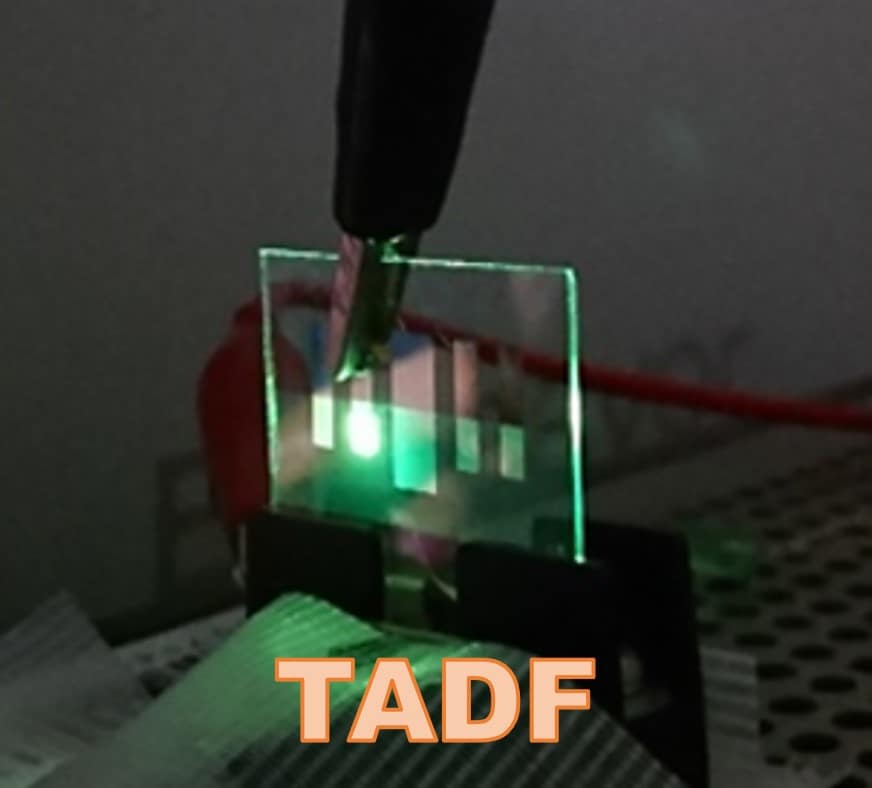
0) まずは超要約 / Quick primer
日本語
- TADF(熱活性化遅延蛍光):暗くなりやすい三重項励起子(triplet)を、熱で一重項へ戻して光として回収し、OLEDの効率を上げる仕組み。
- ロールオフ:明るくすると効率が落ちる現象。スマホや照明の実用域で重要。
- CP‑OLED(円偏光OLED):左右いずれかに“ねじれた”光(円偏光)を出すOLED。3D表示や光学素子で注目。
English
- TADF recycles triplet excitons back to emissive singlets using thermal activation, improving OLED efficiency.
- Efficiency roll‑off is the drop in efficiency at high brightness—critical for real devices.
- CP‑OLEDs emit circularly polarized light, relevant to 3D displays and photonic devices.
1) 選定した上位3本
- ADVANCED MATERIALS(JIF 26.8)— Heavy Chalcogen Elements in OLEDs: Advances of Sulfur and Selenium for Organic Light-Emitting Materials — DOI: 10.1002/adma.202521581
- ADVANCED FUNCTIONAL MATERIALS(JIF 19.0)— Uncovering the Origin of Efficiency Roll-Off in TADF OLEDs — DOI: 10.1002/adfm.202531845
- CHEMICAL ENGINEERING JOURNAL(JIF 13.2)— Balancing efficiency and circular polarization in CP-OLEDs: chiral alkyl-substituted dicyanoquinoxaline-based TADF emitters — DOI: 10.1016/j.cej.2026.174414
2) 解説(日本語)
1. Heavy Chalcogen Elements in OLEDs: Advances of Sulfur and Selenium for Organic Light-Emitting Materials
- 掲載誌:ADVANCED MATERIALS(JIF 26.8)
- 年:2026
- DOI:10.1002/adma.202521581
ポイント(わかりやすい箇条書き) - テーマ:硫黄(S)・セレン(Se)といった「重いカルコゲン元素」を有機分子へ導入し、発光過程(励起状態ダイナミクス)を制御してOLED性能を高める研究動向をまとめた総説。
- キーワード:重原子効果でスピン軌道相互作用を強め、TADFや室温りん光(RTP)で励起子を“使い切る”設計につなげる。
- 扱う範囲:D–A型TADF、MR‑TADF、純有機RTPなど多様な枠組みでのS/Se活用例を整理。
- 応用の広がり:発光体だけでなく、硫黄含有ユニットをホスト材料へ使う方向性も示し、材料設計の選択肢を拡張。
2. Uncovering the Origin of Efficiency Roll-Off in TADF OLEDs
- 掲載誌:ADVANCED FUNCTIONAL MATERIALS(JIF 19.0)
- 年:2026
- DOI:10.1002/adfm.202531845
ポイント(わかりやすい箇条書き) - 背景:TADF OLEDは高効率が期待される一方、高輝度になると効率が落ちる「ロールオフ」が課題。
- 工夫:デバイス動作中(in‑operando)に、周波数領域の測定手法で発光ダイナミクスを解析し、速度定数の推定を可能にする。
- 結論:ロールオフは単一要因ではなく、STA(S–T消滅)、SPA(S–ポーラロン消滅)、TPA(T–ポーラロン消滅)が組み合わさって起こることを定量的に示す。
- 意義:どの損失過程が支配的かを“測って分ける”ことで、材料設計・素子設計の改善点が明確になる。
3. Balancing efficiency and circular polarization in CP-OLEDs: chiral alkyl-substituted dicyanoquinoxaline-based TADF emitters
- 掲載誌:CHEMICAL ENGINEERING JOURNAL(JIF 13.2)
- 年:2026
- DOI:10.1016/j.cej.2026.174414
ポイント(わかりやすい箇条書き) - 狙い:円偏光OLED(CP‑OLED)で、発光効率(EQE)と円偏光度(gEL)を両立させる材料設計。
- 方法:キラル源(カンファーキノン)を導入してCP‑TADFの鏡像体(R/S)を設計し、受容体ユニットの改良で発光機構をTADFへ最適化。
- 材料面:高い熱安定性(Td>446℃)と小さなΔEST(<0.3 eV)、高いPLQY(例:89.5%)などを報告。
- デバイス:増感層なしでEQEmax 31.83%(532 nm)を達成し、円偏光指標gELも提示。
- 意義:次世代3D表示などで重要な“偏光を帯びた光”を、高効率で出すための足場になる。
3) English Version (Website-ready)
1. Heavy Chalcogen Elements in OLEDs: Advances of Sulfur and Selenium for Organic Light-Emitting Materials
- Journal: ADVANCED MATERIALS (JIF 26.8)
- Year: 2026
- DOI: 10.1002/adma.202521581
Key points (rephrased; no abstract text copied) - Topic: a review on using heavy chalcogen elements (S/Se) in organic molecules to tune excited‑state dynamics and enhance OLED performance.
- Key idea: heavy‑atom effects can strengthen spin–orbit coupling, helping exciton utilization in TADF and room‑temperature phosphorescence (RTP).
- Scope: covers donor–acceptor TADF, multiple‑resonance (MR) TADF, and purely organic RTP frameworks, highlighting design patterns.
- Broader impact: also discusses sulfur‑containing units in host materials, expanding practical materials choices.
2. Uncovering the Origin of Efficiency Roll-Off in TADF OLEDs
- Journal: ADVANCED FUNCTIONAL MATERIALS (JIF 19.0)
- Year: 2026
- DOI: 10.1002/adfm.202531845
Key points (rephrased; no abstract text copied) - Problem: TADF OLEDs often suffer from efficiency “roll‑off” at high brightness.
- Approach: an in‑operando frequency‑domain method is used to access rate constants that are hard to extract with conventional techniques.
- Finding: roll‑off arises from a combined interplay of singlet–triplet annihilation (STA), singlet–polaron annihilation (SPA), and triplet–polaron annihilation (TPA), with quantified contributions.
- Why it matters: separating and quantifying loss channels points directly to where materials and device stacks should be improved.
3. Balancing efficiency and circular polarization in CP-OLEDs: chiral alkyl-substituted dicyanoquinoxaline-based TADF emitters
- Journal: CHEMICAL ENGINEERING JOURNAL (JIF 13.2)
- Year: 2026
- DOI: 10.1016/j.cej.2026.174414
Key points (rephrased; no abstract text copied) - Goal: balance high EQE and meaningful circular polarization (gEL) in circularly polarized OLEDs (CP‑OLEDs).
- Design: chiral CP‑TADF enantiomers are built using camphorquinone; acceptor engineering shifts the emission mechanism toward intrinsically efficient TADF.
- Materials: reports high thermal stability (Td > 446 °C), small ΔEST (<0.3 eV), and high PLQY (e.g., 89.5%).
- Devices: achieves EQEmax 31.83% at 532 nm without a sensitization layer and reports gEL values.
- Impact: supports practical high‑efficiency CP‑OLED materials for 3D/photonic display technologies.
4) 参考文献 / References
- Li, MK; Chen, ZJ; Su, SJ. Heavy Chalcogen Elements in OLEDs: Advances of Sulfur and Selenium for Organic Light-Emitting Materials. ADVANCED MATERIALS (2026). DOI: 10.1002/adma.202521581.
- King, LG; Yoshida, K; Ruseckas, A; Samuel, IDW. Uncovering the Origin of Efficiency Roll-Off in TADF OLEDs. ADVANCED FUNCTIONAL MATERIALS (2026). DOI: 10.1002/adfm.202531845.
- Fan, TW; Nie, XW; Xu, LX; Wang, T; Liu, WH; Wang, LY; Tang, H; Su, SJ; Cao, DR. Balancing efficiency and circular polarization in CP-OLEDs: chiral alkyl-substituted dicyanoquinoxaline-based TADF emitters. CHEMICAL ENGINEERING JOURNAL (2026). DOI: 10.1016/j.cej.2026.174414.