date: 2026-01-12
tags: [スピロピラン, フォトクロミズム, メロシアニン, pH, プロトン化, 電気化学, 酸化還元, 分子スイッチ, spiropyran, merocyanine, electrochemistry, redox]
「スピロピランを“イオン化(プロトン化・酸化還元)”で切り替える」研究を、一般向けにやさしく解説します。
1分でわかる:なぜ“イオン化”が効くの?
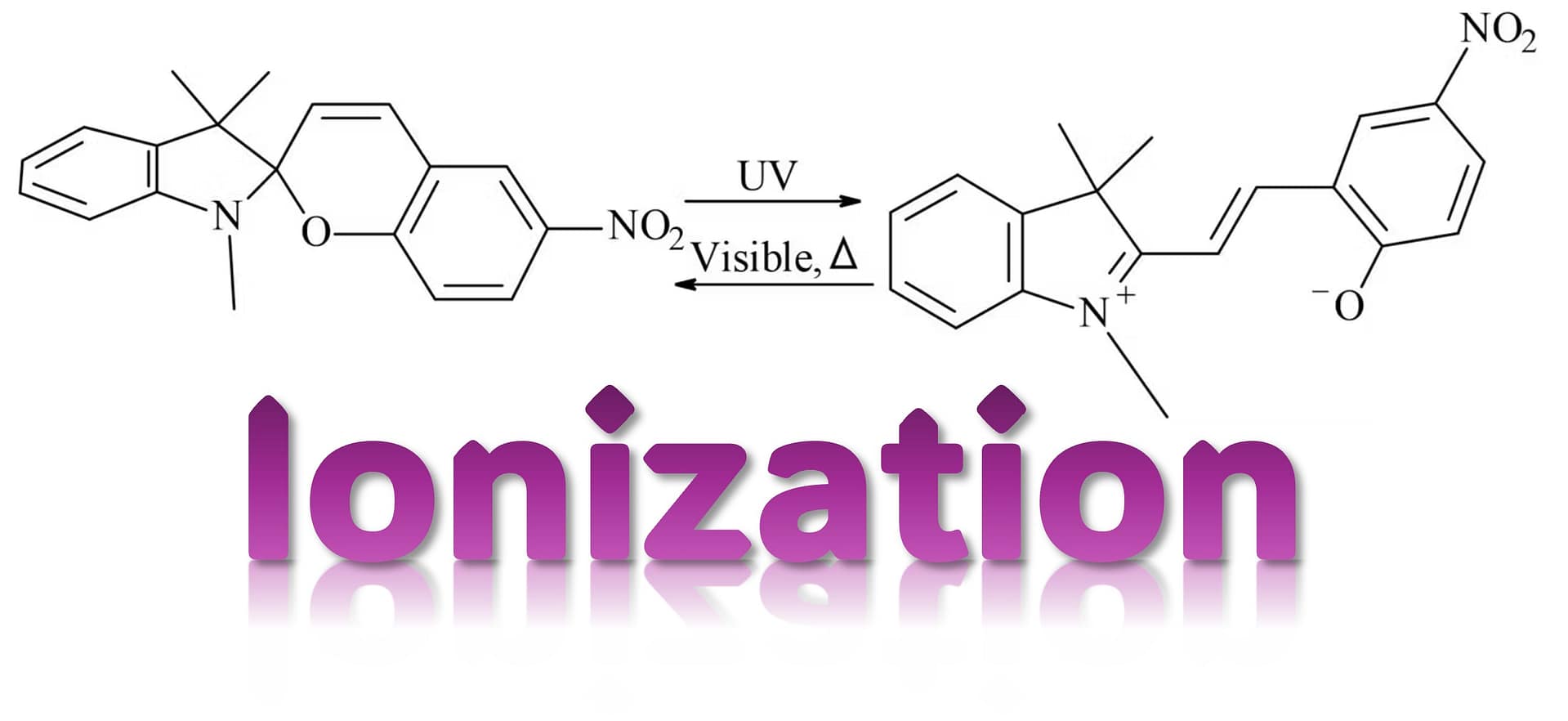
スピロピラン(SP)は、刺激で形が変わる分子スイッチです。
- SP(閉環体):無色〜淡色になりやすい
- MC(メロシアニン、開環体):共役が伸びて色が出やすい
- ただし MC は条件によっては不安定で、すぐ戻ってしまうことも
そこで登場するのが イオン化です。
– プロトン化(H⁺を付ける) → MC を“塩”のように安定化できる
– 酸化還元(電子を出し入れ) → 光を使わずに、電気で SP⇄MC を切り替えられる
研究のポイント①:pH(酸)で“スイッチのモード”を切り替える(2018)
この論文は、酸(H⁺)を使ってスピロピランの開環体(プロトン化MC)を安定化し、
さらに 光(UV/可視)で E/Z 異性化を可逆に制御する道筋を示します。
ここがポイント(一般向け)
- 酸で SP が開環して “プロトン化 MC” になりやすい
- 酸の強さ(pKₐ)と濃度を調整すると、自発的に開環して Z-MC が得られる条件
- 光で Z/E を行き来できる条件
- さらに 熱的に安定な状態を作る条件を作り分けられる
- 結果として、pH が“ゲート”になり、熱的に戻りやすい(可逆)
- 熱的に戻りにくい(実質“固定”)の切り替えができる、という考え方です。
参考文献1:Kortekaas, L et al.. Proton-Stabilized Photochemically Reversible E/Z Isomerization of Spiropyrans. Journal Of Physical Chemistry B (2018) 122(24) 6423-6430. https://doi.org/10.1021/acs.jpcb.8b03528
研究のポイント②:光の代わりに“電気”で開閉する(2021)
この論文は、光で行う SP⇄MC の切り替えを、電気化学(酸化→還元)で実現します。
言い換えると「光子のエネルギー」を「電子の出し入れ」で置き換える発想です。
ここがポイント(一般向け)
- 分子スイッチをデバイスに組み込むには、2つの安定状態(双安定)が重要
- 通常のフォトスイッチは、励起状態で一瞬だけ結合の性質が変わって切り替わる
- 本研究では、スピロピランを 酸化→還元して、
- 4状態サイクル(複数の電荷・構造状態)
を回しながら 開環(MC側)と閉環(SP側)を“電気で”制御 - 分子設計として、二次反応(例:H⁺生成など)の影響を抑える置換基を選び、
望まない反応でスイッチが壊れにくい方向に工夫している点も重要です。
参考文献2:Steen, JD et al.. Electrochemical Ring-Opening and -Closing of a Spiropyran. Journal Of Physical Chemistry A (2021) 125(16) 3355-3361. https://doi.org/10.1021/acs.jpca.1c01142
2報をつなぐ “見取り図”(超ざっくり)
- pH(プロトン化):MC を安定化して、切り替えの「安定度・戻りやすさ」を調整
- 電気化学(酸化還元):光を使わず、電気入力で SP⇄MC を駆動
→ 将来的には、
「pHで“モード”を決め、電気で“ON/OFF操作”する」のような複合制御の考え方にもつながります。
用語ミニ解説
- イオン化:ここでは主に「プロトン化(H⁺付加)」や「酸化還元(電子の出し入れ)」
- pKₐ:酸の強さの目安(小さいほど強酸)
- 酸化/還元:電子を失う/受け取る
- 双安定(bistability):2つの安定状態を保てること(デバイス化で重要)
参考文献(添付ファイル内)
- Kortekaas, L et al.. Proton-Stabilized Photochemically Reversible E/Z Isomerization of Spiropyrans. Journal Of Physical Chemistry B (2018) 122(24) 6423-6430. https://doi.org/10.1021/acs.jpcb.8b03528
- Steen, JD et al.. Electrochemical Ring-Opening and -Closing of a Spiropyran. Journal Of Physical Chemistry A (2021) 125(16) 3355-3361. https://doi.org/10.1021/acs.jpca.1c01142
English (for your website)
Scope (limited to the attached file)
This page summarizes only the papers included in SP_Ionization.txt (Web of Science export), and explains—at a general-audience level—how spiropyran switches can be controlled by “ionization”:
protonation (H⁺) and redox (oxidation/reduction).
The file contains two papers, so we focus on these two.
Why “ionization” works (in 1 minute)
Spiropyrans (SP) are classic molecular switches:
- SP (closed form): often colorless/pale
- MC (merocyanine, open form): extended conjugation → visible absorption → often colored
- MC can be unstable depending on conditions
Ionization provides strong handles:
– Protonation (adding H⁺): can stabilize MC as a salt-like, thermally stable form
– Redox (electron transfer): enables electrical control of SP⇄MC without light
Key message 1: pH gating and proton-stabilized switching (2018)
The 2018 study shows that acid (H⁺) can drive ring opening to a protonated merocyanine, and that careful control of acid strength (pKₐ) and concentration enables photochemically reversible E/Z isomerization and thermally stable states.
Take-home ideas:
– Match acid strength and concentration to tune whether ring opening occurs spontaneously or requires irradiation
– Under sufficiently acidic conditions, both E and Z isomers can be thermally stable
– Choosing an acid with pKₐ between the E- and Z-merocyanine forms enables pH-gated switching behavior
Reference 1: Kortekaas, L et al.. Proton-Stabilized Photochemically Reversible E/Z Isomerization of Spiropyrans. Journal Of Physical Chemistry B (2018) 122(24) 6423-6430. https://doi.org/10.1021/acs.jpcb.8b03528
Key message 2: switching by electricity—electrochemical ring opening/closing (2021)
The 2021 study demonstrates that the energy normally delivered by a photon can instead be provided electrochemically via oxidation followed by reduction, producing a multi-state cycle with electrically controlled ring opening and closing.
Take-home ideas:
– Bistability is crucial for molecular-device applications
– A tailored spiropyran design reduces sensitivity to secondary electrochemical processes (e.g., unintended proton generation)
– Redox control enables electrically driven access to lowered Z–E barriers in the oxidized state, akin to photochemical pathways
Reference 2: Steen, JD et al.. Electrochemical Ring-Opening and -Closing of a Spiropyran. Journal Of Physical Chemistry A (2021) 125(16) 3355-3361. https://doi.org/10.1021/acs.jpca.1c01142
A simple combined view
- Protonation (pH): stabilizes MC and tunes thermal stability / reversibility
- Redox (electrochemistry): provides electrical ON/OFF control of SP⇄MC
Together, these ideas point toward multi-input control—e.g., using pH to set the “mode” and electricity to operate the switch.
References (from the attached file)
- Kortekaas, L et al.. Proton-Stabilized Photochemically Reversible E/Z Isomerization of Spiropyrans. Journal Of Physical Chemistry B (2018) 122(24) 6423-6430. https://doi.org/10.1021/acs.jpcb.8b03528
- Steen, JD et al.. Electrochemical Ring-Opening and -Closing of a Spiropyran. Journal Of Physical Chemistry A (2021) 125(16) 3355-3361. https://doi.org/10.1021/acs.jpca.1c01142