date: 2026-01-12
tags: [スピロピラン, フォトクロミズム, メロシアニン, 固体化学, 結晶工学, ハロゲン結合, パッシベーション, photochromism, spiropyran, merocyanine]
スピロピラン(Spiropyran, SP)は、光・酸(プロトン)・周囲の相互作用で色が変わる分子スイッチです。
ところが、溶液では観測しやすい開環体(メロシアニン:MC、色が出やすい形)が、固体では“めったに見えない/すぐ戻る”ことが多いのも事実です。
このページでは、添付ファイル(Web of Science 抽出)に含まれる 3本の論文だけを使い、
「固体でMCをどう安定化し、どう色(吸収)を設計するか?」を一般向けにやさしくまとめます。
(※解説・文献は添付ファイル内に限定)
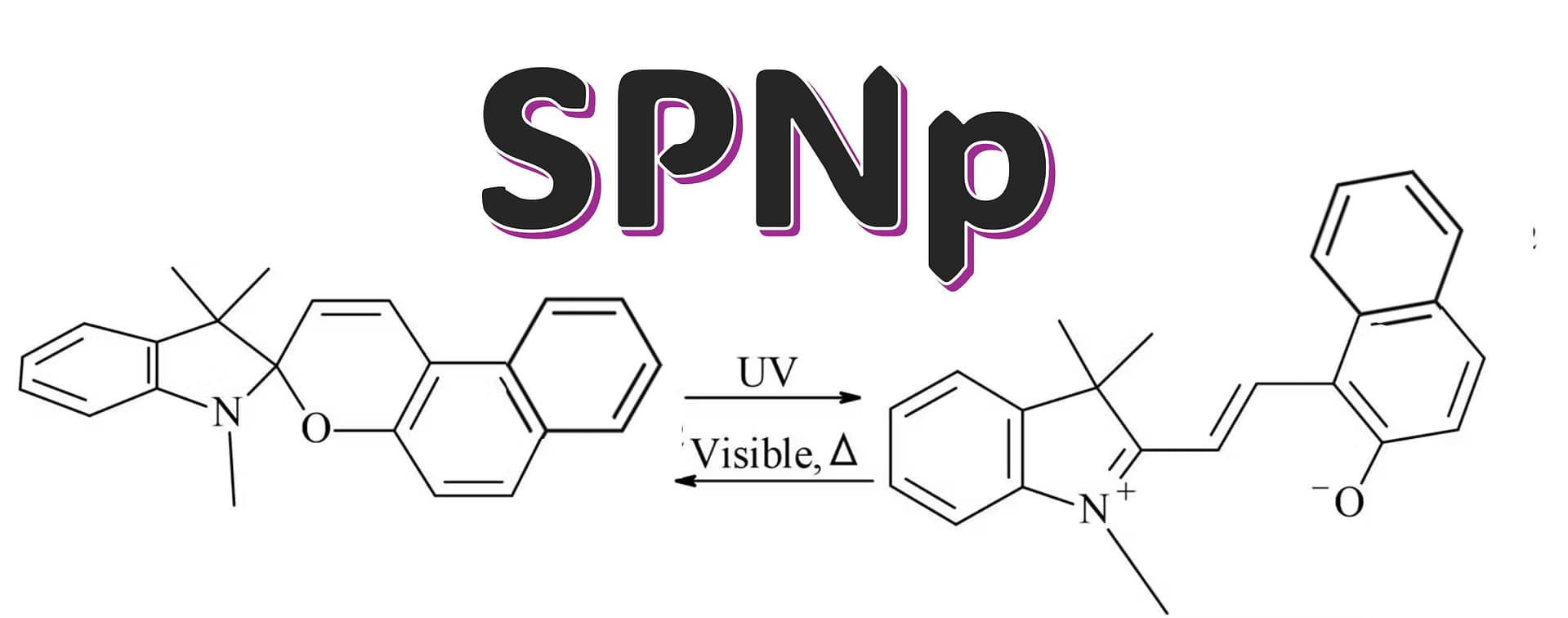
まず覚える:SP ⇄ MC で色が変わる
- SP(閉環体):無色〜淡色のことが多い
- MC(開環体):共役が伸びて可視吸収を持ちやすい → 有色になりやすい
- 固体では分子の動きが制限され、MCが出にくい/戻りやすい
固体で“色を保つ”3つの設計ルール(この3論文から)
ルール1:酸(プロトン)でMCを“塩”として固定する(アシドクロミズム)
スピロピランを無機酸と一緒に共結晶化すると、開環して生じたMCの酸素原子がプロトン化され、
陰イオンと水素結合で支えられる形になり、固体中でも有色MCを安定化できる、という発想です。
「固体でMCが稀にしか見えない」問題に対して、再現性のある固定化手法を示しています。
- キーワード:共結晶化/プロトン化/塩形成(サルティフィケーション)/拡散反射スペクトル
参考文献1:Seiler, VK et al.. Acidochromic spiropyran-merocyanine stabilisation in the solid state. Crystengcomm (2018) 20(24) 3318-3327. https://doi.org/10.1039/c8ce00291f
ルール2:ハロゲン結合(XB)や水素結合(HB)でMCの“要点”をつかむ
固体中でMCを得る鍵として、MCのフェノラート酸素(O)を
水素結合(HB)やハロゲン結合(XB)で“つかまえる”設計が示されます。
ただし、MCのOはXB受容体として弱い場合があるため、無機酸や二価金属塩(例:Zn/Co塩化物)など
「相互作用を強めるビルディングブロック」を組み合わせて、固体での色・クロミック特性を調整可能にしています。
- キーワード:ハロゲン結合ネットワーク/無機ビルディングブロック/固体での色の可変性
参考文献2:Seiler, VK et al.. Merocyanines in a Halogen-Bonded Network Involving Inorganic Building Blocks. Crystal Growth & Design (2020) 20(2) 608-616. https://doi.org/10.1021/acs.cgd.9b00903
ルール3:金属錯形成 vs 塩形成を使い分けて“色のパレット”を広げる
金属塩(例:ZnCl₂, ZnBr₂, CoCl₂)を加えると、SP→MCの開環で生じるMCが
金属との相互作用(錯形成)や、塩としての固定化など、複数の結合様式で安定化されます。
合成経路・固体形の違いが吸収に強く効き、固体のまま赤〜緑まで広く色を設計できる
「色づくりの道具(coloring tool)」として提示されています。
- キーワード:金属錯形成/固体形制御/吸収(色)のチューニング
参考文献3:Seiler, VK et al.. A coloring tool for spiropyrans: solid state metal-organic complexation versus salification. Crystengcomm (2019) 21(33) 4925-4933. https://doi.org/10.1039/c9ce00805e
用語ミニ解説
- フォトクロミズム:光で構造が変わり、色(吸収)が変化する現象
- メロシアニン(MC):スピロピランの開環体。共役が伸びて色が出やすい
- 共結晶化:複数成分を一緒に結晶化して性質を作り込む方法
- HB/XB:水素結合(HB)/ハロゲン結合(XB)。分子間相互作用で構造や性質を制御する
参考文献(添付ファイル内)
- Seiler, VK et al.. Acidochromic spiropyran-merocyanine stabilisation in the solid state. Crystengcomm (2018) 20(24) 3318-3327. https://doi.org/10.1039/c8ce00291f
- Seiler, VK et al.. Merocyanines in a Halogen-Bonded Network Involving Inorganic Building Blocks. Crystal Growth & Design (2020) 20(2) 608-616. https://doi.org/10.1021/acs.cgd.9b00903
- Seiler, VK et al.. A coloring tool for spiropyrans: solid state metal-organic complexation versus salification. Crystengcomm (2019) 21(33) 4925-4933. https://doi.org/10.1039/c9ce00805e
English (for your website)
Purpose of this page
Spiropyrans (SP) are classic molecular switches whose color can change in response to light, acids (protons), and intermolecular interactions.
However, the open-ring merocyanine form (MC)—often responsible for visible color in solution—is rarely observed or quickly reverts in the solid state.
Using only the three records included in the attached Web of Science export, this page explains—at a general-audience level—how researchers design solids that stabilize MC and tune color/absorption.
The basic switch: SP ⇄ MC
- SP (closed form): often colorless/pale
- MC (merocyanine, open form): extended conjugation → visible absorption → often colored
- In solids, restricted motion makes MC harder to form and/or less stable
Three design rules to keep “color” in solids (from these three papers)
Rule 1: Use acids (protons) to lock MC as a salt (acidochromism)
Co-crystallization with inorganic acids can protonate the key oxygen site created upon ring-opening, and stabilize the colored MC via counterions and hydrogen bonding.
The work frames this as a reliable way to obtain the otherwise rare solid-state merocyanine.
Reference 1: Seiler, VK et al.. Acidochromic spiropyran-merocyanine stabilisation in the solid state. Crystengcomm (2018) 20(24) 3318-3327. https://doi.org/10.1039/c8ce00291f
Rule 2: Capture MC using hydrogen bonds (HB) and halogen bonds (XB)
A practical strategy is to “hold” the merocyanine phenolate oxygen through HB/XB interactions.
Because the MC oxygen can be a weak XB acceptor, the study introduces inorganic building blocks (inorganic acids and divalent metal salts) to strengthen interactions and tune chromic properties in the solid state.
Reference 2: Seiler, VK et al.. Merocyanines in a Halogen-Bonded Network Involving Inorganic Building Blocks. Crystal Growth & Design (2020) 20(2) 608-616. https://doi.org/10.1021/acs.cgd.9b00903
Rule 3: Choose between metal complexation and salification to expand the color palette
Adding metal salts (e.g., ZnCl₂, ZnBr₂, CoCl₂) can stabilize MC through different linkage modes (complex, salt, or mixed forms).
Solid-form control strongly affects absorption, enabling a broad visible tuning (reported from red to green), presented as a practical “coloring tool.”
Reference 3: Seiler, VK et al.. A coloring tool for spiropyrans: solid state metal-organic complexation versus salification. Crystengcomm (2019) 21(33) 4925-4933. https://doi.org/10.1039/c9ce00805e
Mini glossary
- Photochromism: light-triggered structural change accompanied by a color/absorption change
- Merocyanine (MC): the colored open form of spiropyran
- Co-crystallization: crystallizing multiple components together to engineer properties
- HB/XB: hydrogen bond / halogen bond, key intermolecular interactions in crystal engineering
References (from the attached file)
- Seiler, VK et al.. Acidochromic spiropyran-merocyanine stabilisation in the solid state. Crystengcomm (2018) 20(24) 3318-3327. https://doi.org/10.1039/c8ce00291f
- Seiler, VK et al.. Merocyanines in a Halogen-Bonded Network Involving Inorganic Building Blocks. Crystal Growth & Design (2020) 20(2) 608-616. https://doi.org/10.1021/acs.cgd.9b00903
- Seiler, VK et al.. A coloring tool for spiropyrans: solid state metal-organic complexation versus salification. Crystengcomm (2019) 21(33) 4925-4933. https://doi.org/10.1039/c9ce00805e