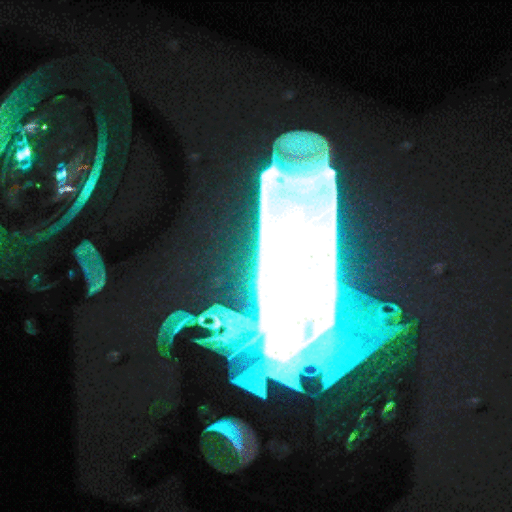
過渡吸収で見る「超高速の世界」
— フェムト秒からピコ秒までの時間スケールをのぞく —
はじめに(日本語)
光を吸った分子や材料は、その直後から「超高速」で姿を変え続けます。
過渡吸収(Transient Absorption / Transient Absorbance)は、その変化を
フェムト秒(10⁻¹⁵秒)〜マイクロ秒(10⁻⁶秒)といった短い時間スケールで観測する分光法です。
このページでは、Web of Science のレビュー論文:
- Oliver, Recent advances in multidimensional ultrafast spectroscopy(2018)
- Tsimilli-Michael, Revisiting JIP-test(2020)
- Crocombe, Portable Spectroscopy(2018)
の内容を手がかりに、過渡吸収の考え方と応用を
一般の方向けにわかりやすく紹介します。
1. 過渡吸収とは?
1-1. 「静止画」ではなく「スローモーション動画」
通常の吸収スペクトルは、
- 「落ち着いた状態(基底状態)」の分子が
- どの波長の光をどれくらい吸収するか
を示した 静止画 のようなものです。
それに対して過渡吸収は、
- 極めて短いレーザーパルスで分子を「たたく」(励起する)
- その後、少し時間をおいてもう一つの光で吸収を測る
- この「待ち時間(遅延時間)」を変えながら、吸収の変化を記録する
という操作を繰り返しながら、時間とともに変化する吸収 を追いかけます。
💡 イメージ:
光を吸った直後の分子を、フェムト秒〜ピコ秒ごとに連続撮影していく
「超高速スローモーション動画撮影」です。
1-2. 時間スケールの感覚
| 単位 | 記号 | 秒に直すと | 典型的に見える現象の例 |
|---|---|---|---|
| フェムト秒 | fs | 10⁻¹⁵ 秒 | 電子の動き、最初の励起状態の生成 |
| ピコ秒 | ps | 10⁻¹² 秒 | 励起状態の緩和、最初の電荷移動 |
| ナノ秒 | ns | 10⁻⁹ 秒 | 一重項・三重項の寿命、蛍光・燐光 |
| マイクロ秒 | µs | 10⁻⁶ 秒 | 長寿命の電荷分離状態やラジカル |
過渡吸収測定では、これらの時間スケールを連続的に観測することで、
- エネルギー移動の速さ
- 電荷移動の効率
- 励起状態や中間体の寿命
などを調べることができます。
2. レビュー論文から見る「過渡吸収」とその広がり
2-1. 多次元超高速分光:過渡吸収の発展形
Oliver, T. A. A., Royal Society Open Science, 2018
Oliver によるレビュー論文は、
「多次元超高速分光(multidimensional ultrafast spectroscopy)」 の発展を幅広くまとめたものです。
ここで扱われているのは、
- 2次元電子分光(2D electronic spectroscopy)
- 2次元振動分光(2D IR spectroscopy)
- 電子状態と振動状態を同時に見る 2D 電子–振動分光
など、従来のポンプ–プローブ型過渡吸収分光のアイデアを拡張した手法です。
多次元分光とは?
通常の過渡吸収では、
- 「どの波長で光を当てたか」
- 「どの波長で吸収変化を測ったか」
を別々に扱うことが多いですが、
多次元分光では 励起の周波数軸と観測の周波数軸を同時にマッピング し、
- どのエネルギー準位からどの準位へエネルギーが流れているか
- 電子状態と振動状態がどのように結びついているか(クロスピーク)
などを、より直感的に読み取れるようにしています。
これにより、
- 光合成タンパク質中のエネルギー移動
- 有機半導体やナノ材料における電荷分離
- 溶液中の化学反応の初期過程
といった現象の「道筋」や「協奏的な動き」まで見えてくるようになっています。
2-2. 植物のクロロフィル蛍光の「過渡応答」
Tsimilli-Michael, Photosynthetica, 2020
このレビューは、植物の光合成で使われる
JIPテスト(OJIP クロロフィル a 蛍光の立ち上がり解析)を詳しく解説した教育的レビューです。
ここで扱われるのは「蛍光」ですが、
- 光を当ててから蛍光が O–J–I–P と段階的に変化する
- その時間変化から、光化学系 II(PSII)の機能や
光合成装置へのストレスの影響を読み取る
という点で、過渡吸収と同じく 「過渡的な光応答から仕組みを読み解く」 研究手法と言えます。
植物の葉からの一瞬の光(蛍光)の変化を解析すると、
乾燥ストレスや高温ストレスなど、環境要因が
光合成装置に与える影響を評価できるようになります。
過渡吸収が「吸収の時間変化」を見るのに対し、
JIP テストは「蛍光の時間変化」を利用している、と理解すると分かりやすいです。
2-3. ポータブル分光と将来の「現場型」過渡測定
Crocombe, Applied Spectroscopy, 2018
Crocombe のレビューは 携帯型・ハンドヘルド分光器 に関する総合レビューです。
ここで扱われるのは、
- X線蛍光(XRF)
- ラマン、近赤外(NIR)、中赤外(IR)
- スマートフォン分光、ハイパースペクトルカメラ
などで、過渡吸収そのものを測る装置ではありません。
しかし、
- 分光器が小型・低価格になり、
現場(フィールド)での即時分析 が可能になってきたこと - 医療、食品、環境計測など「非専門家でも使える」
分析ツールとしての可能性
が詳しく論じられています。
将来的には、こうした小型分光技術と、超高速レーザー技術が組み合わされることで、
「現場での時間分解測定」や「簡易な過渡応答測定」が
一般化する可能性も考えられます。
3. 過渡吸収で何がわかるのか?
過渡吸収・多次元超高速分光から得られる情報は、主に次のようなものです。
- エネルギー移動のルート
- 光合成アンテナ複合体中のエネルギー移動
- 有機太陽電池や有機EL材料中の励起子拡散
- 電荷分離と再結合
- 励起状態から電子・正孔が分かれて電荷分離状態になるまでの時間
- それがどのくらいの寿命を持つか(再結合の速さ)
- 振動と構造変化
- 分子骨格の振動モードが、電子状態とどのように結びついているか
- 反応座標に沿った構造変化の初期過程
- 量子コヒーレンスの役割
- 光合成で議論される「量子ゆらぎ/コヒーレンス」が
エネルギー移動にどの程度寄与しているか など
Oliver のレビューは、こうした問題に対して多次元分光がどのような情報を与えてきたかを、
生体分子・有機材料・ナノ材料などの例でまとめたものになっています。
4. 応用分野のイメージ
過渡吸収や多次元超高速分光は、一見すると「基礎物理・基礎化学」の道具ですが、
背景には次のような応用が見据えられています。
- 高効率な 太陽電池・光触媒 の設計
- 低消費電力で高輝度な 有機ELデバイス の材料開発
- 光合成の理解 に基づくバイオマス・作物生産やストレス診断
- 光スイッチ・フォトクロミック分子などの 光制御材料
将来的には、Crocombe のレビューにあるような
ポータブル分光技術との融合により、
- 研究室だけでなく、現場・教育現場・医療現場などで
光応答・過渡応答を簡便に測定する
という方向も期待されています。
Transient Absorption: A Gentle Introduction (English)
1. What is transient absorption?
When a material absorbs light, its electrons are promoted to excited states and a cascade of processes starts immediately.
Transient absorption spectroscopy monitors how the sample’s absorption changes with time after a short laser pulse.
Conceptually:
- A short pump pulse excites the system.
- A weaker probe pulse measures the absorption after a controlled delay.
- By scanning the delay from femtoseconds to microseconds,
we obtain a time-resolved map of the absorption changes.
This technique allows us to follow
- excited-state relaxation,
- energy and charge transfer,
- the appearance and decay of intermediate states,
on the natural timescales of the underlying processes.
2. Time scales
Typical processes observed in transient absorption:
- Femtoseconds (10⁻¹⁵ s)
- Electronic excitation, initial rearrangements
- Picoseconds (10⁻¹² s)
- Vibrational relaxation, early charge transfer
- Nanoseconds (10⁻⁹ s)
- Singlet and triplet lifetimes, fluorescence and phosphorescence
- Microseconds (10⁻⁶ s) and beyond
- Long-lived charge-separated states, radicals, reaction intermediates
By covering this wide time window, transient absorption bridges the gap between
“instantaneous” excitation and “slow” chemical or biological changes.
3. Insights from review articles
Based on the review articles listed in the Transient Absorbance_Review.txt file, we can place transient absorption in a broader context:
3-1. Multidimensional ultrafast spectroscopy (Oliver, 2018)
Oliver’s review in Royal Society Open Science surveys recent developments in
multidimensional ultrafast spectroscopy, which can be regarded as advanced extensions of pump–probe transient absorption.
Key ideas include:
- Two-dimensional electronic spectroscopy:
correlating excitation and detection frequencies to reveal
energy transfer pathways and couplings between electronic states. - Two-dimensional infrared and electronic–vibrational spectroscopy:
linking vibrational motions to electronic dynamics and charge-transfer states.
These techniques have been applied to
- photosynthetic pigment–protein complexes,
- organic semiconductors and nanostructured materials,
- complex chemical and biological systems,
providing a more detailed picture of how energy and charge flow through matter.
3-2. Transient fluorescence in photosynthesis (Tsimilli-Michael, 2020)
Tsimilli-Michael’s educational review in Photosynthetica focuses on the JIP-test,
which analyses the OJIP rise of chlorophyll a fluorescence.
Although it deals with fluorescence rather than absorption, the philosophy is similar:
- Record the transient optical response after turning on the light.
- Decode the sequence of phases (O–J–I–P) in terms of
the structure and function of photosystem II. - Use this information to assess how environmental stresses affect the photosynthetic apparatus.
This can be viewed as a complementary example of using time-resolved optical signals
to probe complex systems—in this case, living plants.
3-3. Portable spectroscopy and future on-site measurements (Crocombe, 2018)
Crocombe’s review in Applied Spectroscopy discusses the rapid progress in
portable and handheld spectrometers, from XRF to Raman, NIR and IR,
including smartphone-based and hyperspectral systems.
While these instruments typically measure steady-state spectra,
the review highlights:
- the miniaturization of spectrometer “engines”,
- their integration into consumer and field devices,
- robust algorithms for non-expert users.
In the long term, such advances in compact hardware and data processing
may open the way to more accessible time-resolved measurements,
bringing concepts related to transient absorption closer to real-world applications.
4. Why transient absorption matters
Taken together, these reviews illustrate how
transient absorption and related ultrafast techniques help us to:
- map energy and charge transfer in functional materials,
- understand and optimize light-harvesting and optoelectronic devices,
- probe biological dynamics in real time,
- and inspire future portable, user-friendly spectroscopic tools.
In short,
Transient absorption turns the act of light absorption
into a rich “ultrafast movie”, revealing how molecules and materials
process energy on their natural timescales.
参考文献 / References
- Tsimilli-Michael, M.
“Revisiting JIP-test: An educative review on concepts, assumptions, approximations, definitions and terminology.”
Photosynthetica 2020, 58(2), 275–292.
DOI: 10.32615/ps.2019.150 - Crocombe, R. A.
“Portable Spectroscopy.”
Applied Spectroscopy 2018, 72(12), 1701–1751.
DOI: 10.1177/0003702818809719 - Oliver, T. A. A.
“Recent advances in multidimensional ultrafast spectroscopy.”
Royal Society Open Science 2018, 5(1), 171425.
DOI: 10.1098/rsos.171425