| Publication Year | Author | Title | Publication Title | DOI | Url | Pages | Issue | Volume |
|---|---|---|---|---|---|---|---|---|
| 2021 | Orellana, Walter | D-π-A dye attached on TiO2(101) and TiO2(001) surfaces: Electron transfer properties from ab initio calculations | Solar Energy | 10.1016/j.solener.2020.12.061 | https://www.sciencedirect.com/science/article/pii/S0038092X20313207 | 266-273 | 216 | |
| 2021 | Suman Krishna, Jonnadula Venkata; Prasanthkumar, Seelam; Dzeba, Iva; Challuri, Vijay; Naim, Waad; Sauvage, Frédéric; Giribabu, Lingamallu | Rationalization of excited state energy transfer in D–π–A porphyrin sensitizers enhancing efficiency in dye-sensitized solar cells | Materials Advances | 10.1039/D1MA00614B | https://pubs.rsc.org/en/content/articlelanding/2021/ma/d1ma00614b | 7922-7931 | 24 | 2 |
| 2021 | Belén Muñoz-García, Ana; Benesperi, Iacopo; Boschloo, Gerrit; J. Concepcion, Javier; H. Delcamp, Jared; A. Gibson, Elizabeth; J. Meyer, Gerald; Pavone, Michele; Pettersson, Henrik; Hagfeldt, Anders; Freitag, Marina | Dye-sensitized solar cells strike back | Chemical Society Reviews | 10.1039/D0CS01336F | https://pubs.rsc.org/en/content/articlelanding/2021/cs/d0cs01336f | 12450-12550 | 22 | 50 |
| 2021 | Lingamallu, Giribabu; Jonnadula, Venkata Suman Krishna; Prasanthkumar, Seelam; Džeba, Iva; Vijay Kumar, Challuri; Naim, Waad; Sauvage, Frederic | Rationalization of Excited State Energy Transfer in D-π-A Porphyrin Sensitizers Enhanced Efficiency in Dye-Sensitized Solar Cells | https://pubs.rsc.org/en/content/articlelanding/2021/ma/d1ma00614b | |||||
| 2022 | Homem-de-Mello, Paula; Aono, Cassiano M.; de Liandra-Salvador, Erica; de Lima, Esther M. C.; Antonio, Felipe C. T.; Mol, Gabriel S.; de Souza, Jhonathan R.; de Toledo, Mateus M. Z.; Gasperin, Nauan F. S.; Correa, Raissa L. G. Quintino; da Cunha, Renato D.; Mora-Diez, Nelaine; Coutinho-Neto, Mauricio D. | 4 - Design of dyes for energy transformation: From the interaction with biological systems to application in solar cells | Green Chemistry and Computational Chemistry | https://www.sciencedirect.com/science/article/pii/B9780128198797000040 | 79-114 | |||
| 2022 | Sen, Anik; Putra, Miftahussurur Hamidi; Biswas, Abul Kalam; Behera, Anil Kumar Behera; Gross, Axel | A Brief History of and Insight in the Choice of Sensitizers/Dyes for Dye Sensitized Solar Cells | 10.26434/chemrxiv-2022-fxl2z | https://chemrxiv.org/engage/chemrxiv/article-details/62a21e04bb751904a5487692 | ||||
| 2016 | Kang, Guo-Jun; Song, Chao; Ren, Xue-Feng | Charge Transfer Enhancement in the D-π-A Type Porphyrin Dyes: A Density Functional Theory (DFT) and Time-Dependent Density Functional Theory (TD-DFT) Study | Molecules | 10.3390/molecules21121618 | https://www.mdpi.com/1420-3049/21/12/1618 | 1618 | 12 | 21 |
| 2013 | Han, Li-Heng; Zhang, Cai-Rong; Zhe, Jian-Wu; Jin, Neng-Zhi; Shen, Yu-Lin; Wang, Wei; Gong, Ji-Jun; Chen, Yu-Hong; Liu, Zi-Jiang | Understanding the Electronic Structures and Absorption Properties of Porphyrin Sensitizers YD2 and YD2-o-C8 for Dye-Sensitized Solar Cells | International Journal of Molecular Sciences | 10.3390/ijms141020171 | https://www.mdpi.com/1422-0067/14/10/20171 | 20171-20188 | 10 | 14 |
| 2018 | Ho, Po-Yu; Mark, Michael F.; Wang, Yi; Yiu, Sze-Chun; Yu, Wai-Hong; Ho, Cheuk-Lam; McCamant, David W.; Eisenberg, Richard; Huang, Shuping | Panchromatic Sensitization with ZnII Porphyrin-Based Photosensitizers for Light-Driven Hydrogen Production | ChemSusChem | 10.1002/cssc.201801255 | https://onlinelibrary.wiley.com/doi/abs/10.1002/cssc.201801255 | 2517-2528 | 15 | 11 |
| 2017 | Srinivasan, Venkatesan; Pavithra, Nagaraj; Anandan, Sambandam; Jaccob, Madhavan; Kathiravan, Arunkumar | Photophysics, TiO2 sensitization and photovoltaic performance of Zn-ProtoporphyrinIX | Journal of Molecular Structure | 10.1016/j.molstruc.2016.12.031 | https://www.sciencedirect.com/science/article/pii/S0022286016313217 | 112-120 | 1134 |
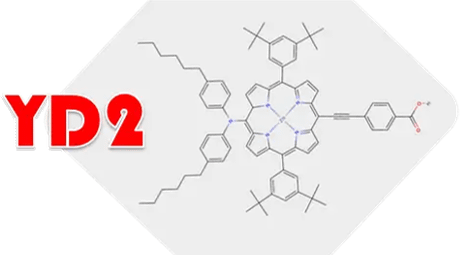
YD2は、ポルフィリン骨格にドナー–π–アクセプター構造を導入した色素であり、特にYD2およびその誘導体YD2-o-C8は、色素増感太陽電池(DSSC)において高い光電変換効率を示すことで注目されている(Chen et al., J. Am. Chem. Soc., 2009)。この色素は、ジアルキルアミノ基を有するポルフィリンをドナーとし、ethynyl基によってπ共役を延長しつつ、カルボン酸基をアクセプターとして導入することで、TiO₂表面への固定と効率的な電子注入を実現している。
これらYD2色素の電子状態や吸収特性を理論的に明らかにするため、密度汎関数理論(DFT)および時間依存DFT(TD-DFT)による計算が行われてきた(Zhang et al., J. Phys. Chem. C, 2010)。構造最適化にはB3LYP関数および6-31G(d,p)基底関数が用いられ、溶媒効果を考慮するためにPCMモデルが適用された。これにより、HOMOは主にポルフィリン中心に局在し、LUMOはカルボン酸基を含むアクセプター部に偏在することが明らかとなった。この分子軌道分布は、光励起により電子が迅速にTiO₂へ移動できることを示唆している。
さらに、TD-DFTにより計算された吸収スペクトルは、実験値とよく一致しており、Qバンド(約540–560 nm)は主にHOMO→LUMO遷移、Soretバンド(約400–450 nm)は高次の分子軌道間遷移によって構成されている(Cao et al., Phys. Chem. Chem. Phys., 2013)。オシレーター強度の解析から、アルキル鎖の導入などによる電子密度再配置が光吸収強度を高めることも理論的に支持された(Syu et al., RSC Adv., 2016)。
以上の結果から、YD2色素はその構造設計により、電子の分離と移動を促進する有望な分子であることが明確になった。TD-DFTを用いた計算は、その分子設計戦略の有効性を支持する強力な理論的根拠を提供している。
YD2, a porphyrin-based dye with a donor–π–acceptor (D–π–A) architecture, has attracted significant attention for its high power conversion efficiency in dye-sensitized solar cells (DSSCs), particularly in its derivative YD2-o-C8 (Chen et al., J. Am. Chem. Soc., 2009). This dye incorporates a dialkylamino-substituted porphyrin as the electron donor, an ethynyl π-bridge for extended conjugation, and a carboxylic acid group as an electron acceptor and anchoring moiety for efficient electron injection into TiO₂.
To investigate the electronic structure and optical properties of YD2, density functional theory (DFT) and time-dependent DFT (TD-DFT) calculations have been extensively employed (Zhang et al., J. Phys. Chem. C, 2010). Geometries were optimized using the B3LYP functional with a 6-31G(d,p) basis set, and solvent effects were modeled using the polarizable continuum model (PCM). The results revealed that the HOMO is primarily localized on the porphyrin core, while the LUMO extends toward the carboxylic acid moiety. This spatial separation facilitates efficient photoinduced electron transfer from the dye to the conduction band of TiO₂.
TD-DFT simulations also reproduced the experimental absorption spectra with good agreement. The Q band (around 540–560 nm) was mainly attributed to HOMO→LUMO transitions, whereas the Soret band (around 400–450 nm) involved transitions between deeper-lying orbitals (Cao et al., Phys. Chem. Chem. Phys., 2013). Oscillator strength analyses indicated that alkyl substitution could modulate the electron density distribution and enhance light absorption (Syu et al., RSC Adv., 2016).
These results confirm that YD2 is a promising dye molecule capable of promoting directional charge separation and efficient electron injection. TD-DFT provides a robust theoretical basis for understanding its photophysical behavior and optimizing molecular design for high-efficiency DSSCs.