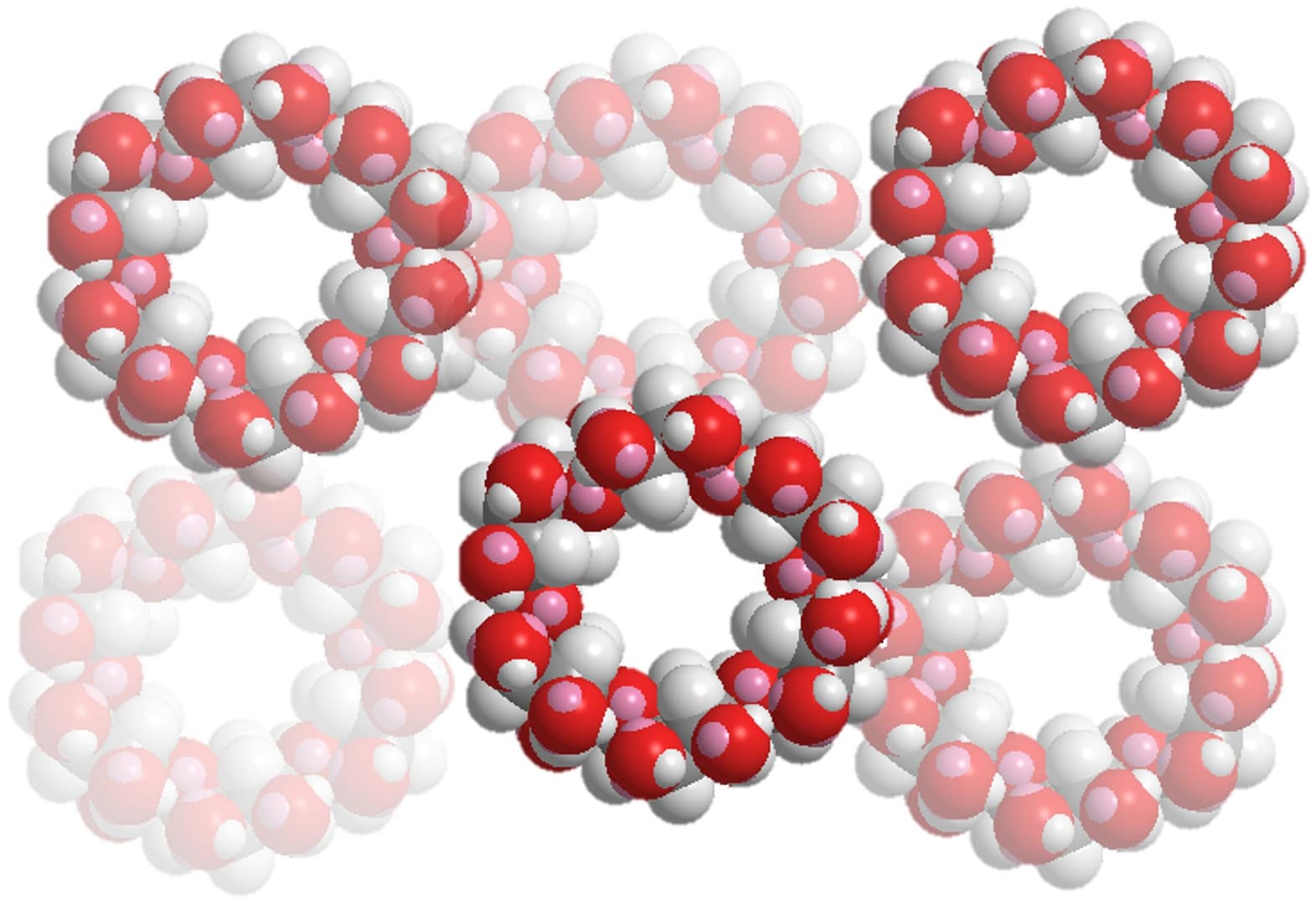
α-Cyclodextrin-Based Polymers: How “Rings” Change Materials—Stronger Yet More Ductile
キーワード(5つ) / Keywords (5)
- α-シクロデキストリン(α-CD) / α-cyclodextrin
- デンプン由来の環状分子。内側に空洞があり、分子を取り込む“ホスト”として働く。ポリマーに組み込むと構造と物性を設計しやすい。
- A starch-derived cyclic host with an internal cavity; when built into polymers, it enables tunable structure and properties.
- ポリロタキサン / Polyrotaxane
- 鎖状高分子に“輪”(CDなど)が通った超分子構造。輪の動きがエネルギー吸収や延性に効き、材料をタフにできる。
- A supramolecular architecture where rings thread onto a polymer chain; ring mobility can enhance toughness and ductility.
- 分子動力学(MD) / Molecular dynamics (MD)
- 分子の動きを計算で追う手法。変形中のナノスケール構造変化を観察しにくい問題を補い、構造—物性の関係を探る。
- A simulation method to track molecular motion and infer structure–property relationships during deformation.
- 界面(接着) / Interface & adhesion
- 繊維強化複合材では繊維と樹脂の界面が性能の鍵。被覆(コーティング)で機械的かみ合い・化学結合を強める設計がある。
- In fiber composites, the fiber–matrix interface governs performance; coatings can enhance adhesion via mechanical interlocking and chemical bonding.
- 耐湿熱劣化 / Hydrothermal aging resistance
- 水分と熱で界面が弱る“湿熱劣化”への耐性。疎水性要素や高架橋構造で水の侵入・拡散を遅らせる考え方が示されている。
- Resistance against moisture-and-heat-driven degradation; hydrophobic and crosslinked structures can slow water ingress and diffusion.
収録論文(2本) / Papers included in the attached file (2)
1) ポリロタキサンガラスを“計算で作って引っ張る”:設計パラメータが強さと延性を決める
1) “Build-and-stretch” polyrotaxane glass in silico: design parameters shape strength and ductility
論文 / Paper: Molecular dynamics modelling of polyrotaxane glass: From model construction to structure-property evaluation
掲載誌 / Journal: Polymer(Impact Factor 4.5, 2024)
DOI: https://doi.org/10.1016/j.polymer.2026.129872
わかりやすい要点(Abstract本文は転載せず) / Key points (no abstract copying)
- α-CD誘導体(プロピオニル化α-CD)を用いたポリロタキサンガラスの構造—物性関係を、分子動力学(MD)で調べる枠組みを提示。citeturn7search123
- 鎖長、CDの修飾度、CD被覆率などの設計変数を変え、引張変形中の構造変化を解析している。
- 鎖長増大が変形の連続性とエネルギー吸収に寄与し、ひずみ硬化の出現につながる可能性を述べている。
- CD修飾度が増えると嵩高さ・充填密度の変化を通じて降伏応力などに影響する、とまとめている。
- Presents an MD framework to study structure–property relations of propionylated α-CD-based polyrotaxane glass.
- Varies chain length, CD modification degree, and CD coverage, analyzing structural evolution during tensile deformation.
- Reports that longer chains can improve deformation continuity and energy absorption, enabling strain-hardening behavior.
- Notes that higher CD modification degree can alter yield/post-peak stresses via steric bulk and packing density changes.
2) 炭素繊維に“水に強いPU被膜”:α-CDを使った界面設計で湿熱劣化に強い複合材へ
2) Water-resistant PU coating on carbon fiber: α-CD-enabled interface design for hydrothermal durability
論文 / Paper: Tailored Polyurethane Coating for Improving Interfacial Performance and Hydrothermal Aging Resistance of Carbon Fiber/Epoxy Composites
掲載誌 / Journal: Polymer Composites(Impact Factor 4.7, 2024)citeturn7search129
DOI: https://doi.org/10.1002/pc.71056
わかりやすい要点(Abstract本文は転載せず) / Key points (no abstract copying)
- CFRP(炭素繊維強化樹脂)の課題である界面接着と湿熱劣化耐性の改善を狙い、繊維表面にPU被膜を形成する方法を提示。
- PUはHTPB・α-CD・IPDIを用いたワンポット合成で作り、繊維表面にコーティングする設計としている。
- 被膜が機械的かみ合い+化学結合で界面を強め、複合材のILSSや曲げ強度指標の向上を報告している。
- 疎水性要素と高架橋構造で水の侵入・拡散を遅らせ、劣化後の界面強度保持(保持率)を高めたと述べている。
- Targets improved interfacial adhesion and hydrothermal aging resistance in carbon fiber/epoxy composites via a PU surface coating.
- The PU is prepared in a one-pot process using HTPB, α-CD, and IPDI, then applied to fiber surfaces.
- Reports enhanced interfacial performance (e.g., ILSS and related bending metrics) via mechanical interlocking and chemical bonding.
- Attributes improved aging resistance to delayed water erosion/diffusion enabled by hydrophobic and crosslinked coating features.
文献 / References
- Jia, L. K.; Kato, K.; Shibanuma, K. Molecular dynamics modelling of polyrotaxane glass: From model construction to structure-property evaluation. Polymer (2026) 353, 129872. https://doi.org/10.1016/j.polymer.2026.129872
- Wu, D. L. et al. Tailored Polyurethane Coating for Improving Interfacial Performance and Hydrothermal Aging Resistance of Carbon Fiber/Epoxy Composites. Polymer Composites (Early Access, 2026). https://doi.org/10.1002/pc.71056